All species › Potoos › Potoos › Long-tailed Potoo
Long-tailed Potoo | Nyctibius aethereus
Wigstaartreuzennachtzwaluw | Nictibio colilargo | Urutau-de-cauda-longa
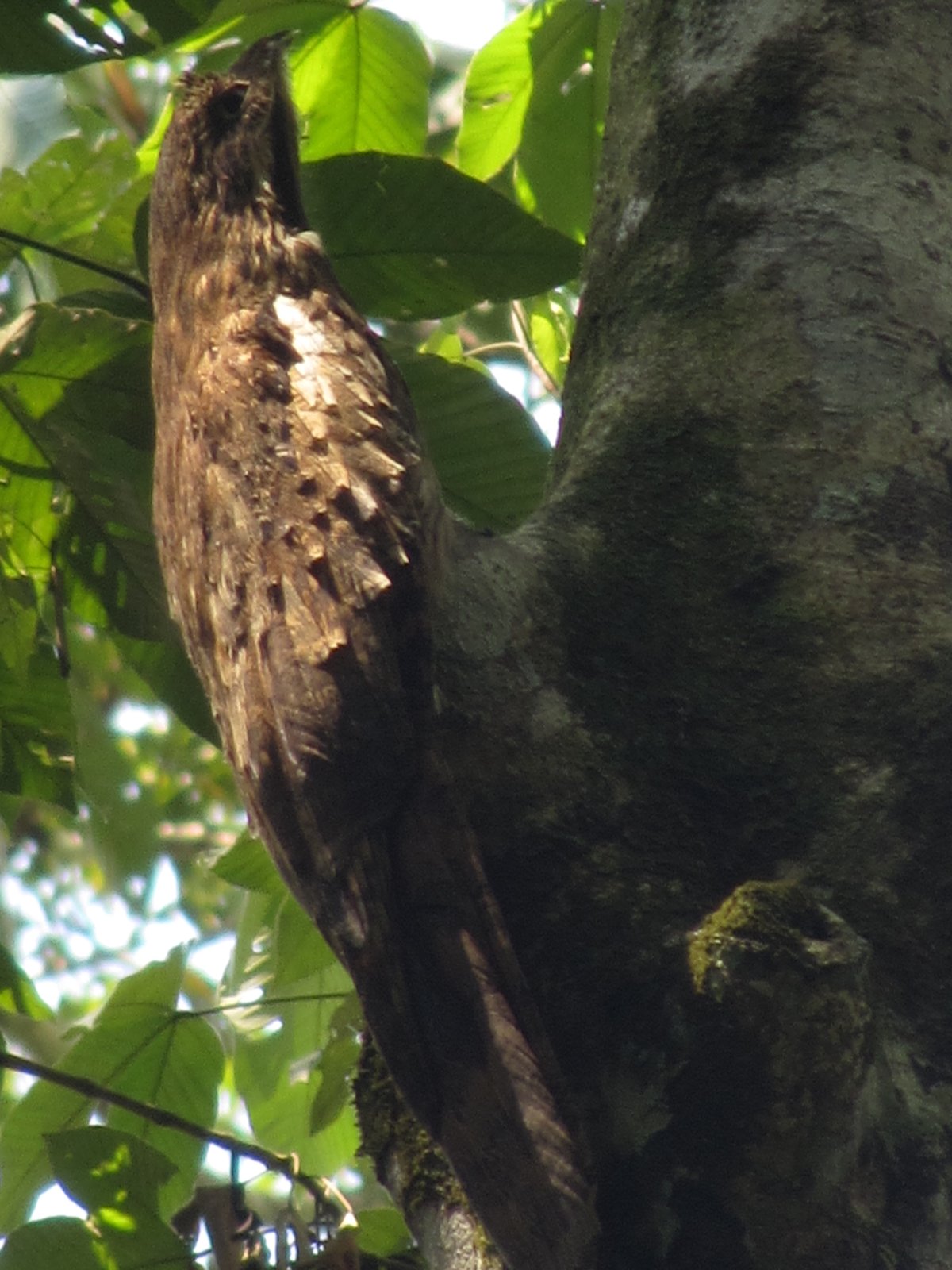
The Long-tailed Potoo is a large, brown potoo with a strikingly long, wedge-shaped tail. It lives in the interior of humid forest in the lowlands and foothills and roosts by day upright on a branch or stump, often at mid-levels. Less is known of its habits than of those of the other species of the genus.
Voice
A loud, plaintive, two-part call, such as waa-oo or whoo-ow, the second part lower, repeated at long intervals, mainly at dusk and at night.
Recording: Luiz Gabriel Mazzoni — CC BY-NC-SA 4.0 · xeno-canto
Identification
45–56 cm, a large part of which is tail; the tail is long and graduated, with pointed central feathers. The plumage is warm brown to greyish brown, finely mottled and streaked with black, buff and white, with pale streaks on the scapulars and a row of dark spots on the breast. A dark malar stripe beside the pale throat. The eyes are large and yellow to brownish and shine orange in torchlight. The sexes are alike.
Confusion species
Common Potoo Nyctibius griseus is smaller and greyer, with a shorter tail, and lives more at forest edges and in open country. Great Potoo Nyctibius grandis is whiter, with a shorter, rounded tail and dark eyes. Andean Potoo Nyctibius maculosus is smaller, with a white wing patch, and lives higher in cloud forest.
Habitat
The interior and mid-levels of humid, tall forest in the lowlands and foothills, also along streams and on forested slopes, up to about 1500 m. At night it sallies from a perch for flying insects. The single egg is laid without a nest on a broken branch or stump.
Where the bird is most at home, classified by the vegetation units of the Andes and the west coast.


Range and movements
In Colombia in the Chocó and in the lowlands and foothills east of the Andes. In Ecuador in the north-west and in the eastern lowlands and foothills. In Peru along the base of the Andes and in the eastern lowlands. In Bolivia scarce and poorly known, in the north and along the base of the Andes. Absent from the Galápagos. Outside the guide area in eastern Panama, Venezuela, the Guianas, Brazilian Amazonia and the Atlantic Forest of south-eastern Brazil, Paraguay and north-eastern Argentina.
- Resident
- dark = core range, pale = thinly spread
How and when to look
At dusk listen on forest trails and along streams in the foothills for the plaintive two-part call, then search with a torch for the eyeshine at mid-levels in the forest.
Conservation status
Least Concern. The species depends on undisturbed, tall forest and disappears with deforestation.
Scientific name
Nyctibius aethereus | (Wied-Neuwied, 1820)
Wied-Neuwied described the species in 1820 as Caprimulgus aethereus; because it was later moved to another genus, the author and year stand in brackets. The genus Nyctibius was introduced in 1816 by Vieillot. The genus name comes from Greek nuktibios, 'night-feeding', from nux, 'night', and bios, 'life'. The species name is Latin aetherius, 'on high, of the air, heavenly'. Wied-Neuwied chose the name because the bird was said to rise to a great height and hover there like a falcon. The specimen the first description was based on came from Rio Mucuri, Bahia, Brazil.