All species › Potoos › Potoos › Great Potoo
Great Potoo | Nyctibius grandis
Vale reuzennachtzwaluw | Nictibio grande | Urutau-grande
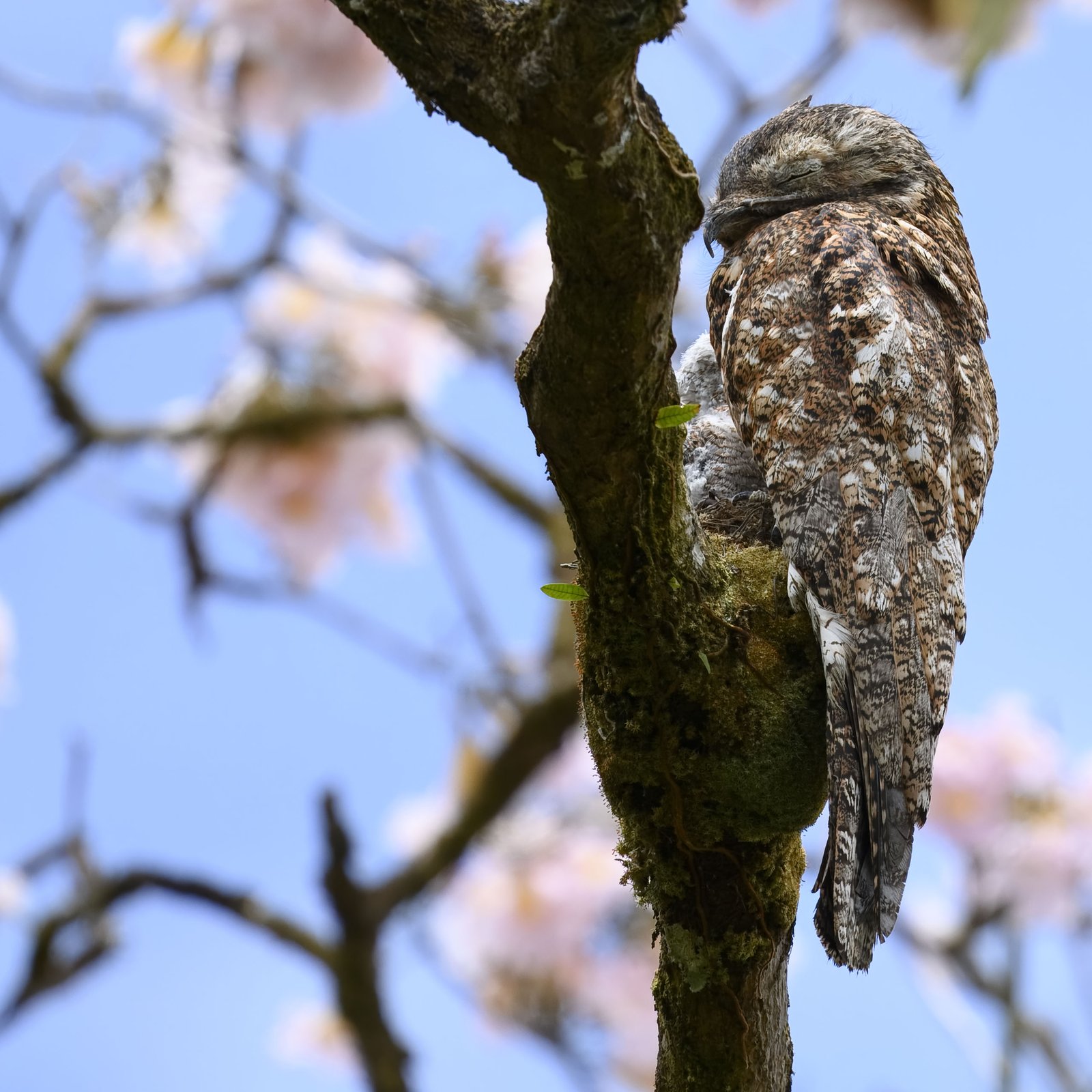
The Great Potoo is the largest member of its family: a pale, owl-like bird of lowland forest with a huge head and a very wide gape. By day it sits motionless on a thick branch high in a tree, where it resembles a lichen-covered stump. Its nocturnal call is a raw, growling roar.
Voice
A loud, hoarse and growling bwaaarr or gwaaa-orrr, repeated at intervals, mainly at night and in moonlight. The sound carries far over the forest.
Recording: Mauricio Cuellar Ramirez (@Birding.travel) — CC BY-NC-SA 4.0 · xeno-canto
Identification
48–55 cm, large and heavy, with a broad head, a short, hooked bill tip above a very wide gape and a long, rounded tail. The plumage is dirty white to pale grey, finely mottled and barred with brown and black; some birds are browner. The eyes are large and dark brown and shine red to orange in torchlight. The sexes are alike; juveniles are whiter, with fewer markings.
Confusion species
Common Potoo Nyctibius griseus is much smaller, with yellow eyes, a row of black spots on the breast and a series of whistles as song. Long-tailed Potoo Nyctibius aethereus is browner, with a longer, wedge-shaped tail, and usually sits lower in the forest interior. Large owls have a facial disc and a hooked bill without a wide gape.
Habitat
High and mid-levels of humid lowland forest, both terra firme and várzea, forest edges, clearings with tall trees and the banks of rivers and lakes, up to about 800 m, locally higher. At night it sallies from a high lookout for large flying insects, such as beetles and moths, and sometimes takes bats. The single egg is laid without a nest in a hollow on top of a thick branch.
Where the bird is most at home, classified by the vegetation units of the Andes and the west coast.


Range and movements
In Colombia in the lowlands of the Chocó and the Caribbean coast, the Magdalena valley and the lowlands east of the Andes. In Ecuador mainly in the eastern lowlands, scarce in the north-west. In Peru in the eastern lowlands. In Bolivia in the lowlands of the north and east. Absent from the high Andes, the dry coastal regions and the Galápagos. Outside the guide area from southern Mexico through Central America to Brazil and Paraguay.
- Resident
- dark = core range, pale = thinly spread
How and when to look
At night listen along rivers and forest edges for the growling roar and search with a torch for the red eyeshine high in the trees. At Amazonian lodges regular roosting sites are often known.
Conservation status
Least Concern. The species is widespread, but depends on tall trees and disappears where forest is cleared on a large scale.
Scientific name
Nyctibius grandis | (Gmelin, 1789)
Gmelin described the species in 1789 as Caprimulgus grandis; because it was later moved to another genus, the author and year stand in brackets. The genus Nyctibius was introduced in 1816 by Vieillot. The genus name comes from Greek nuktibios, 'night-feeding', from nux, 'night', and bios, 'life'. The species name is Latin grandis, 'great'. The specimen the first description was based on came from Cayenne, French Guiana.