All species › Potoos › Potoos › Rufous Potoo
Rufous Potoo | Phyllaemulor bracteatus
Rosse reuzennachtzwaluw | Nictibio rufo | Urutau-ferrugem
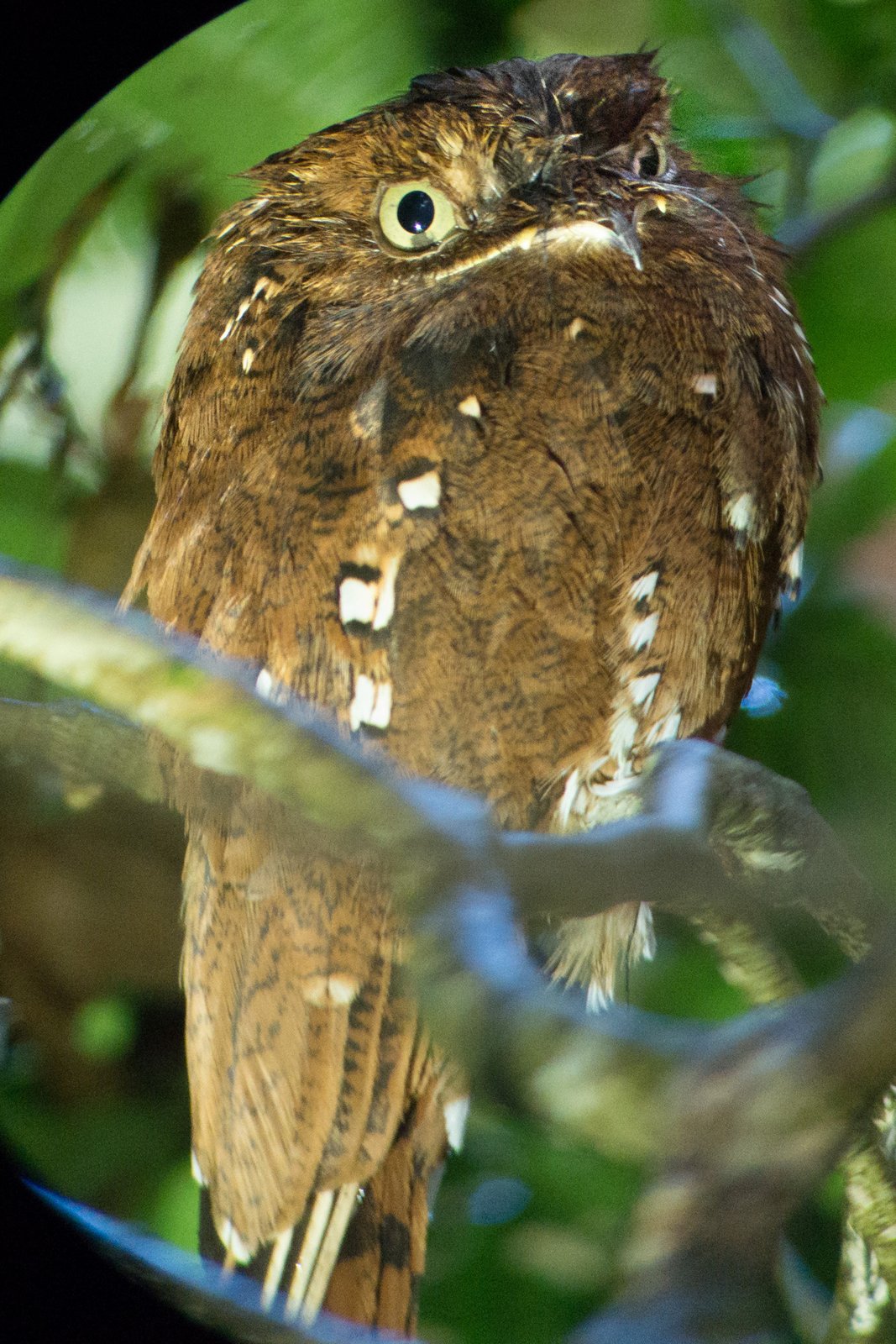
The Rufous Potoo is the smallest and most distinctive potoo: a rufous bird of Amazonian forest that sits low in the forest by day and then resembles a cluster of dead leaves. It is now placed in a genus of its own. Because of its hidden habits it is poorly known and is found mainly by voice.
Voice
A series of soft, hollow notes that gradually descend and slow down, such as boo-boo-boo-boo-bu, mainly at dusk and at night from the forest interior.
No recording with a suitable Creative Commons licence is available for this species yet.
Identification
21–25 cm, small and compact for a potoo, with a large head, a wide gape and a fairly long tail. The whole plumage is warm rufous, finely streaked and barred with black, with conspicuous white, black-edged teardrop spots on the scapulars, the wing-coverts and especially the underparts. The tail is rufous with narrow black bars. The eyes are large and yellow. The sexes are alike.
Confusion species
The other lowland potoos, such as Common Potoo Nyctibius griseus and White-winged Potoo Nyctibius leucopterus, are grey or brown without a warm rufous ground colour and without white teardrop spots on the underparts. Nightjars such as Rufous-bellied Nighthawk Lurocalis rufiventris have a small head and roost lying down, not upright.
Habitat
The lower and middle strata of humid lowland terra firme forest, especially on poor sandy soils and along streams, locally in tall várzea forest, up to about 500 m. By day it roosts upright on a thin branch a few metres up, often beneath a dense layer of leaves. At night it sallies from a perch for flying insects. Little is known of its breeding biology.
Where the bird is most at home, classified by the vegetation units of the Andes and the west coast.


Range and movements
In Colombia in Amazonia in the south-east, with few records. In Ecuador in the eastern lowlands. In Peru in the eastern lowlands, mainly in the north. In Bolivia scarce in the northern lowlands. Absent from the Andes, west of them and from the Galápagos. Outside the guide area in Brazilian Amazonia, the Guianas and southern Venezuela.
- Resident
- dark = core range, pale = thinly spread
How and when to look
At dusk and at night listen on trails through terra firme forest, especially on white sand, for the descending series of hollow notes; the bird often sits low and close by.
Conservation status
Least Concern. The species is widespread but hidden and probably more often present than the records suggest; deforestation in Amazonia is the main threat.
Scientific name
Phyllaemulor bracteatus | (Gould, 1846)
Gould described the species in 1846 as Nyctibius bracteatus; because it was later moved to another genus, the author and year stand in brackets. The genus Phyllaemulor was introduced in 2018 by Costa, Whitney, Braun, White, Silveira & Cleere. The genus name means 'leaf-mimicker', from Greek phullon, 'leaf', and Latin aemulor, 'to emulate': a bird that imitates a dead leaf. The species name is Latin bracteatus, 'gilded, gold-plated', from bractea, 'gold leaf'. The specimen the first description was based on came from Bogotá, Colombia.