All species › Oilbirds › Oilbird › Oilbird
Oilbird | Steatornis caripensis
Vetvogel | Guácharo | Guácharo
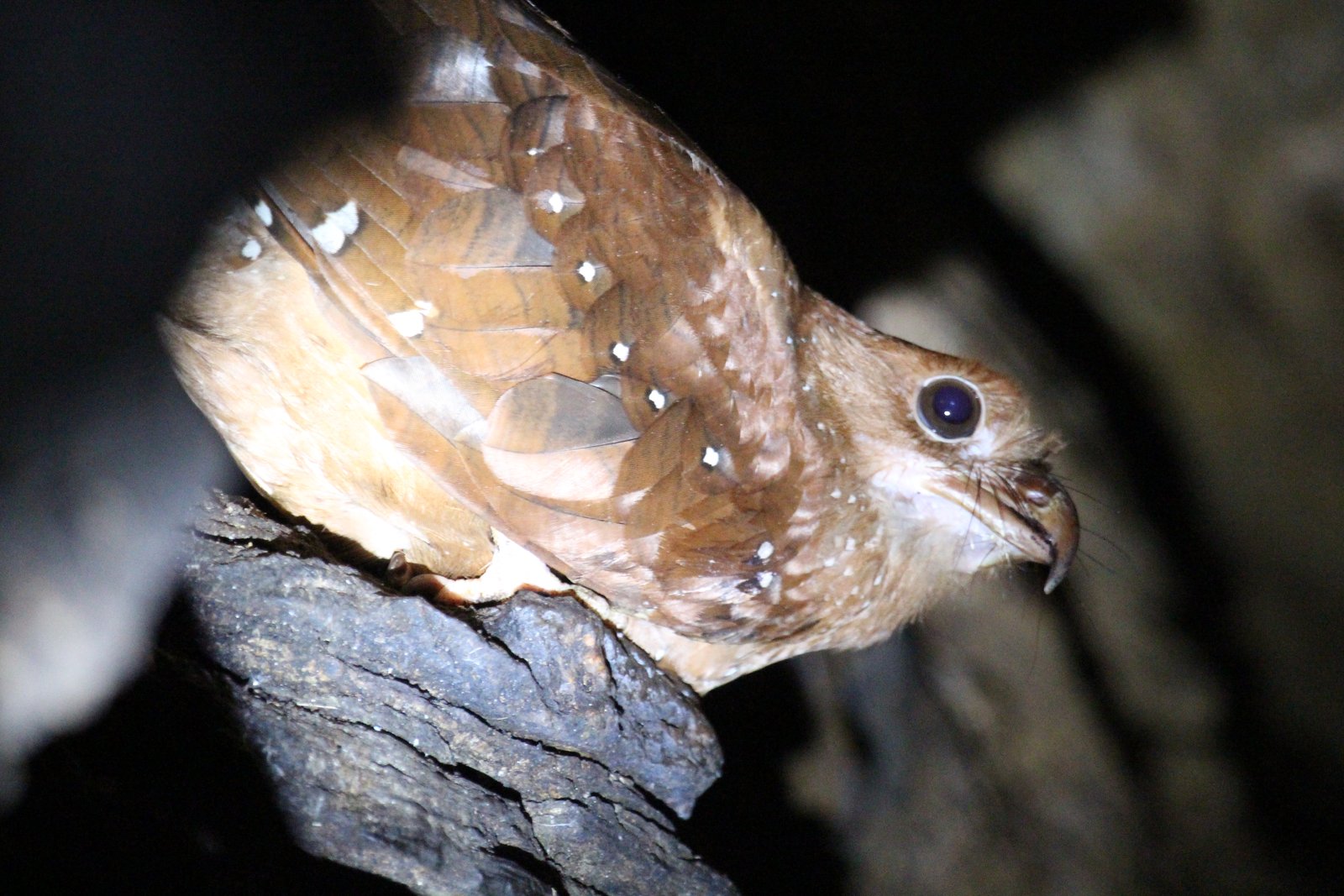
The Oilbird is the only member of its family: a large, rufous nocturnal bird that breeds in colonies in caves and feeds exclusively on fruit. In the darkness of the cave it navigates by audible clicks, a form of echolocation that is rare among birds. At night it flies tens of kilometres to pluck the fruit of palms and laurels.
Voice
In and near the cave a deafening chorus of hoarse screams, shrieks and snarling sounds. In addition, short, dry clicks that the bird uses for echolocation when flying in the dark and that are clearly audible to people.
Recording: Mauricio Cuellar Ramirez (@Birding.travel) — CC BY-NC-SA 4.0 · xeno-canto
Identification
43–48 cm, with long, broad wings, a long, graduated tail and a short, strongly hooked bill surrounded by long bristles. The plumage is warm rufous-brown, with small white, black-edged spots on the head, wings and underparts; the spots on the wings and tail are the largest. The eyes are large and dark and shine red in torchlight. The legs are short and weak. The sexes are alike; juveniles are duller.
Confusion species
Potoos, such as Great Potoo Nyctibius grandis and Long-tailed Potoo Nyctibius aethereus, are grey or brown and mottled without white spots, have a broad, unhooked bill and hunt insects from a fixed perch. Nightjars are much smaller. Inside the cave the Oilbird cannot be confused with any other bird.
Habitat
Breeds and roosts in caves, gorges and deep ravines, from the lowlands to roughly 3000 m, with most colonies on the slopes of the Andes. It forages at night in humid foothill and montane forest, plucking fruit of palms, laurels and incense trees in flight; the seeds are later regurgitated in the cave. The nest is a mound of regurgitated fruit pulp on a ledge in the cave; the young become very fat.
Where the bird is most at home, classified by the vegetation units of the Andes and the west coast.


Range and movements
In Colombia scattered in the three Andean ranges and in the Sierra Nevada de Santa Marta. In Ecuador on the eastern and western slopes of the Andes. In Peru along the eastern slope of the Andes, locally also on the western slope in the north. In Bolivia on the eastern slope of the Andes in the Yungas. Absent from the Galápagos. Outside the guide area in Venezuela, Trinidad, the Guianas, northern Brazil and eastern Panama.
- Resident
- dark = core range, pale = thinly spread
How and when to look
Visit a known cave with a colony, such as in national parks in Colombia, Ecuador and Peru, and watch the entrance just after sunset, when the birds fly out. Inside the cave use only dimmed light and stay on the paths.
Conservation status
Least Concern. The colonies depend on undisturbed caves and on forest within the foraging range; disturbance of caves and the harvesting of fat nestlings locally threaten colonies.
Scientific name
Steatornis caripensis | Humboldt, 1817
Humboldt described the species in 1817 and placed it straight away in the genus where it still stands. The genus Steatornis was introduced in 1814 by Humboldt. The genus name comes from Greek stear, steatos, 'fat, tallow', and ornis, 'bird', for the fat nestlings that were once rendered for oil. The species name refers to Caripe in Venezuela, where Humboldt saw the birds in the Cueva del Guácharo. The specimen the first description was based on came from Cueva del Guácharo, Caripe, Monagas, Venezuela.