All species › Passerines › Antbirds › Magdalena Antbird
Magdalena Antbird | Sipia palliata
Magdalenamiervogel | Hormiguero de Magdalena | Formigueiro-do-magdalena
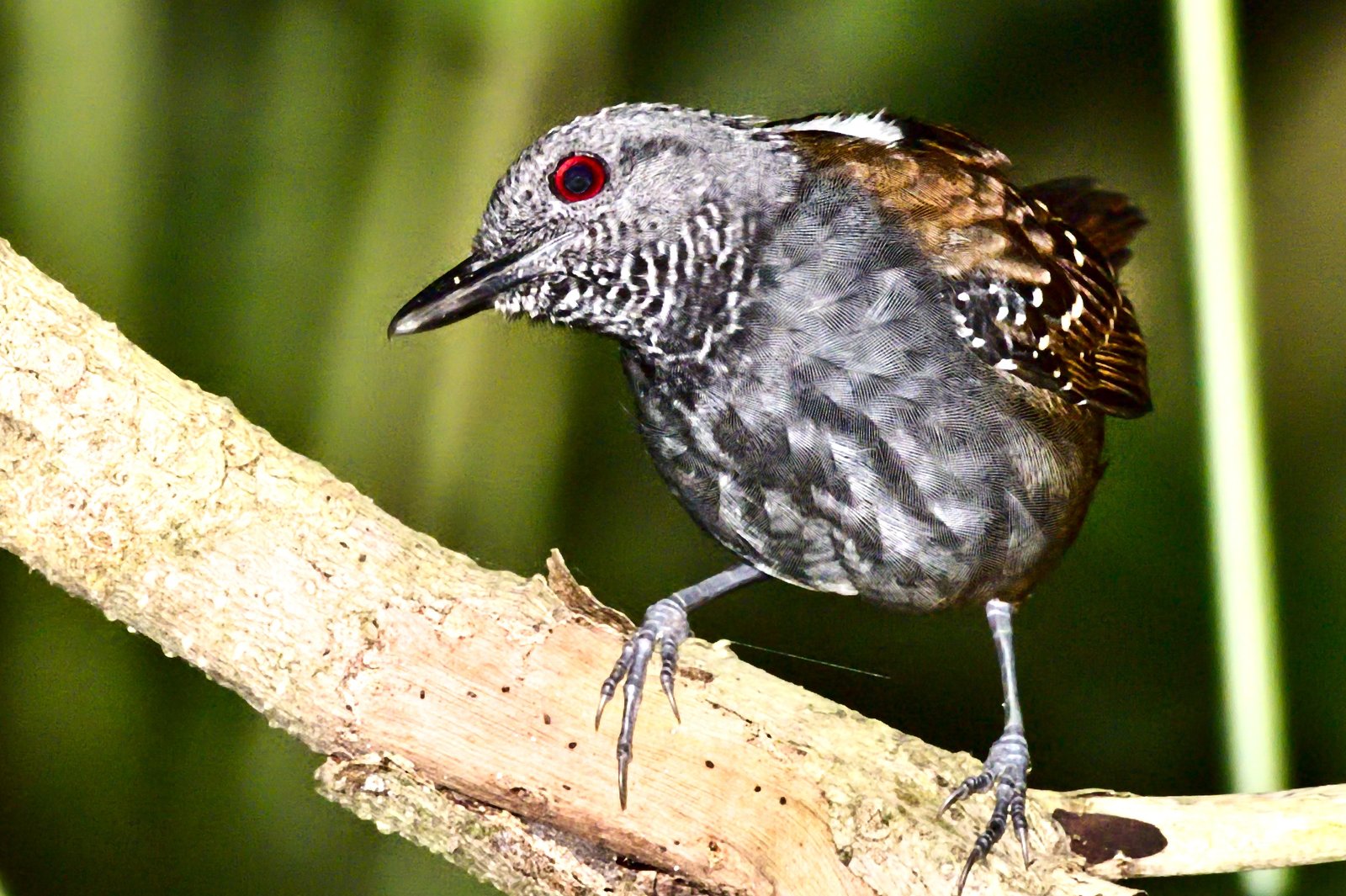
The Magdalena Antbird is a dark antbird with a red iris and a chestnut rear end that occurs almost only in northern Colombia, mainly in and around the Magdalena Valley. It was split from the Dull-mantled Antbird in 2010 on the basis of song and DNA. It lives close to the ground in ravines and dense vegetation of humid foothill forest.
Voice
The male's song resembles that of Dull-mantled Antbird, but starts more slowly, with marked rising and falling slurs, and has a third section of high notes. The female sings a single series of four flat notes. Calls: a flattened, rounded note and a rising note.
Recording: Brian Cox — CC BY-NC-SA 4.0 · xeno-canto
Identification
14–15 cm. The male has a slate-grey head and neck, a brown upper back with a usually concealed white interscapular patch, a black throat and black wing coverts with buff and white dots. The lower back, rump and tail are chestnut; the flanks and lower belly brown, the rest of the underparts slate-grey. The female resembles the male, but has a black-and-white checkered throat and buff instead of white wing dots. Both sexes have a dark red iris.
Confusion species
Dull-mantled Antbird Sipia laemosticta in the extreme north-west of Colombia has nearly identical plumage, but sings differently; the ranges barely overlap. In Esmeraldas Antbird Sipia nigricauda on the Pacific side the male is grey, without a brown back. Chestnut-backed Antbird Poliocrania exsul has blue skin around the eye, a dark iris and no white wing dots.
Habitat
Floor and understorey of wet evergreen foothill forest and adjacent lowlands, especially in ravines, on slopes with dense vegetation and in regrowth on landslides and in clearings; in Colombia up to about 1100 m. It lives in pairs close to the ground and searches for insects in leaf litter and low vegetation.
Where the bird is most at home, classified by the vegetation units of the Andes and the west coast.


Range and movements
Colombia: from Córdoba and Cesar south through the Magdalena Valley to Caldas, on the lower slopes on both sides of the valley; the range may be discontinuous. Absent from Ecuador, Peru, Bolivia and the Galápagos. Outside the guide area in north-western Venezuela (Zulia, Táchira and Mérida).
- Resident
- dark = core range, pale = thinly spread
How and when to look
In forest reserves on the lower slopes along the middle Magdalena Valley, search stream ravines with dense vegetation and listen for the song; the birds stay low, close to the ground.
Conservation status
Near Threatened. The range is fragmented and the population is probably declining because of deforestation in the Magdalena Valley and on the lower slopes; in north-western Venezuela most forest has disappeared.
Scientific name
Sipia palliata | (Todd, 1917)
Todd described the species in 1917 as Myrmeciza Ioemosticta palliata; because it was later moved to another genus, the author and year stand in brackets. The genus Sipia was introduced in 1924 by Hellmayr. The genus name, introduced by Hellmayr in 1924, refers to Sipí in the Chocó, western Colombia. The species name comes from Latin palliatus, 'cloaked'. The specimen the first description was based on came from La Palmita, Santander, Colombia.