All species › Passerines › Antbirds › Esmeraldas Antbird
Esmeraldas Antbird | Sipia nigricauda
Esmeraldasmiervogel | Hormiguero de Esmeraldas | Formigueiro-de-esmeraldas
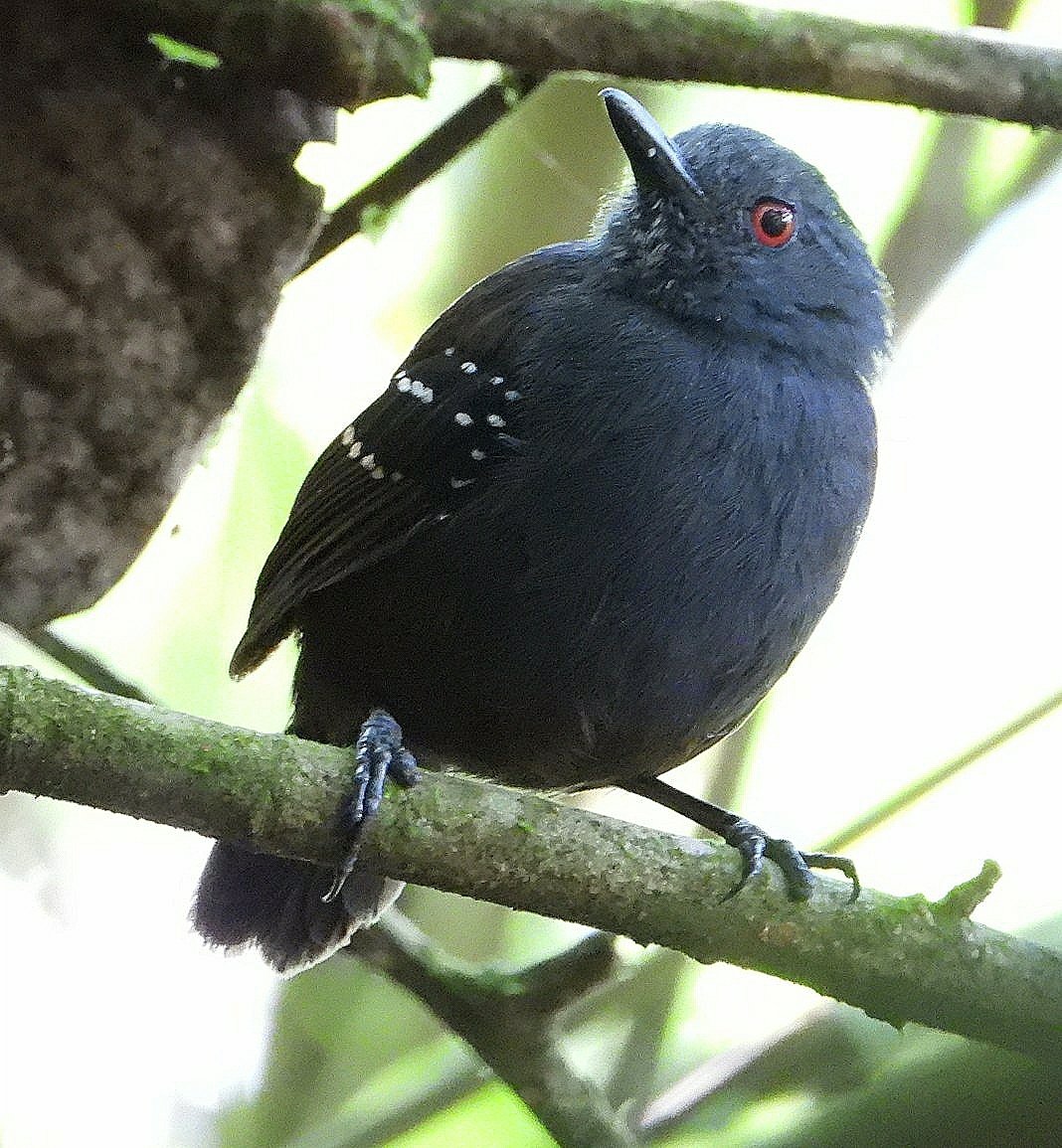
The Esmeraldas Antbird is a dark grey antbird with a red iris of the humid foothill forests of the Chocó, from western Colombia to south-western Ecuador. Male and female differ so much that they were long described as two species. It lives close to the ground in ravines and dense vegetation.
Voice
The song is a short series of very high, thin, sharp notes, the second and last higher and more emphatic. The call is a sharp, nasal, falling note, roughly skweeyr.
Recording: Daan van der Hoeven — CC BY-NC-SA 4.0 · xeno-canto
Identification
13–14 cm. The male is mostly dark grey, with a white interscapular patch, darker wings and tail and black wing coverts with white tips. The female has a dark grey head and neck, dark rufous-brown upperparts, dark brown flight feathers with broad rufous-brown edges and a rufous-tinged tail; the throat is barred black and white, the breast dark grey and the belly to undertail coverts ochre-brown. Both sexes have a red iris.
Confusion species
Stub-tailed Antbird Sipia berlepschi lives mainly lower down, in the lowlands, has a much shorter tail, and the male is blacker; the female is blackish with a white-spotted throat and breast, without rufous-brown upperparts. In Dull-mantled Antbird Sipia laemosticta and Magdalena Antbird Sipia palliata, which live farther north, the male has a brown back. Chestnut-backed Antbird Poliocrania exsul has blue skin around the eye and is warmer brown.
Habitat
Floor and understorey of wet evergreen forest and adjacent mature secondary forest in the foothills, especially in ravines, on slopes with dense vegetation and in regrowth on landslides and in clearings; in Ecuador mostly between 500 and 1100 m, locally from 150 to 1500 m. It lives in pairs close to the ground and searches for insects in leaf litter and low vegetation.
Where the bird is most at home, classified by the vegetation units of the Andes and the west coast.


Range and movements
Colombia: along the Pacific slope from central Chocó south into Nariño. Ecuador: along the Pacific slope south into El Oro. Absent from Peru, Bolivia and the Galápagos. Endemic to the guide area.
- Resident
- dark = core range, pale = thinly spread
How and when to look
In foothill forest in north-western Ecuador (Pichincha and Esmeraldas), search stream ravines with dense vegetation and listen for the high, thin song; the birds stay low, close to the ground.
Conservation status
Least Concern. The population is probably declining because of deforestation in the Chocó and western Ecuador; much suitable forest remains, but relatively little of it is protected.
Scientific name
Sipia nigricauda | (Salvin & Godman, 1892)
Salvin & Godman described the species in 1892 as Myrmeciza nigricauda; because it was later moved to another genus, the author and year stand in brackets. The genus Sipia was introduced in 1924 by Hellmayr. The genus name, introduced by Hellmayr in 1924, refers to Sipí in the Chocó, western Colombia. The species name comes from Latin niger, 'black', and cauda, 'tail'. The specimen the first description was based on came from Intag, Imbabura, Ecuador.