All species › Passerines › Antbirds › Stub-tailed Antbird
Stub-tailed Antbird | Sipia berlepschi
Kortstaartmiervogel | Hormiguero colimocho | Formigueiro-de-cauda-curta
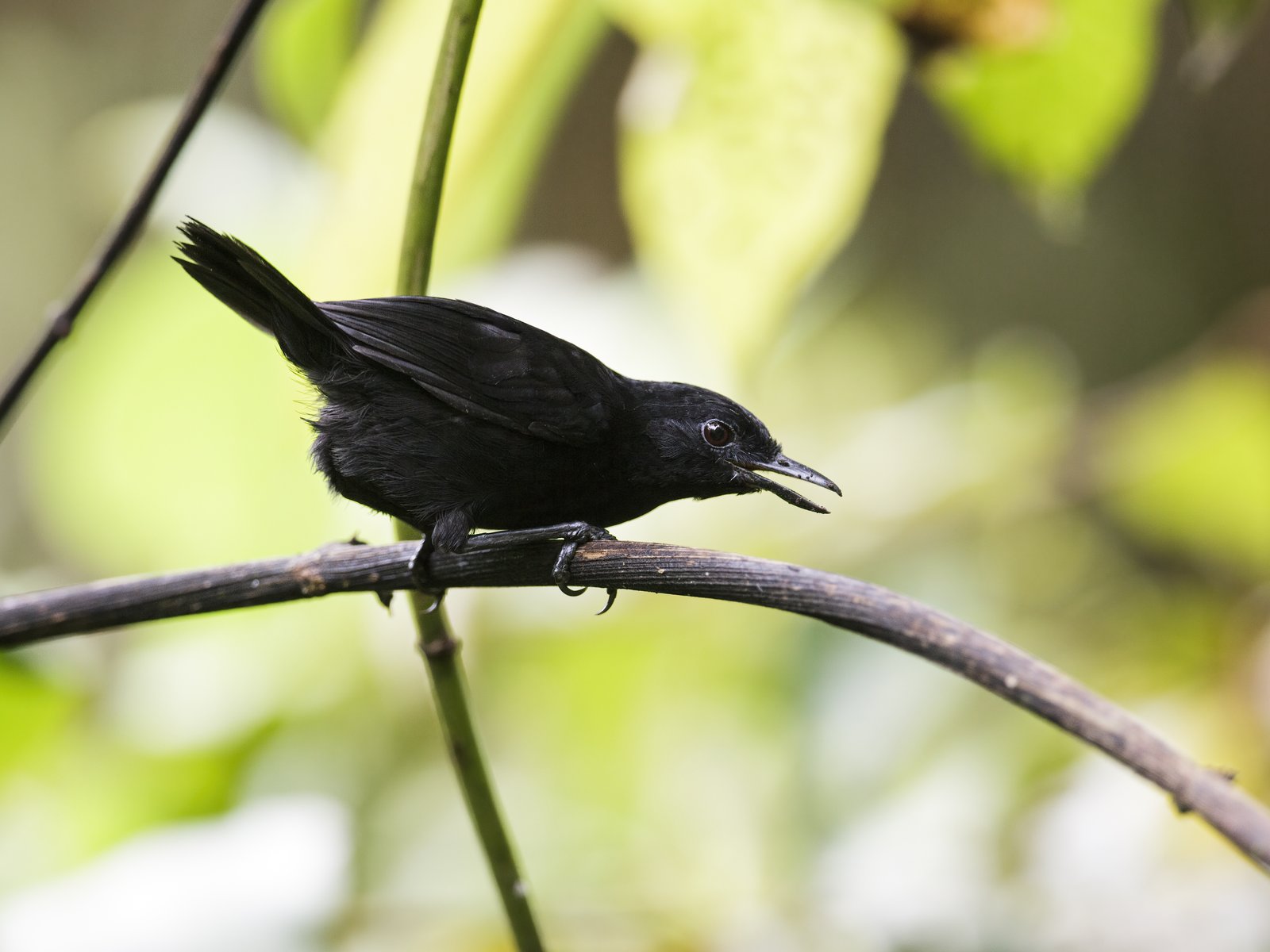
The Stub-tailed Antbird is a dark, compact antbird with a very short tail, found only in the Chocó lowlands of Colombia and north-western Ecuador. It lives in pairs low in the understorey of wet forest, often near streams and swampy spots. Together with the Esmeraldas and Dull-mantled Antbirds it belongs to the genus Sipia.
Voice
The song is a fast series of high, clear notes, often dropping slightly at the end. Calls are short, sharp chip notes and a dry rattle.
Recording: Fabrice Schmitt — CC BY-NC-SA 4.0 · xeno-canto
Identification
14 cm, with a short black bill and a very short tail. The male is entirely black, with small white dots on the wing coverts. The female is also dark, but has small white dots on the throat and breast and fewer or no white dots on the wing. Young birds are duller and browner.
Confusion species
Esmeraldas Antbird Sipia nigricauda is slate-grey rather than black, has a longer tail and usually lives higher, in the foothills. Chestnut-backed Antbird Poliocrania exsul has a chestnut back and wings and bare blue skin around the eye. Dusky Antbird Cercomacroides tyrannina is greyer, with a longer tail, and is more often in shrubbery at the forest edge. Zeledon's Antbird Hafferia zeledoni is larger, with a longer tail and bare blue skin around the eye.
Habitat
Understorey of wet lowland forest and tall secondary forest, especially along streams, in swampy hollows and in places with dense shrubbery and fallen trees, from sea level to about 900 m. It forages in pairs for insects and spiders just above the ground, sometimes at army-ant swarms. Little is known about its breeding.
Where the bird is most at home, classified by the vegetation units of the Andes and the west coast.


Range and movements
Colombia: in the Pacific lowlands from Chocó south through Valle del Cauca and Cauca to Nariño. Ecuador: in the north-west, mainly in Esmeraldas and adjacent Imbabura and Pichincha. Peru: absent. Bolivia: absent. Absent from the Galápagos. Hardly or not at all found outside the guide area.
- Resident
- dark = core range, pale = thinly spread
How and when to look
In wet Chocó forest along streams, listen for the fast, high song; pairs often answer each other and stay low in dense growth. Wait quietly near a singing bird until it appears in a gap.
Conservation status
Least Concern. The species is locally fairly common in undisturbed forest, but the Chocó lowland forest is shrinking through logging and conversion to farmland.
Scientific name
Sipia berlepschi | (Hartert, 1898)
Hartert described the species in 1898 as Pyriglena berlepschi; because it was later moved to another genus, the author and year stand in brackets. The genus Sipia was introduced in 1924 by Hellmayr. The genus name, introduced by Hellmayr in 1924, refers to Sipí in the Chocó, western Colombia. The species name honours the German ornithologist Hans von Berlepsch (1850–1915), who built a large collection of South American birds. The specimen the first description was based on came from Cachabí, Esmeraldas, Ecuador.