All species › Passerines › Antbirds › Northern White-fringed Antwren
Northern White-fringed Antwren | Formicivora intermedia
Noordelijke witbandmiersluiper | Hormiguerito coicorita norteño | Papa-formiga-pardo-do-norte
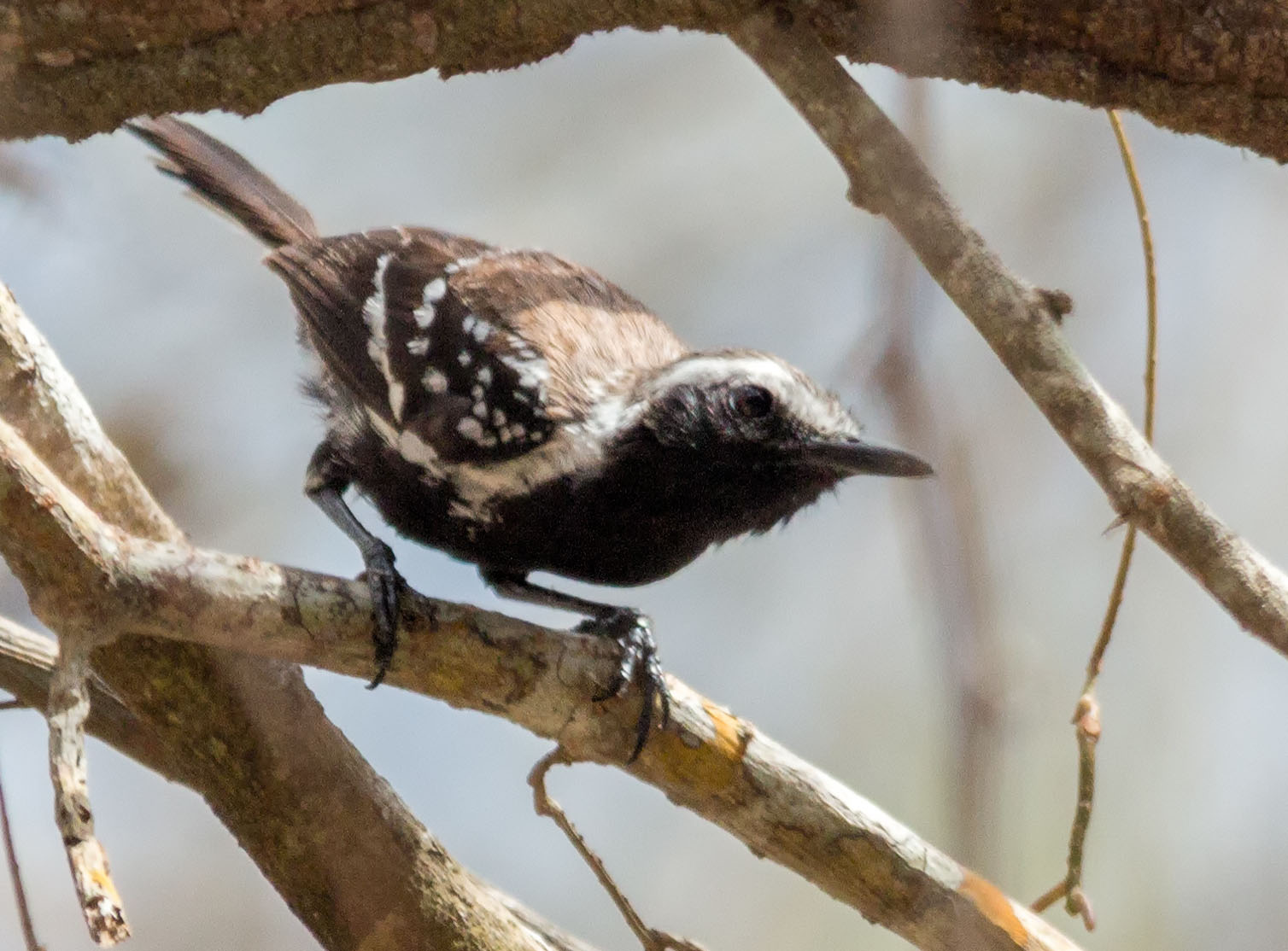
The Northern White-fringed Antwren is a small antwren of dry scrub and forest edges in northern Colombia and Venezuela. The male stands out by its black underparts with a white band running from the eyebrow along the side of the neck and breast to the flanks. It was formerly considered one species with the Southern White-fringed Antwren.
Voice
The song is a fast series of even, dull notes, often given as a duet by both sexes. The call is a short, nasal 'chup' and a dry rattle.
Recording: Brian Cox — CC BY-NC-SA 4.0 · xeno-canto
Identification
12–13 cm, with a fairly long, graduated tail. The male is greyish brown above; face, throat, breast and belly are black, bordered by a white band from the eyebrow to the flanks. The wing coverts are black with white spots, and the tail is blackish with white tips. The female is greyish brown above, with a whitish eyebrow, a dark eye-stripe and white wing spots, and whitish to pale buff below, often with fine dark spots on the breast.
Confusion species
Southern White-fringed Antwren Formicivora grisea is very similar, but in the guide area occurs only in eastern Colombia and north-eastern Bolivia; there the female is warmer ochre below. The female Barred Antshrike Thamnophilus doliatus is larger and rufous, with a heavy bill and a streaked head. Antwrens of the genus Myrmotherula have shorter tails and usually live in wetter forest.
Habitat
Dry forest, thorn scrub, forest edges, secondary growth and thickets along streams and fields, also in mangroves and gallery forest in savanna; mostly below 1000 m. It searches dense shrubbery for insects and spiders, often in pairs, wagging its tail as it moves. The nest is a cup placed low in a shrub.
Where the bird is most at home, classified by the vegetation units of the Andes and the west coast.


Range and movements
Colombia: in the Caribbean lowlands, around the Sierra Nevada de Santa Marta and on the La Guajira peninsula, in the Magdalena and Cauca valleys, and locally in the llanos at the foot of the Eastern Andes. Absent from Ecuador, Peru, Bolivia and the Galápagos. Outside the guide area in Venezuela, on Trinidad and Tobago, on Margarita Island and on the Pearl Islands of Panama.
- Resident
- dark = core range, pale = thinly spread
How and when to look
Search dry scrub and forest edges around Santa Marta and in La Guajira, or in the dry parts of the Magdalena valley. Pairs are often heard before they come into view.
Conservation status
Least Concern. The species tolerates secondary growth and small-scale farming well and is common in suitable habitat.
Scientific name
Formicivora intermedia | Cabanis, 1847
Cabanis described the species in 1847 and placed it straight away in the genus where it still stands. The genus Formicivora was introduced in 1824 by Swainson. The genus name combines Latin formica, 'ant', and -vorus, 'eating' (from vorare, 'to devour'). The species name comes from Latin intermedius, 'intermediate', for a form between related species. The specimen the first description was based on came from Aragua, Venezuela.