All species › Passerines › Antbirds › Southern White-fringed Antwren
Southern White-fringed Antwren | Formicivora grisea
Zuidelijke witbandmiersluiper | Hormiguerito coicorita sureño | Papa-formiga-pardo
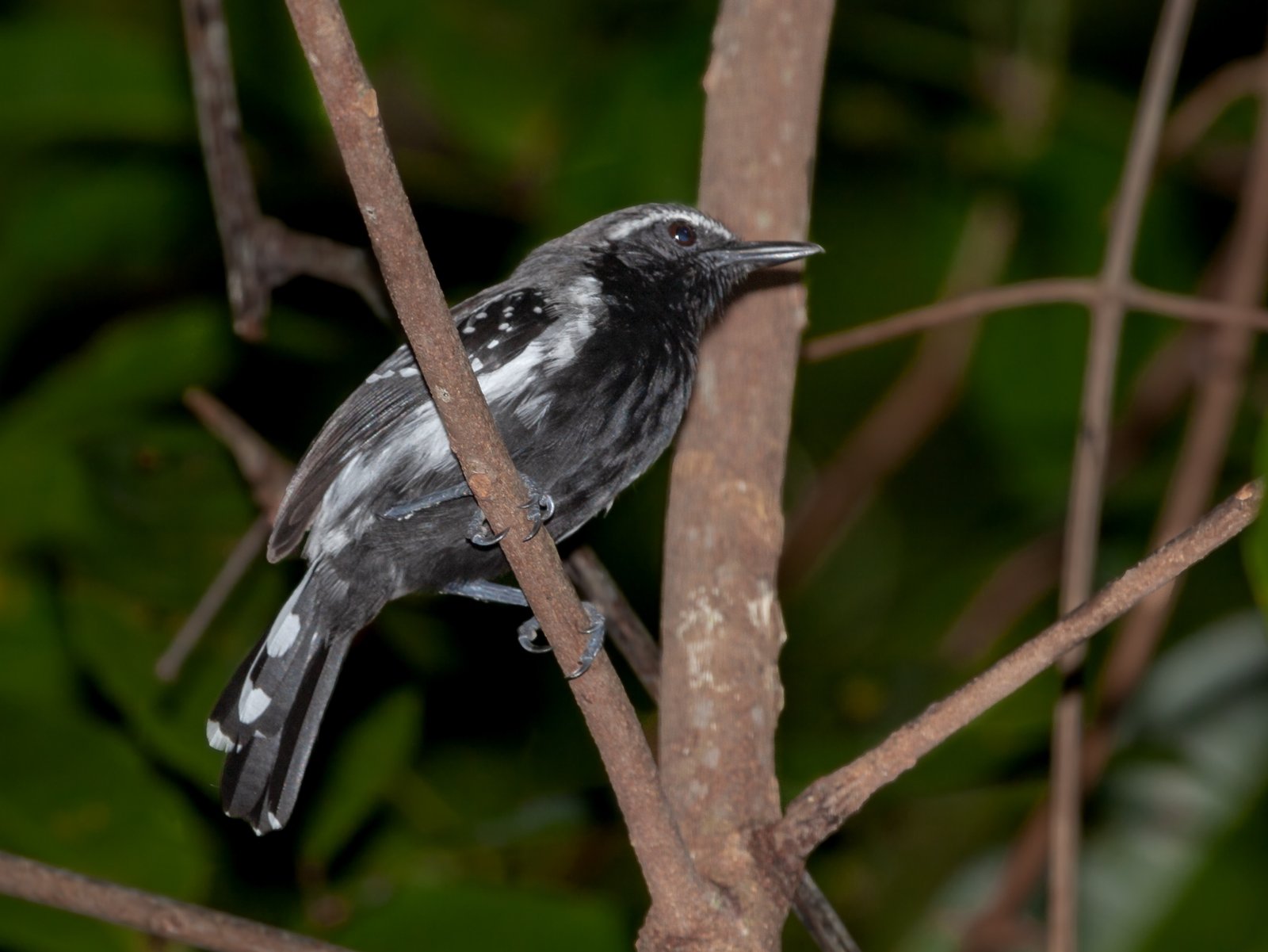
The Southern White-fringed Antwren is a small antwren of scrub, savanna woodland and forest edges in north-eastern South America. The guide area lies at the western edge of its range: it occurs there only on sandy soils in eastern Colombia and in north-eastern Bolivia. The male has the same white band along black underparts as the Northern White-fringed Antwren.
Voice
The song is a fast series of even, dull notes, often as a duet. The call is a short, nasal 'chup', also given in series.
Recording: JAYRSON ARAUJO DE OLIVEIRA — CC BY-NC-SA 4.0 · xeno-canto
Identification
12–13 cm, with a fairly long, graduated tail. The male is greyish brown above; face, throat, breast and belly are black, bordered by a white band from the eyebrow to the flanks. The wing coverts are black with white spots, and the tail is blackish with white tips. The female is greyish brown above, with a pale eyebrow and white wing spots, and plain ochre to cinnamon below.
Confusion species
Northern White-fringed Antwren Formicivora intermedia lives in northern Colombia, and its female is paler, whitish below. The male Rusty-backed Antwren Formicivora rufa has a rufous back and the female white underparts streaked black; it lives in open savanna. The male Black-bellied Antwren Formicivora melanogaster is similar, but the female is white below with a black mask.
Habitat
Scrub and low forest on white sand, savanna with shrubs, cerrado and the edges of humid forest, in the lowlands. Pairs search dense shrubbery for insects and spiders, wagging the tail. The nest is a cup placed low in a shrub.
Where the bird is most at home, classified by the vegetation units of the Andes and the west coast.


Range and movements
Colombia: in the east, mainly in Guainía and Vaupés, on sandy soils with scrub and low forest. Bolivia: locally in the north-east, along the Brazilian border, in cerrado and forest edges; its exact distribution there is poorly known. Absent from Ecuador, Peru and the Galápagos. Outside the guide area in southern Venezuela, the Guianas and large parts of Brazil.
- Resident
- dark = core range, pale = thinly spread
How and when to look
Search the white-sand savannas and low scrub forest around Inírida in Guainía. Look for an antwren with a broad white side band moving through the shrubs in pairs.
Conservation status
Least Concern. The species has a very large range and tolerates secondary growth; in the guide area it is local.
Scientific name
Formicivora grisea | (Boddaert, 1783)
Boddaert described the species in 1783 as Turdus griseus; because it was later moved to another genus, the author and year stand in brackets. The genus Formicivora was introduced in 1824 by Swainson. The genus name combines Latin formica, 'ant', and -vorus, 'eating' (from vorare, 'to devour'). The species name comes from Latin griseus, 'grey'. The specimen the first description was based on came from Cayenne, French Guiana.