All species › Passerines › Antbirds › Black-bellied Antwren
Black-bellied Antwren | Formicivora melanogaster
Zwartbuikmiersluiper | Hormiguerito ventrinegro | Formigueiro-de-barriga-preta
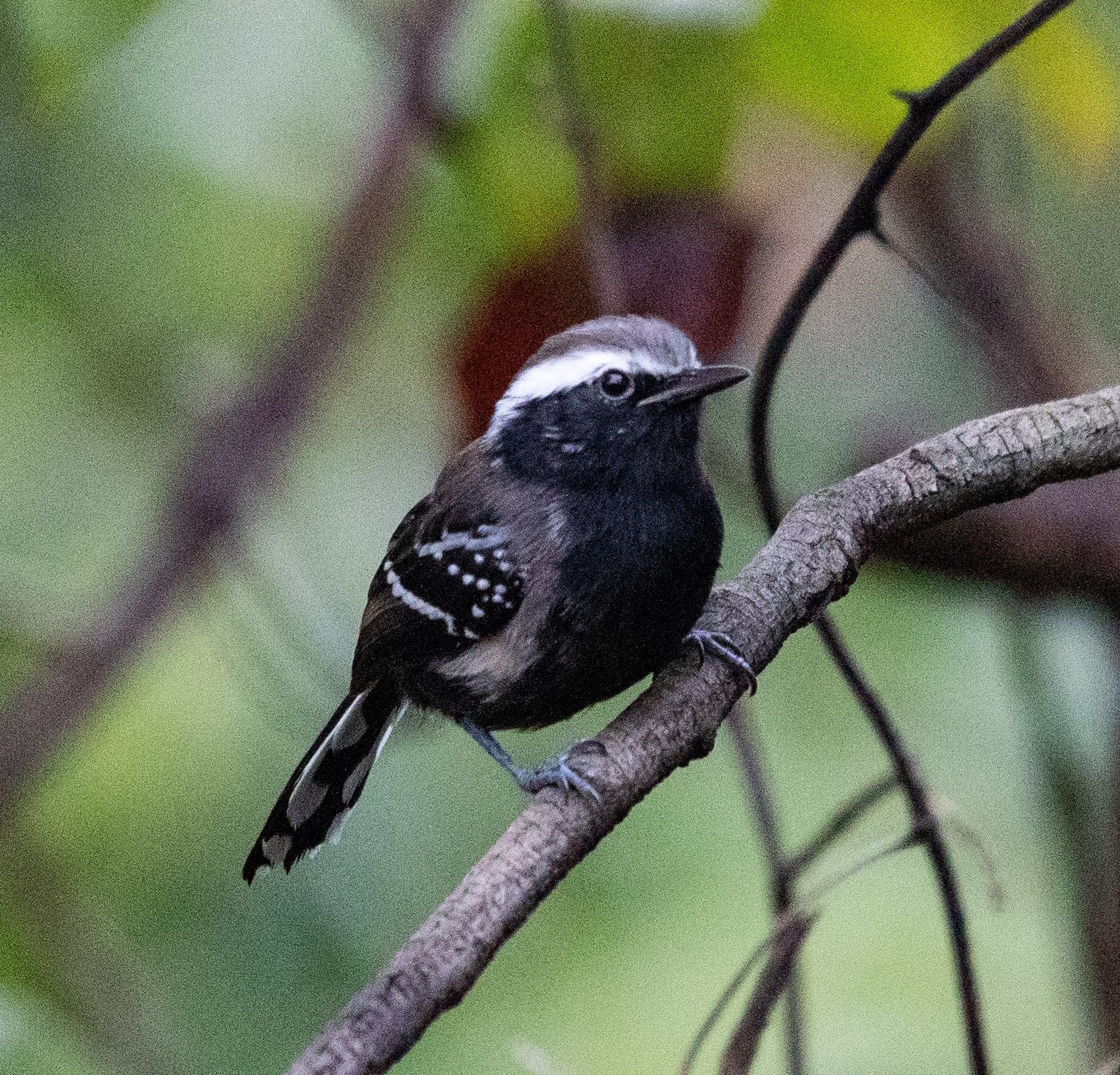
The Black-bellied Antwren is an antwren of dry forest and scrub in the interior of South America. In the guide area it lives only in the eastern lowlands of Bolivia, in Chiquitano dry forest and the Chaco. The male is black from throat to belly, with a white band along the side.
Voice
The song is a fast series of even, short notes, often as a duet. The call is a dry 'chup' and a short rattle.
Recording: JAYRSON ARAUJO DE OLIVEIRA — CC BY-NC-SA 4.0 · xeno-canto
Identification
13–14 cm, with a long, graduated tail. The male is greyish brown above; face, throat, breast and belly are deep black, bordered by a broad white band from the eyebrow to the flanks. The wing coverts are black with white spots, and the tail is black with white tips. The female has a black mask through the eye with a white eyebrow above it, greyish-brown upperparts and white, unstreaked underparts.
Confusion species
Rusty-backed Antwren Formicivora rufa has a rufous back; the female has black streaks on the breast and flanks. Southern White-fringed Antwren Formicivora grisea has a shorter tail; the female is ochre below, without a black mask. The male Black-capped Antwren Herpsilochmus atricapillus is grey with a black crown and lives higher in the trees.
Habitat
Semi-deciduous and dry forest, scrub, Chaco woodland and dense undergrowth at forest edges, in the lowlands up to about 1000 m. Pairs search dense undergrowth for insects and spiders, low above the ground. The nest is a cup placed low in a shrub.
Where the bird is most at home, classified by the vegetation units of the Andes and the west coast.


Range and movements
Bolivia: in the eastern and south-eastern lowlands, mainly in Santa Cruz, south into the Chaco. Absent from Colombia, Ecuador, Peru and the Galápagos. Outside the guide area in Paraguay and in central and eastern Brazil.
- Resident
- dark = core range, pale = thinly spread
How and when to look
Search the dry forest around Santa Cruz de la Sierra and in the Chiquitano region, in dense undergrowth at forest edges and along roads. Pairs reveal themselves by their rapid duets.
Conservation status
Least Concern. The species has a large range, but the dry forest it inhabits is being cleared in many places for farming and cattle ranching.
Scientific name
Formicivora melanogaster | Pelzeln, 1868
Pelzeln described the species in 1868 and placed it straight away in the genus where it still stands. The genus Formicivora was introduced in 1824 by Swainson. The genus name combines Latin formica, 'ant', and -vorus, 'eating' (from vorare, 'to devour'). The species name combines Greek melas, 'black', and gastēr, 'belly'. The specimen the first description was based on came from Cidade de Goiás, Brazil.