All species › Passerines › Antbirds › Rusty-backed Antwren
Rusty-backed Antwren | Formicivora rufa
Roestrugmiersluiper | Hormiguerito dorsirrufo | Papa-formiga-vermelho
The Rusty-backed Antwren is a long-tailed antwren of open savanna with shrubs. In the guide area it lives in the savannas of Bolivia and south-eastern Peru, and also in a few isolated dry valleys on the eastern slope of the Andes in Peru. It keeps low in shrubbery, usually in pairs.
Voice
The song is a series of rapid, dry notes, often as a duet. The call is a short, harsh 'chup', sometimes repeated.
Recording: Jacob Wijpkema — CC BY-NC-SA 4.0 · xeno-canto
Identification
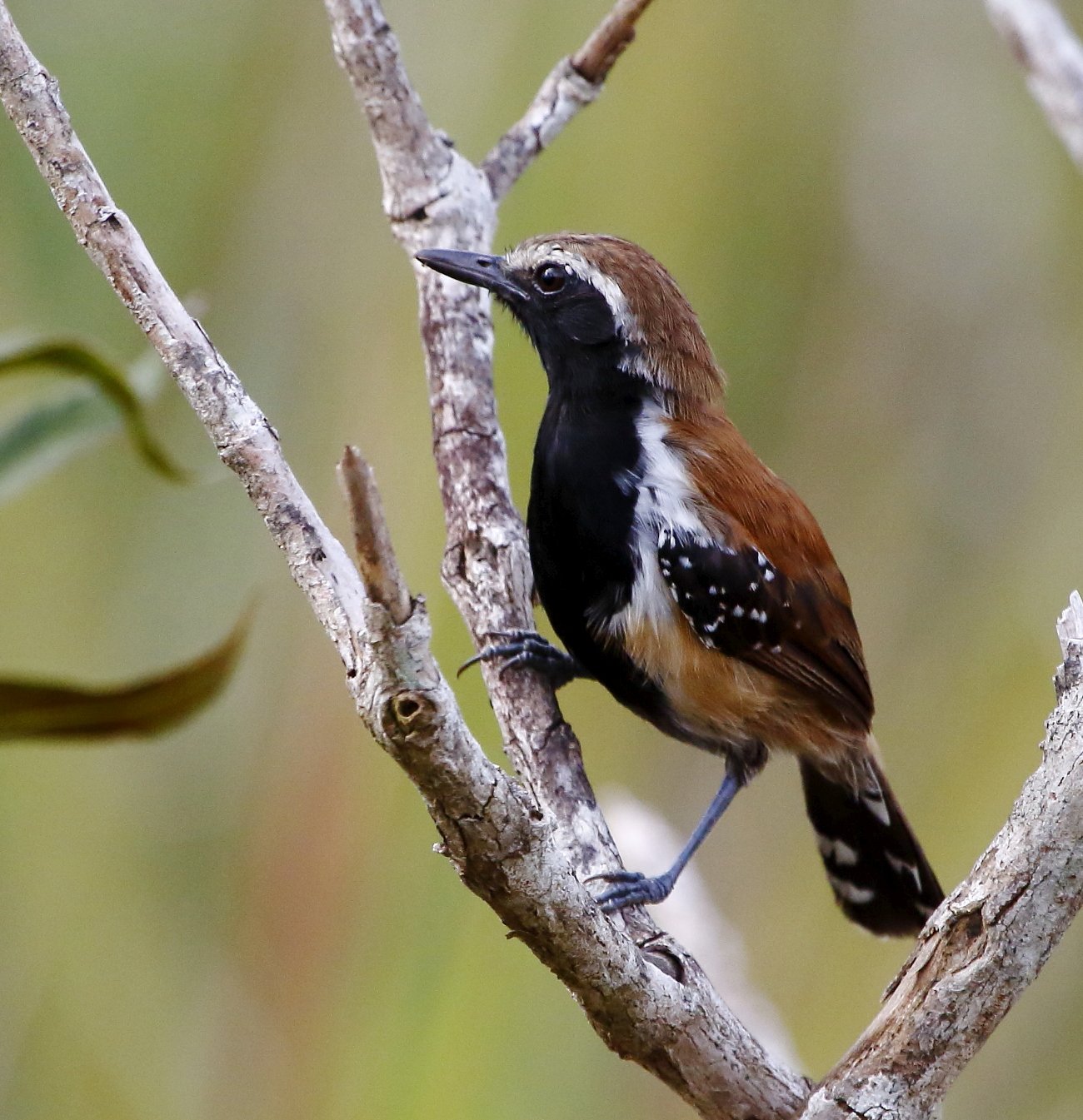
13–14 cm, with a long, graduated tail. The male has a warm rufous back and crown; face, throat and centre of breast and belly are black, bordered by a white band from the eyebrow to the flanks. The wing coverts are black with white spots, and the tail is dark with white tips. The female is rufous above, with a white eyebrow and a dark eye-stripe, and white below with black streaks on the throat, breast and flanks.
Confusion species
Black-bellied Antwren Formicivora melanogaster has a greyish-brown back; the female is unstreaked white below with a black mask. Southern White-fringed Antwren Formicivora grisea is greyish brown above and the female is ochre below. The female Barred Antshrike Thamnophilus doliatus is larger, with a heavy bill and unstreaked buff underparts.
Habitat
Savanna with shrubs, cerrado, open grassland with clumps of shrubs and scrub on dry slopes, from the lowlands up to about 1500 m in Andean valleys. Pairs search low shrubs and tall grass for insects, wagging the tail. The nest is a cup placed low in a shrub or grass tussock.
Where the bird is most at home, classified by the vegetation units of the Andes and the west coast.


Range and movements
Peru: in the Pampas del Heath in Madre de Dios, and isolated in dry valleys on the eastern slope of the Andes, such as the Huallaga valley in San Martín and the Urubamba valley in Cusco. Bolivia: widespread in the savannas of Beni and the eastern lowlands of Santa Cruz. Absent from Colombia, Ecuador and the Galápagos. Outside the guide area in Paraguay, central and eastern Brazil and locally in Suriname.
- Resident
- dark = core range, pale = thinly spread
How and when to look
Search the savannas of Beni, the cerrado of Noel Kempff Mercado or the shrubby slopes around Tarapoto. Pairs often sit in low shrubs and give their duets.
Conservation status
Least Concern. The species has a large range; the isolated populations in Andean valleys are small and may be vulnerable to fires and conversion to farmland.
Scientific name
Formicivora rufa | (Wied-Neuwied, 1831)
Wied-Neuwied described the species in 1831 as Myiothera rufa; because it was later moved to another genus, the author and year stand in brackets. The genus Formicivora was introduced in 1824 by Swainson. The genus name combines Latin formica, 'ant', and -vorus, 'eating' (from vorare, 'to devour'). The species name comes from Latin rufus, 'red, rufous'. The specimen the first description was based on came from interior of Bahia, Brazil.