All species › Passerines › Antbirds › Barred Antshrike
Barred Antshrike | Thamnophilus doliatus
Gebandeerde mierklauwier | Batará barrado | Choca-barrada
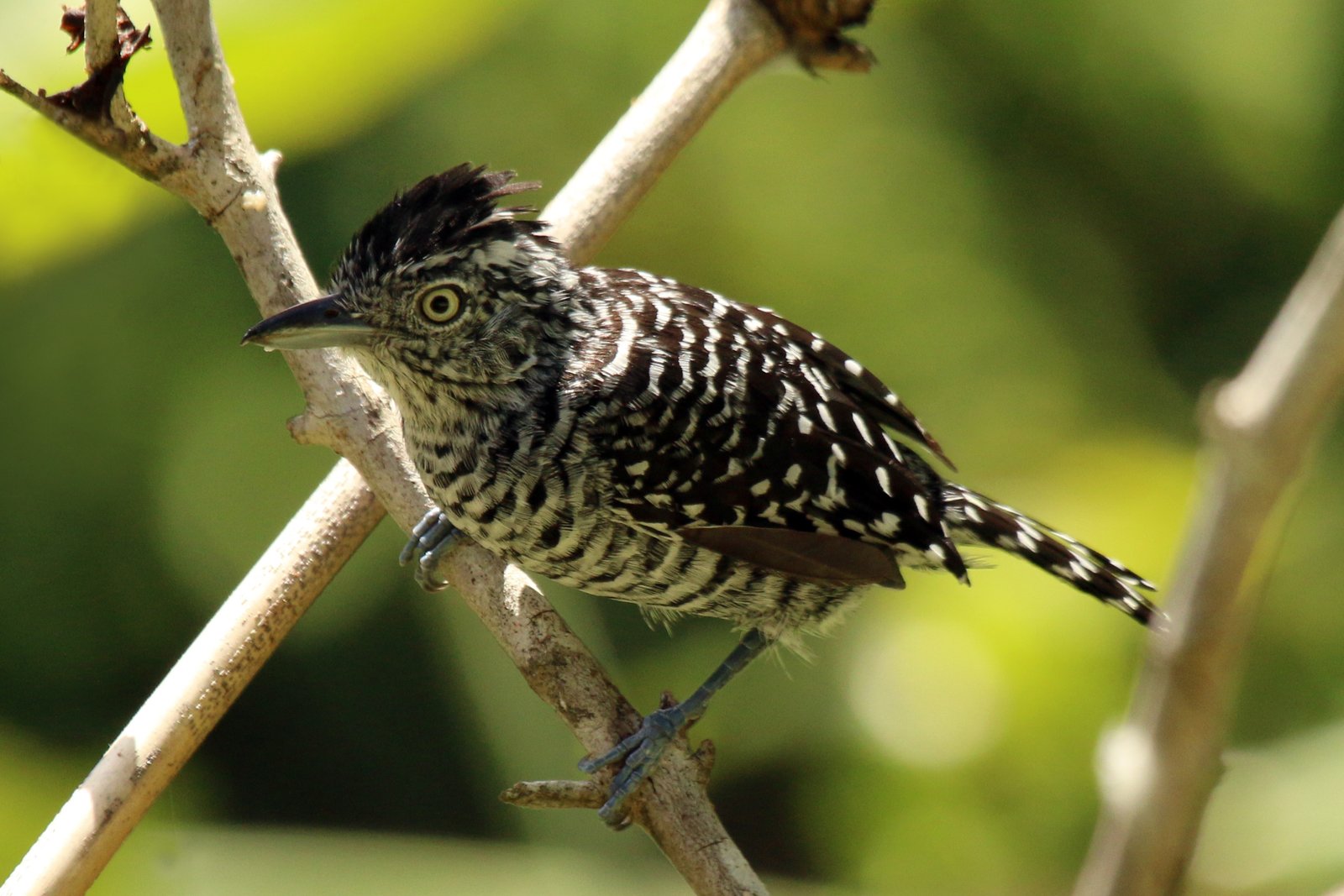
The Barred Antshrike is one of the most widespread antshrikes of the Neotropics, from Mexico to Argentina. The male is finely barred black and white from head to tail, the female cinnamon-rufous. It lives in scrub, forest edges and secondary growth and avoids the closed interior of the forest.
Voice
The song is an accelerating series of nasal, laughing notes ending in an emphatic, higher note: ha-ha-ha-hahahaha-ánk. Also growling and cawing calls.
Recording: JAYRSON ARAUJO DE OLIVEIRA — CC BY-NC-SA 4.0 · xeno-canto
Identification
15–16 cm, with a crest, a fairly heavy, hooked bill and a pale eye. The male is narrowly barred black and white throughout, with a black crest with concealed white bases. The female has rufous to cinnamon upperparts and crest, a black-and-white streaked face and neck and buff underparts. Juveniles resemble the female.
Confusion species
Chapman's Antshrike Thamnophilus zarumae of western Ecuador and Peru has a black crown, less barring on the belly and buff flanks and vent. Bar-crested Antshrike Thamnophilus multistriatus in the Andes of Colombia has a barred crest in the male and black-and-white barred underparts in the female. Black-crested Antshrike Sakesphorus canadensis has a black head and breast (male) and an unbarred back.
Habitat
Scrub, forest edges, overgrown fields, secondary growth, gallery forest, river islands and dry woodland; from sea level to about 1500 m, higher in the valleys of Colombia. It searches low in dense vegetation for insects. The nest is a deep cup, low in a shrub.
Where the bird is most at home, classified by the vegetation units of the Andes and the west coast.


Range and movements
Colombia: widespread in the Caribbean lowlands, the Magdalena and Cauca valleys, the llanos and along rivers in Amazonia. Ecuador: locally in the eastern lowlands, mainly on river islands along the Napo. Peru: in the Amazonian lowlands, mainly on river islands and in young riverine growth, and in some dry valleys of the eastern slope. Bolivia: widespread in the lowlands of the north and east, into the Chaco. Absent from western Ecuador and Peru, where Chapman's Antshrike replaces it, and from the Galápagos. Outside the guide area from Mexico through Central America to Venezuela, the Guianas, Brazil, Paraguay and northern Argentina.
- Resident
- dark = core range, pale = thinly spread
How and when to look
Listen in scrub and forest edges for the laughing series with its emphatic ending; the birds stay low in cover but often answer each other and then briefly come to the edge.
Conservation status
Least Concern. Common and benefits from deforestation and secondary growth.
Scientific name
Thamnophilus doliatus | (Linnaeus, 1764)
Linnaeus described the species in 1764 as Lanius doliatus; because it was later moved to another genus, the author and year stand in brackets. The genus Thamnophilus was introduced in 1816 by Vieillot. The genus name comes from Greek thamnos, 'bush', and philos, 'loving': bush-lover. The species name comes from New Latin doliatus, 'barred'. The specimen the first description was based on came from Suriname.