All species › Passerines › Antbirds › Rufous-capped Antshrike
Rufous-capped Antshrike | Thamnophilus ruficapillus
Roodkapmierklauwier | Batará pardo | Choca-de-chapéu-vermelho
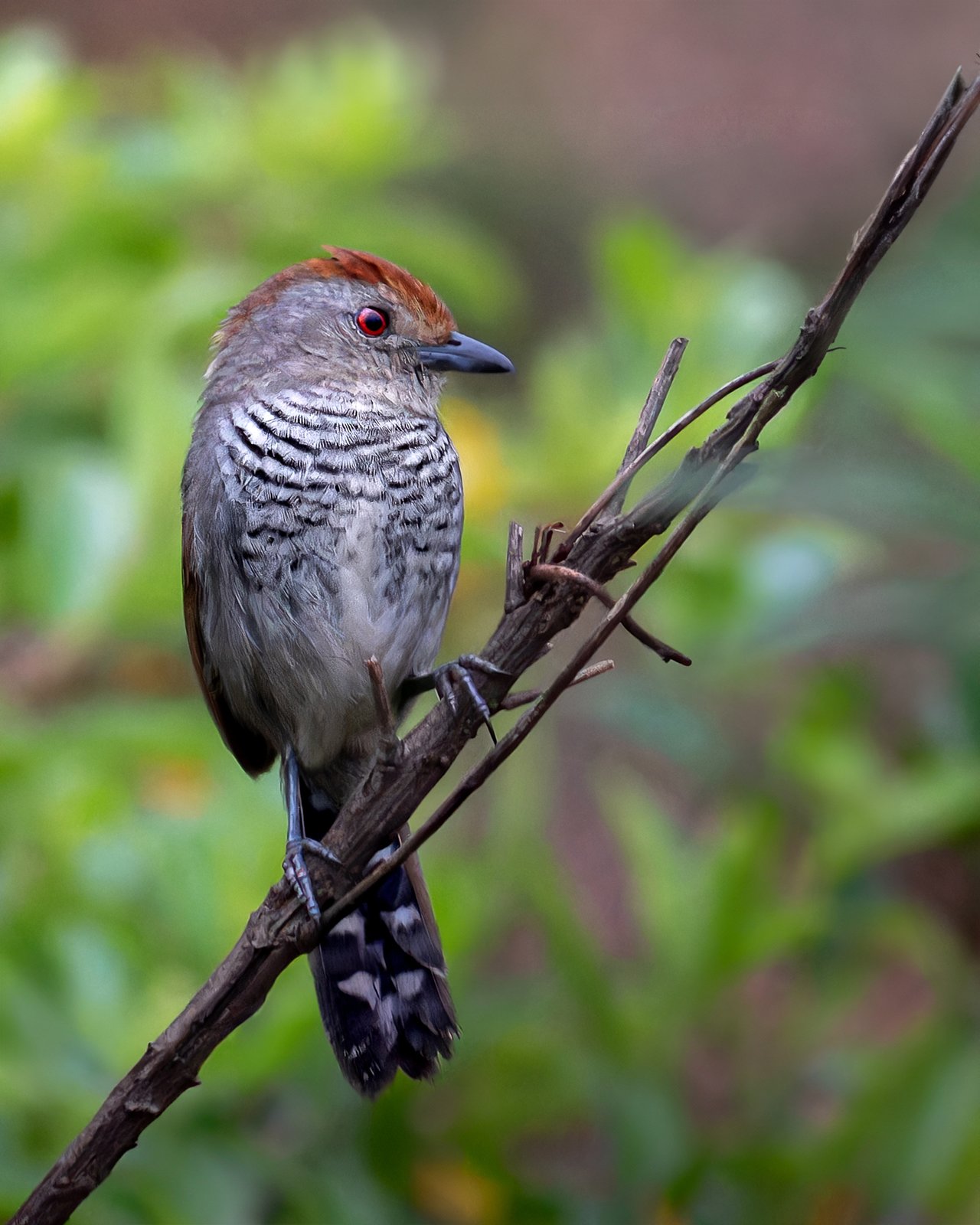
The Rufous-capped Antshrike is an antshrike with a rufous crown and, in the male, finely barred underparts. In the guide area it lives in scrub and forest edges on the eastern slope of the Andes and in dry valleys in Peru and Bolivia. A second, separate population lives in south-eastern South America.
Voice
The song is a series of nasal notes that accelerates and ends in a slightly lower, growling note, as in related antshrikes. Also short, plaintive calls.
Recording: Kauê Werner — CC BY-NC-SA 4.0 · xeno-canto
Identification
16 cm. Both sexes have a rufous crown and olive-brown upperparts with rufous-tinged wings. The male has a blackish tail with white bars and whitish underparts with fine black barring, mainly on the breast and flanks. The female is ochre to tawny below, with little or no barring.
Confusion species
The male Variable Antshrike Thamnophilus caerulescens is grey with a blacker crown and lacks the barring below; the female has a less rufous crown. Barred Antshrike Thamnophilus doliatus lives lower; the male is also barred on the back and the female is cinnamon with a streaked face. Rufous-winged Antshrike Thamnophilus torquatus in the cerrado of Bolivia has a black crown in the male and more strongly rufous wings.
Habitat
Scrub, forest edges, shrubby clearings, dry and humid montane forest and degraded slopes on the eastern slope of the Andes and in dry valleys, roughly between 1000 and 3000 m. It searches low to mid-level in dense vegetation for insects. The nest is a small cup in the fork of a shrub.
Where the bird is most at home, classified by the vegetation units of the Andes and the west coast.


Range and movements
Peru: on the eastern slope of the Andes and in the dry valleys, from the Marañón region in the north to Cusco and Puno. Bolivia: in the Yungas and the dry valleys of La Paz, Cochabamba, Santa Cruz, Chuquisaca and Tarija. Absent from Colombia, Ecuador and the Galápagos. Outside the guide area in north-western Argentina and, as a separate population, in south-eastern Brazil, Paraguay, Uruguay and north-eastern Argentina.
- Resident
- dark = core range, pale = thinly spread
How and when to look
Search shrubby slopes and forest edges in the valleys of the eastern slope; pairs move low through dense growth and give themselves away by their song.
Conservation status
Not Evaluated in its current circumscription. The species lives mainly in edges and scrub and tolerates small-scale disturbance.
Scientific name
Thamnophilus ruficapillus | Vieillot, 1816
Vieillot described the species in 1816 and placed it straight away in the genus where it still stands. He introduced the genus Thamnophilus in that same work. The genus name comes from Greek thamnos, 'bush', and philos, 'loving': bush-lover. The species name comes from Latin rufus, 'red', and capillus, 'hair of the head': red-capped. The specimen the first description was based on came from Corrientes, Argentina.