All species › Passerines › Tyrant flycatchers and allies › Marble-faced Bristle Tyrant
Marble-faced Bristle Tyrant | Pogonotriccus ophthalmicus
Marmerwanglooftiran | Orejerito carijaspeado | Barbudinho-de-face-marmorizada
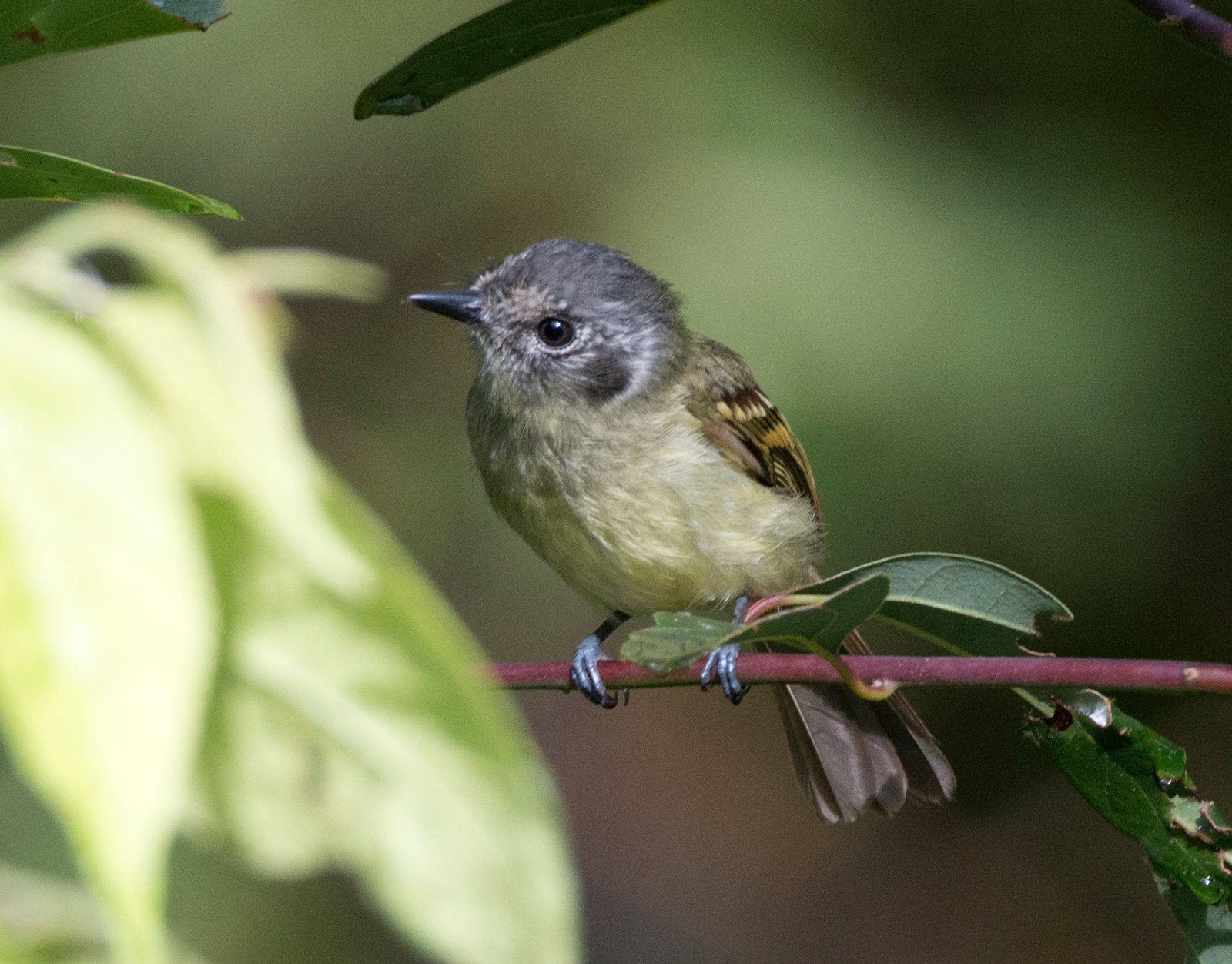
The Marble-faced Bristle Tyrant is a small, upright-perching tyrant flycatcher of Andean montane forest, named after its grey-and-white marbled face with a black crescent on the ear-coverts. It is a regular member of mixed flocks and, like its relatives, repeatedly lifts one wing. The genus Pogonotriccus was long included in Phylloscartes.
Voice
A sharp, high tsip and a short, lively trill, often followed by a few lower notes.
Recording: Sue Riffe — CC BY-NC-SA 4.0 · xeno-canto
Identification
11 cm, with a short, narrow bill and a fairly long tail. The crown is grey, the back olive-green. The face is marbled grey and white, with a black crescent on the ear-coverts. The wings are dark, with two distinct yellow wing-bars. The throat is greyish, the breast mottled olive, the belly yellow. The sexes are alike.
Confusion species
Variegated Bristle Tyrant Pogonotriccus poecilotis has cinnamon wing-bars and cinnamon lores and usually lives slightly higher. Spectacled Bristle Tyrant Pogonotriccus orbitalis has a distinct pale eye-ring and a less marbled face, and lives lower on the east slope. Antioquia Bristle Tyrant Pogonotriccus lanyoni occurs only at lower elevations in Colombia and has a less marbled face. Inca Flycatcher Leptopogon taczanowskii and its relatives are larger, with buffy or yellowish wing-bars.
Habitat
The middle storey and lower canopy of humid montane forest and cloud forest, also forest edges, roughly between 1000 and 2400 m. It perches upright on an open branch and makes short sallies to pick insects from leaves; it almost always joins mixed flocks.
Where the bird is most at home, classified by the vegetation units of the Andes and the west coast.


Range and movements
Colombia: in all three Andean ranges and the Serranía de Perijá. Ecuador: on both slopes of the Andes. Peru: on the east slope along the whole length of the country. Bolivia: in the Yungas of La Paz, Cochabamba and western Santa Cruz. Absent from the Galápagos. Outside the guide area in northern and western Venezuela.
- Resident
- dark = core range, pale = thinly spread
How and when to look
Follow mixed flocks in cloud forest at middle elevations; watch for a small, upright-perched flycatcher that lifts one wing and shows a black cheek mark.
Conservation status
Least Concern. The species is widespread in Andean montane forest.
Scientific name
Pogonotriccus ophthalmicus | Taczanowski, 1874 (GBIF: Phylloscartes ophthalmicus)
Taczanowski described the species in 1874 and placed it straight away in the genus where it still stands. The genus Pogonotriccus was introduced in 1860 by Cabanis & Heine. The genus name comes from Greek pōgōn, 'beard', and trikkos, a small unidentified bird, used in ornithology for tyrant flycatchers. The species name comes from Greek ophthalmikos, 'of the eye', for the markings around the eye. The specimen the first description was based on came from Amable María, Chanchamayo, Junín, Peru.