All species › Passerines › Tyrant flycatchers and allies › Antioquia Bristle Tyrant
Antioquia Bristle Tyrant | Pogonotriccus lanyoni
Antioquialooftiran | Tiranuelo antioqueño | Barbudinho-de-antioquia
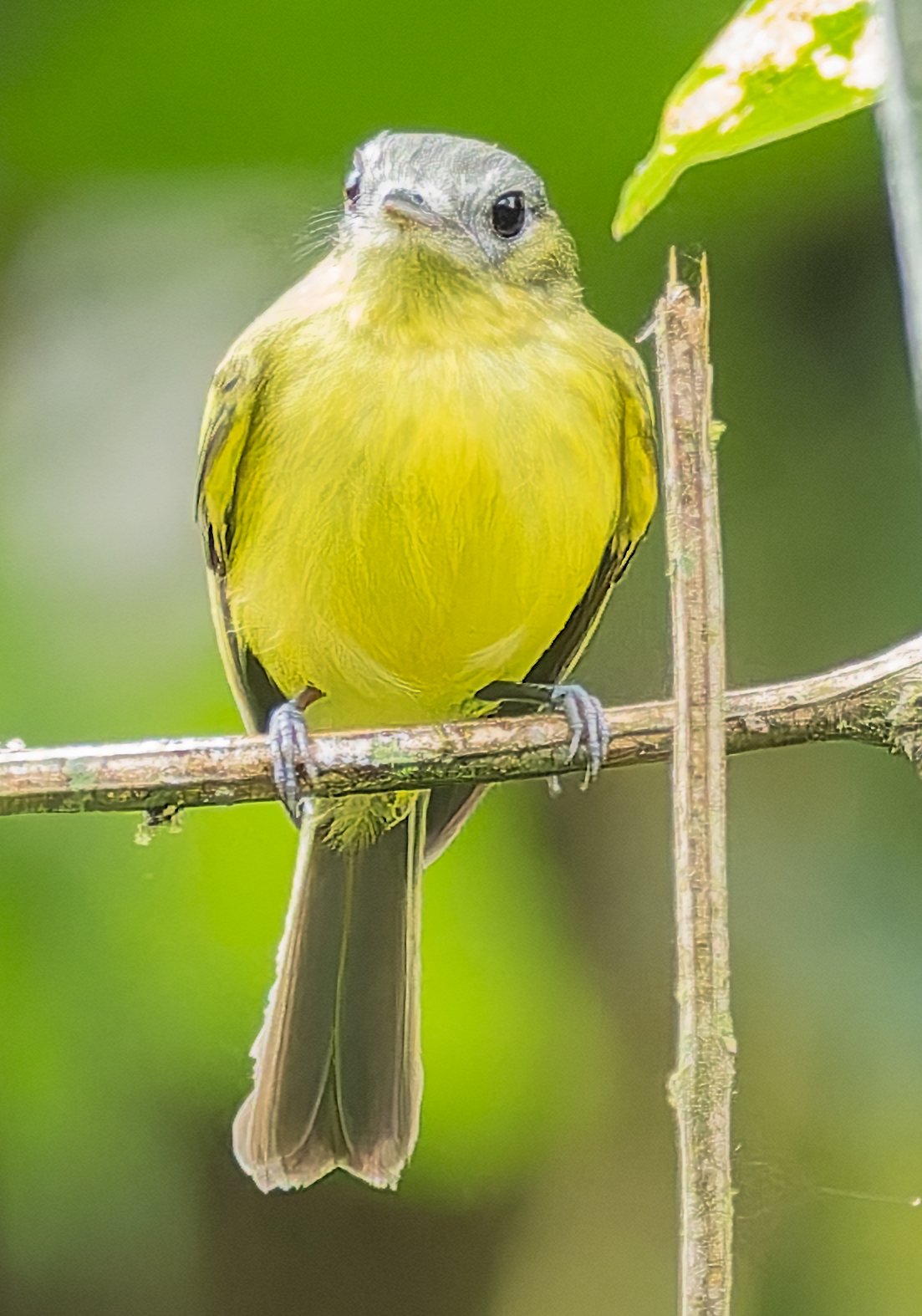
The Antioquia Bristle Tyrant is a small tyrant flycatcher found only in Colombia, on the lower slopes on both sides of the middle Magdalena valley. It was described only in 1988 and is named after the department of Antioquia. Its habitat, humid forest at low elevations, has largely been cleared.
Voice
A short series of sharp, high notes and a rapid, rising trill.
Recording: Ross Gallardy — CC BY-NC-SA 4.0 · xeno-canto
Identification
11 cm, with a short, narrow bill and a fairly long tail. The upperparts are olive-green, the crown slightly greyer. The face is greyish olive with a faint dark mark on the ear-coverts. The wings are dark, with two yellow wing-bars. The throat is pale grey, the breast olive, the belly yellow. The sexes are alike.
Confusion species
Marble-faced Bristle Tyrant Pogonotriccus ophthalmicus has a more strongly grey-and-white marbled face with a sharper black ear crescent and lives higher in montane forest. Variegated Bristle Tyrant Pogonotriccus poecilotis has cinnamon wing-bars and also lives higher. Tyrannulets such as Golden-faced Tyrannulet Zimmerius chrysops have a shorter tail, a yellowish face and yellow wing edgings without distinct wing-bars.
Habitat
The middle storey and lower canopy of humid forest at low elevations and in the foothills, also forest edges and old secondary forest, roughly between 450 and 1200 m. It perches upright, repeatedly lifts one wing and makes short sallies to pick insects from leaves; often in mixed flocks.
Where the bird is most at home, classified by the vegetation units of the Andes and the west coast.


Range and movements
Colombia: endemic, on the slopes on both sides of the middle Magdalena valley, mainly in eastern Antioquia and eastern Caldas, with a few reports from adjacent departments. Absent from Ecuador, Peru, Bolivia and the Galápagos. Does not occur outside the guide area.
- Resident
- dark = core range, pale = thinly spread
How and when to look
Search the remaining forest fragments along streams in eastern Antioquia, such as around Río Claro, and follow mixed flocks in the middle storey there.
Conservation status
Vulnerable. Its small range lies in a region where lowland forest has largely been converted to pasture and plantations; there the species is restricted to forest fragments.
Scientific name
Pogonotriccus lanyoni | (Graves, 1988) (GBIF: Phylloscartes lanyoni)
Graves described the species in 1988 as Phylloscartes lanyoni; because it was later moved to another genus, the author and year stand in brackets. The genus Pogonotriccus was introduced in 1860 by Cabanis & Heine. The genus name comes from Greek pōgōn, 'beard', and trikkos, a small unidentified bird, used in ornithology for tyrant flycatchers. The species name honours the American ornithologist Wesley E. Lanyon (1926–2017), for his research on tyrant flycatchers. The specimen the first description was based on came from El Pescado, near Puerto Valdivia, Antioquia, Colombia.