All species › Passerines › Tyrant flycatchers and allies › Variegated Bristle Tyrant
Variegated Bristle Tyrant | Pogonotriccus poecilotis
Bonte looftiran | Orejerito variegado | Barbudinho-variegado
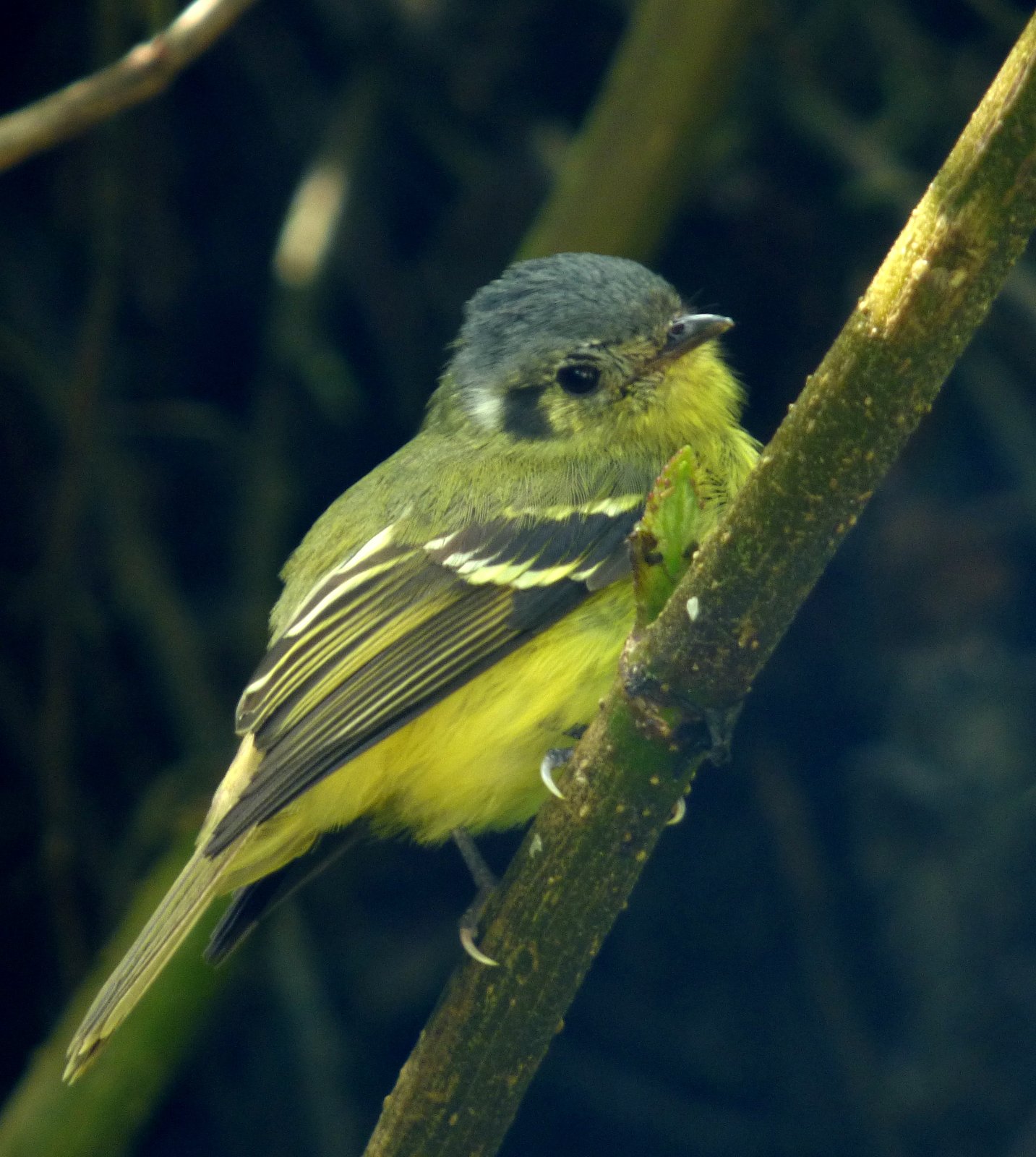
The Variegated Bristle Tyrant is a small, upright-perching tyrant flycatcher of cloud forest in the northern and central Andes, with a grey crown, a patterned face and cinnamon wing-bars. It forages in mixed flocks and, like its relatives, repeatedly lifts one wing. On average it lives slightly higher than the Marble-faced Bristle Tyrant.
Voice
A high, sharp tsip and a short, dry trill.
Recording: Mitch Lysinger — CC BY-NC-SA 4.0 · xeno-canto
Identification
11 cm, with a short, narrow bill and a fairly long tail. The crown is grey, the back olive-green. The face is spotted white and grey, with cinnamon lores, a narrow pale eye-ring and a black crescent on the ear-coverts. The wings are dark, with two distinct cinnamon wing-bars. The throat is greyish white, the breast olive, the belly yellow. The sexes are alike.
Confusion species
Marble-faced Bristle Tyrant Pogonotriccus ophthalmicus has yellow wing-bars and no cinnamon on the face. Inca Flycatcher Leptopogon taczanowskii also has buffy wing-bars, but is larger, with a longer bill and a more uniform olive-grey breast. Rufous-browed Tyrannulet Phylloscartes superciliaris has a white throat, a rufous eyebrow and no cinnamon wing-bars.
Habitat
The middle storey and lower canopy of humid montane forest and cloud forest, also forest edges, roughly between 1300 and 2400 m. It perches upright and makes short sallies to pick insects from leaves; almost always in mixed flocks.
Where the bird is most at home, classified by the vegetation units of the Andes and the west coast.


Range and movements
Colombia: in all three Andean ranges. Ecuador: mainly on the east slope, on the west slope only in the far north. Peru: on the east slope from Cajamarca and Amazonas through San Martín, Huánuco, Pasco and Junín to Cusco, with a single report from Puno. Absent from Bolivia and the Galápagos. Outside the guide area in western Venezuela.
- Resident
- dark = core range, pale = thinly spread
How and when to look
Follow mixed flocks in cloud forest along roads on the east slope, for example in Napo in Ecuador or in San Martín and Cusco in Peru; watch for the cinnamon wing-bars.
Conservation status
Least Concern. The species is fairly widespread, but depends on montane forest, which is being cleared locally.
Scientific name
Pogonotriccus poecilotis | (Sclater, 1862) (GBIF: Phylloscartes poecilotis)
Sclater described the species in 1862 as Leptopogon poecilotis; because it was later moved to another genus, the author and year stand in brackets. The genus Pogonotriccus was introduced in 1860 by Cabanis & Heine. The genus name comes from Greek pōgōn, 'beard', and trikkos, a small unidentified bird, used in ornithology for tyrant flycatchers. The species name comes from Greek poikilos, 'variegated', and ous, 'ear', for the patterned ear-coverts. The specimen the first description was based on came from Bogotá, Colombia (trade skin).