All species › Passerines › Tyrant flycatchers and allies › Maroon-belted Chat-Tyrant
Maroon-belted Chat-Tyrant | Ochthoeca thoracica
Kastanjebandtapuittiran | Pitajo pechicastaño | Chasco-tirano-de-cinta-castanha
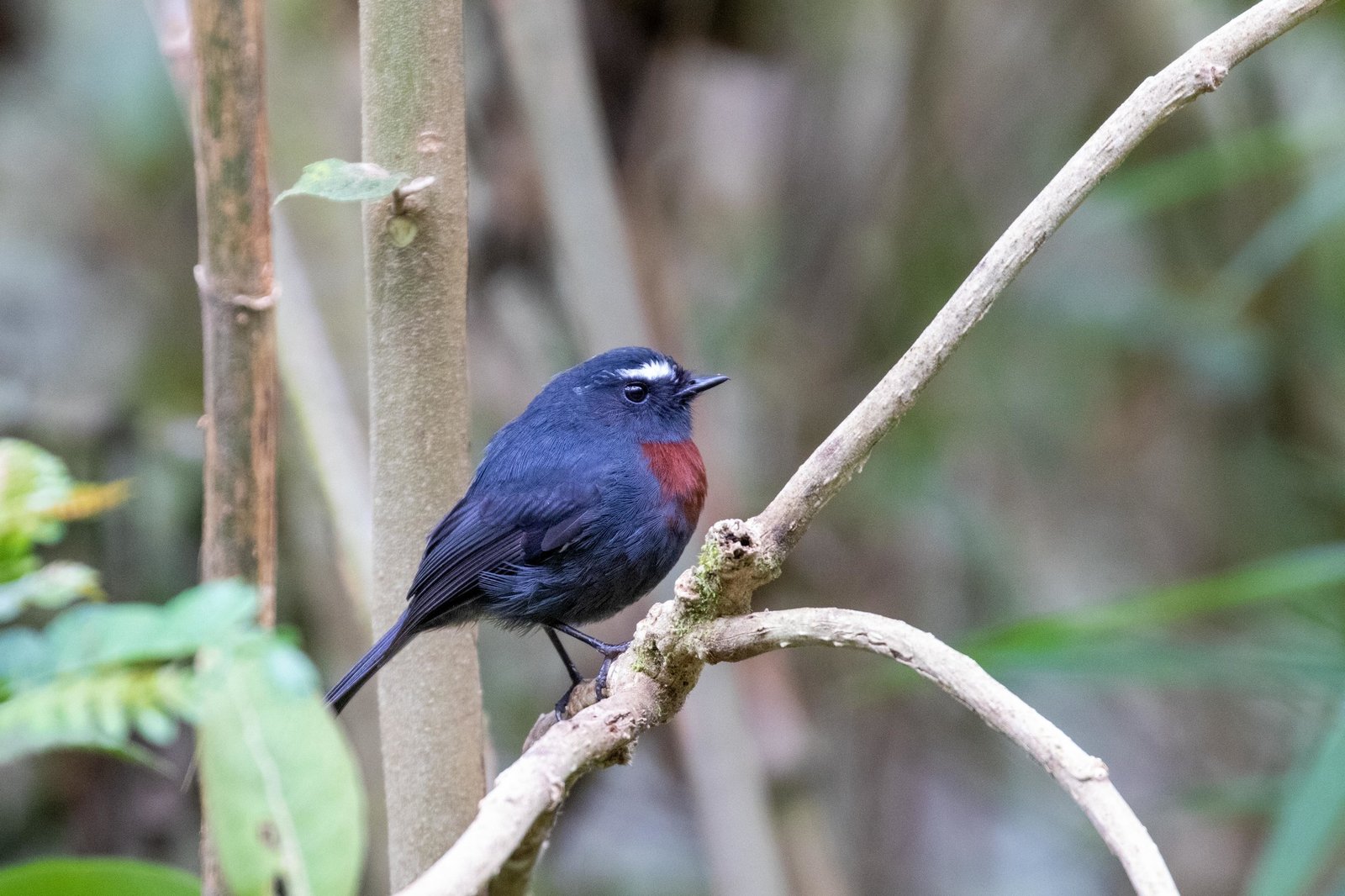
The Maroon-belted Chat-Tyrant is a small, dark chat-tyrant of mountain streams and humid ravines in the cloud forest of Peru and Bolivia. It perches low on a branch or rock above running water and makes short sallies after insects. It was formerly included in Slaty-backed Chat-Tyrant, but has a dark maroon breast band instead of an entirely rufous belly.
Voice
A high, thin, descending whistle, roughly tseeeeu, repeated at intervals and audible over the noise of the water; also short, sharp tsip calls.
Recording: Jacob Wijpkema — CC BY-NC-SA 4.0 · xeno-canto
Identification
13 cm, with an upright posture, a short black bill and a fairly long tail. The head, upperparts, wings and tail are dark slate-grey to blackish, with a short white supercilium above the eye. A broad, dark maroon band crosses the breast; the throat and belly are slate-grey. Distinct wing bars are lacking. The sexes are alike; young birds are duller and browner.
Confusion species
Slaty-backed Chat-Tyrant Ochthoeca cinnamomeiventris, north of this species' range in Ecuador and Colombia, has an entirely chestnut belly. Rufous-breasted Chat-Tyrant Ochthoeca rufipectoralis has a brown back, a long white supercilium reaching the nape, a paler orange-rufous breast band and a rufous wing bar, and is not tied to water. Torrent Tyrannulet Serpophaga cinerea, also along running water, is smaller, pale grey and white, without a breast band.
Habitat
Streams, waterfalls and humid ravines in cloud forest and upper montane forest on the eastern slope of the Andes, mostly between 1700 and 3000 m. It perches low and upright on a branch, root or rock close to the water, sallies briefly after flying insects and returns to a perch. It lives alone or in pairs. The nest is a moss cup in a niche in a rock face or bank.
Where the bird is most at home, classified by the vegetation units of the Andes and the west coast.


Range and movements
Peru: on the eastern slope of the Andes, from the north (Amazonas and San Martín) south to Puno. Bolivia: in the Yungas of La Paz and Cochabamba. Absent from Colombia, Ecuador and the Galápagos. The entire range lies within the guide area.
- Resident
- dark = core range, pale = thinly spread
How and when to look
Follow a stream or mountain road through cloud forest at 2000–3000 m and watch branches and rocks just above the water; the bird often perches low in the shade under overhanging vegetation. Listen for the high whistle over the sound of the stream.
Conservation status
Least Concern. The species is locally fairly common in montane forest along streams; clearing of stream valleys reduces its habitat locally.
Scientific name
Ochthoeca thoracica | Taczanowski, 1874
Taczanowski described the species in 1874 and placed it straight away in the genus where it still stands. The genus Ochthoeca was introduced in 1847 by Cabanis. The genus name combines Greek okhthos, 'bank' or 'mound', with oikos, 'dwelling'. Latin thoracicus, 'of the chest', for the maroon breast band. The specimen the first description was based on came from Chilpes, Peru.