All species › Passerines › Tyrant flycatchers and allies › Rufous-breasted Chat-Tyrant
Rufous-breasted Chat-Tyrant | Ochthoeca rufipectoralis
Roodborsttapuittiran | Pitajo pechirrufo | Chasco-tirano-de-peito-ruivo
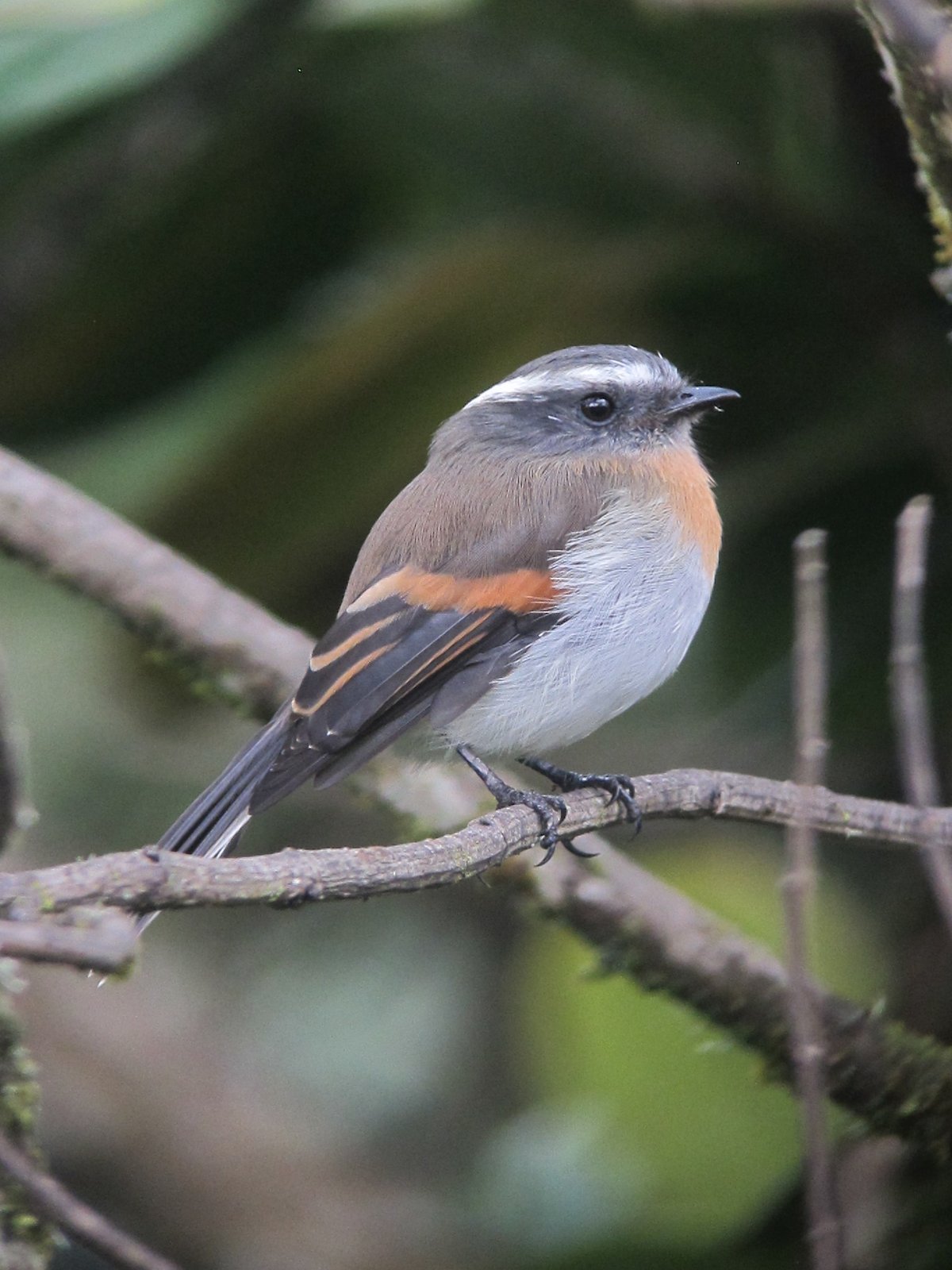
The Rufous-breasted Chat-Tyrant is a small tyrant flycatcher of the upper forest belt throughout the Andes of the guide area. It perches upright and often in the open on a branch at the forest edge and is recognised by its long white supercilium and orange-rufous breast band. It regularly joins mixed flocks of the highlands.
Voice
A dry, rattling series and short, sharp calls, often repeated from a perch at the forest edge; pairs sometimes call in quick succession.
Recording: Jacob Wijpkema — CC BY-NC-SA 4.0 · xeno-canto
Identification
12–13 cm, compact, with a small black bill. The crown and sides of the head are dark grey, with a long, broad white supercilium that reaches the nape. The back is brown to olive-brown, and the wings are blackish with a rufous wing bar. The throat is grey, a broad orange-rufous band crosses the breast, and the belly is pale grey to whitish. The sexes are alike.
Confusion species
Maroon-belted Chat-Tyrant Ochthoeca thoracica is dark slate-grey above, has a short supercilium and a dark maroon breast band, and lives along streams. Brown-backed Chat-Tyrant Ochthoeca fumicolor is larger and has entirely cinnamon underparts and two wing bars. Cinnamon Flycatcher Pyrrhomyias cinnamomeus is entirely cinnamon-rufous below and lacks a white supercilium. Crowned Chat-Tyrant Silvicultrix frontalis has a pale forehead band and uniform grey underparts without a breast band.
Habitat
Edges and clearings of cloud forest and upper montane forest, Polylepis groves, bamboo and scrub up to the treeline, mostly between 2400 and 3700 m. It perches on an open branch in the middle or lower storey, sallies after flying insects or picks them from leaves; it lives in pairs and joins mixed flocks. The nest is a cup of moss and fibres in a niche or among epiphytes.
Where the bird is most at home, classified by the vegetation units of the Andes and the west coast.


Range and movements
Colombia: in all three Andean ranges and the Sierra Nevada de Santa Marta. Ecuador: on both slopes of the Andes. Peru: along the whole eastern slope and locally on the western side in the north. Bolivia: in the Yungas of La Paz and Cochabamba. Absent from the Galápagos. Outside the guide area in the Serranía de Perijá in Venezuela.
- Resident
- dark = core range, pale = thinly spread
How and when to look
Search along mountain roads and trails through the upper forest belt for birds perching upright on a bare branch at the forest edge. In mixed flocks of the highlands it is often one of the regular members.
Conservation status
Least Concern. The species is widespread and fairly common and tolerates forest edges and small forest remnants.
Scientific name
Ochthoeca rufipectoralis | (d'Orbigny, ACVMD & de Lafresnaye, 1837)
D'Orbigny, ACVMD & de Lafresnaye described the species in 1837 as F[luvicola] rufi-pectoralis; because it was later moved to another genus, the author and year stand in brackets. The genus Ochthoeca was introduced in 1847 by Cabanis. The genus name combines Greek okhthos, 'bank' or 'mound', with oikos, 'dwelling'. Latin rufus, 'rufous', and pectoralis, 'of the breast', for the rufous breast. The specimen the first description was based on came from Ayopaya, Cochabamba, Bolivia.