All species › Passerines › Tyrant flycatchers and allies › Brown-backed Chat-Tyrant
Brown-backed Chat-Tyrant | Ochthoeca fumicolor
Bruinrugtapuittiran | Pitajo dorsipardo | Chasco-tirano-de-dorso-pardo
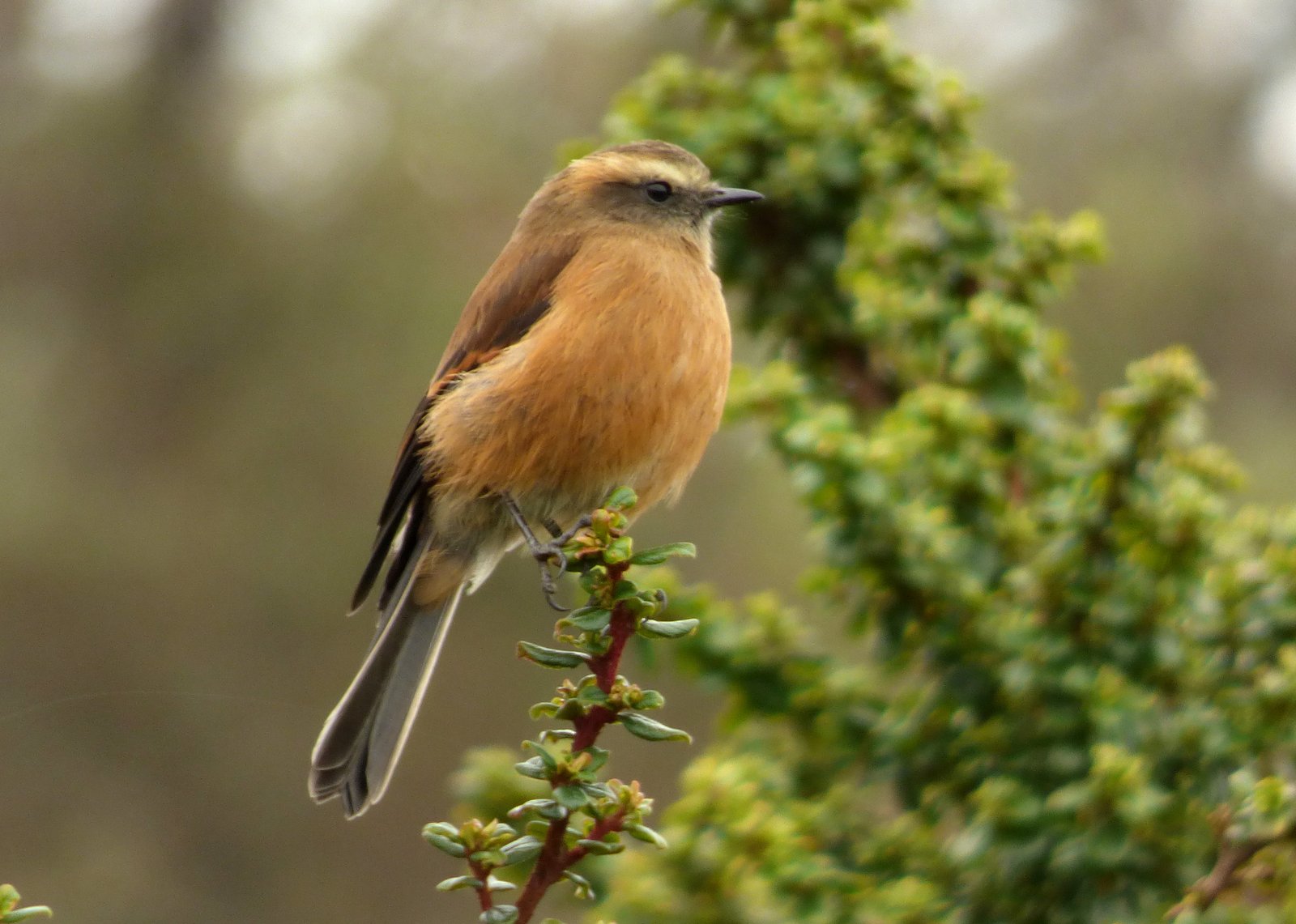
The Brown-backed Chat-Tyrant is a chat-tyrant of the treeline, páramo scrub and the upper forest edges. It is larger and warmer-coloured than most of its relatives, with a long pale supercilium and rufous underparts. It often perches in the open on top of a shrub in the transition between forest and grassland.
Voice
A high, descending whistle, roughly tsiew, and short, sharp calls; in the early morning a repeated, whistled song from a high perch.
Recording: Juan Freile — CC BY-NC-SA 4.0 · xeno-canto
Identification
14–15 cm, with an upright posture and a fairly long tail. The upperparts are warm brown, the crown slightly darker. A long, broad supercilium is white to buff. The wings are blackish with two broad rufous wing bars. The throat and breast are greyish brown, the rest of the underparts cinnamon to rufous. The tail is blackish. The sexes are alike.
Confusion species
D'Orbigny's Chat-Tyrant Ochthoeca oenanthoides is greyer brown, has a white supercilium and only a cinnamon lower belly, and lives in drier, more open terrain. Rufous-breasted Chat-Tyrant Ochthoeca rufipectoralis is smaller, with a grey head, an orange-rufous breast band and a pale belly. Streak-throated Bush Tyrant Myiotheretes striaticollis is much larger, with a streaked throat and much rufous in the wings in flight.
Habitat
Scrub and edges of elfin forest at the treeline, shrubby páramo and jalca, Polylepis groves and hedges along fields, mostly between 2800 and 4100 m. It perches in the open on shrubs, rocks or fence posts and sallies after insects in the air or on the ground; it lives alone or in pairs. The nest is a cup of moss and plant material in a niche in a bank or in dense vegetation.
Where the bird is most at home, classified by the vegetation units of the Andes and the west coast.


Range and movements
Colombia: in all three Andean ranges. Ecuador: in the highlands along both slopes. Peru: along the Andes from north to south, mainly on the east side, south to Puno. Bolivia: in the highlands of La Paz and Cochabamba. Absent from the Galápagos. Outside the guide area in western Venezuela.
- Resident
- dark = core range, pale = thinly spread
How and when to look
Go up to the treeline and search along the edge of the elfin forest and the shrubby páramo for birds perching in the open on top of a shrub. They often use the same perches and fly up briefly after insects.
Conservation status
Least Concern. The species is widespread and common, but locally loses habitat to fires and the clearing of scrub at the treeline.
Scientific name
Ochthoeca fumicolor | Sclater, 1856
Sclater described the species in 1856 and placed it straight away in the genus where it still stands. The genus Ochthoeca was introduced in 1847 by Cabanis. The genus name combines Greek okhthos, 'bank' or 'mound', with oikos, 'dwelling'. Latin fumus, 'smoke', and color, 'colour': smoke-coloured, for the greyish-brown back. The specimen the first description was based on came from Bogotá, Colombia.