All species › Passerines › Tyrant flycatchers and allies › D'Orbigny's Chat-Tyrant
D'Orbigny's Chat-Tyrant | Ochthoeca oenanthoides
D'Orbigny's tapuittiran | Pitajo de d'Orbigny | Chasco-tirano-de-d'orbigny
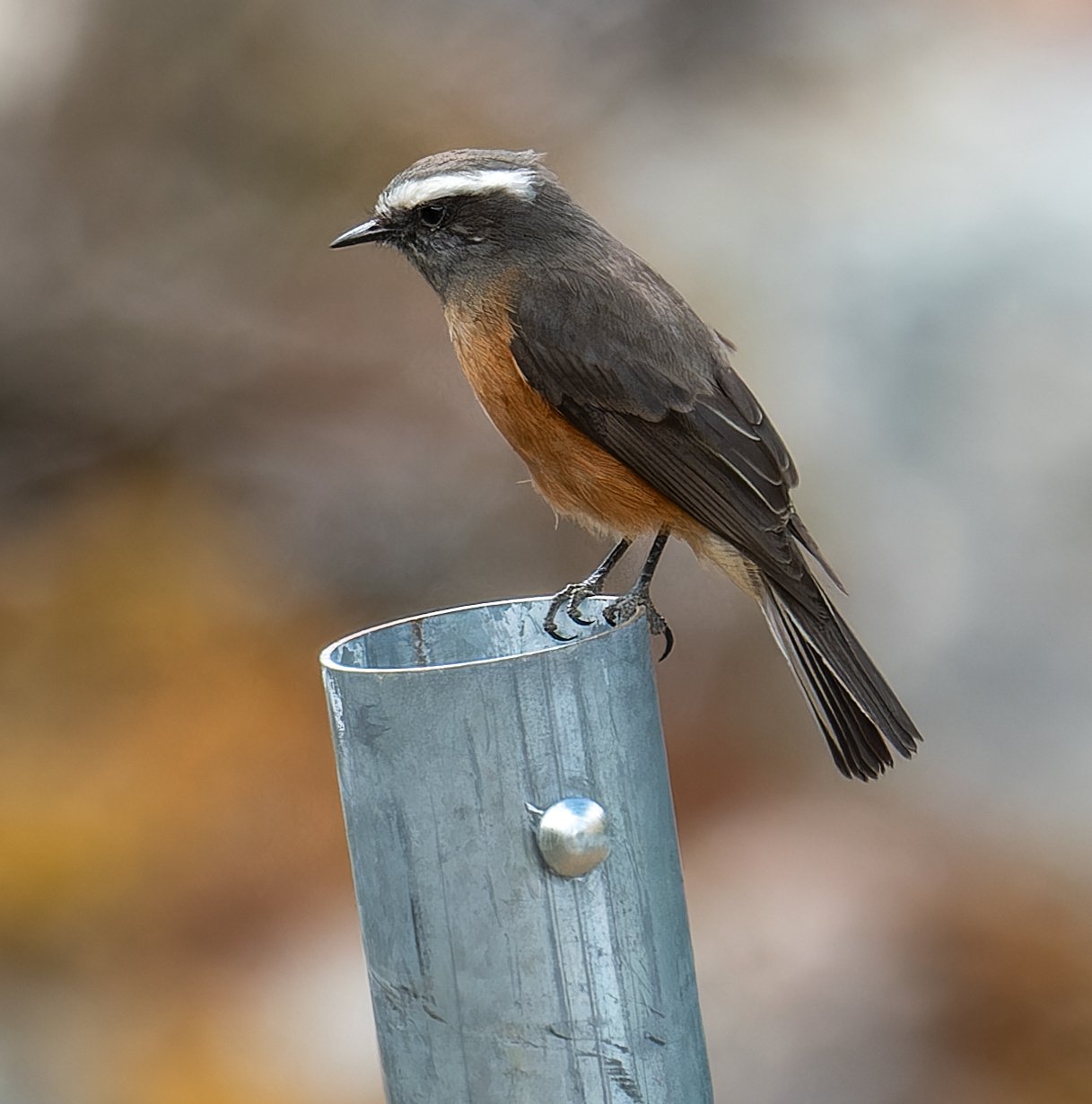
D'Orbigny's Chat-Tyrant is a chat-tyrant of dry scrub, Polylepis woodland and rocky slopes in the highlands of Peru and Bolivia. It is greyer brown and less rufous than Brown-backed Chat-Tyrant and lives higher and in drier, more open terrain. The name honours the French naturalist Alcide d'Orbigny.
Voice
A high, thin whistle and a rapid, descending series of whistled notes; also short tsip calls.
Recording: Jacob Wijpkema — CC BY-NC-SA 4.0 · xeno-canto
Identification
15–16 cm, with an upright posture. The upperparts are greyish brown, with a long white supercilium. The wings are dark with rufous wing bars. The throat and breast are greyish, the belly cinnamon to buff, strongest towards the undertail coverts. The tail is blackish. The sexes are alike.
Confusion species
Brown-backed Chat-Tyrant Ochthoeca fumicolor is warmer brown, with entirely cinnamon to rufous underparts, and lives mainly at the more humid treeline. White-browed Chat-Tyrant Ochthoeca leucophrys is greyer, with a white belly lacking cinnamon, and usually lives lower. Ground tyrants such as Puna Ground Tyrant Muscisaxicola juninensis walk on the ground, have longer legs and a black tail with white outer edges.
Habitat
Polylepis woodland, dry scrub, rocky slopes with scattered shrubs and the edges of fields in the highlands, mostly between 3200 and 4600 m. It perches on shrubs, rocks or stone walls and sallies after insects in the air or on the ground. The nest is a cup in a niche in a rock or wall, or under an overhanging bank.
Where the bird is most at home, classified by the vegetation units of the Andes and the west coast.


Range and movements
Peru: in the Andes from the north south to Puno, also on the western slope in the south. Bolivia: in the highlands from La Paz to Potosí and Tarija. Absent from Colombia, Ecuador and the Galápagos. Outside the guide area in northern Chile and north-western Argentina.
- Resident
- dark = core range, pale = thinly spread
How and when to look
Search Polylepis groves and shrubby rocky slopes above 3500 m, for example in the Cordillera Blanca, for birds perching in the open on a rock or shrub.
Conservation status
Least Concern. Its habitat, especially Polylepis woodland, is shrinking locally through cutting, fires and grazing.
Scientific name
Ochthoeca oenanthoides | (d'Orbigny, ACVMD & de Lafresnaye, 1837)
D'Orbigny, ACVMD & de Lafresnaye described the species in 1837 as F[luvicola] OEnanthoides; because it was later moved to another genus, the author and year stand in brackets. The genus Ochthoeca was introduced in 1847 by Cabanis. The genus name combines Greek okhthos, 'bank' or 'mound', with oikos, 'dwelling'. From the genus Oenanthe (wheatears) with Greek -oidēs, 'resembling': wheatear-like. The specimen the first description was based on came from La Paz, Bolivia.