All species › Passerines › Tyrant flycatchers and allies › Piura Chat-Tyrant
Piura Chat-Tyrant | Ochthoeca piurae
Piuratapuittiran | Pitajo de Piura | Chasco-tirano-de-piura
The Piura Chat-Tyrant is the smallest chat-tyrant of the guide area and occurs only on the western slope of the Andes in northern and central Peru. It lives in dry montane scrub and shrubby ravines. Its range is small and fragmented.
Voice
A short, high, descending whistle and a rapid, thin series of notes; also sharp tsip calls.
Recording: Andrew Spencer — CC BY-NC-SA 4.0 · xeno-canto
Identification
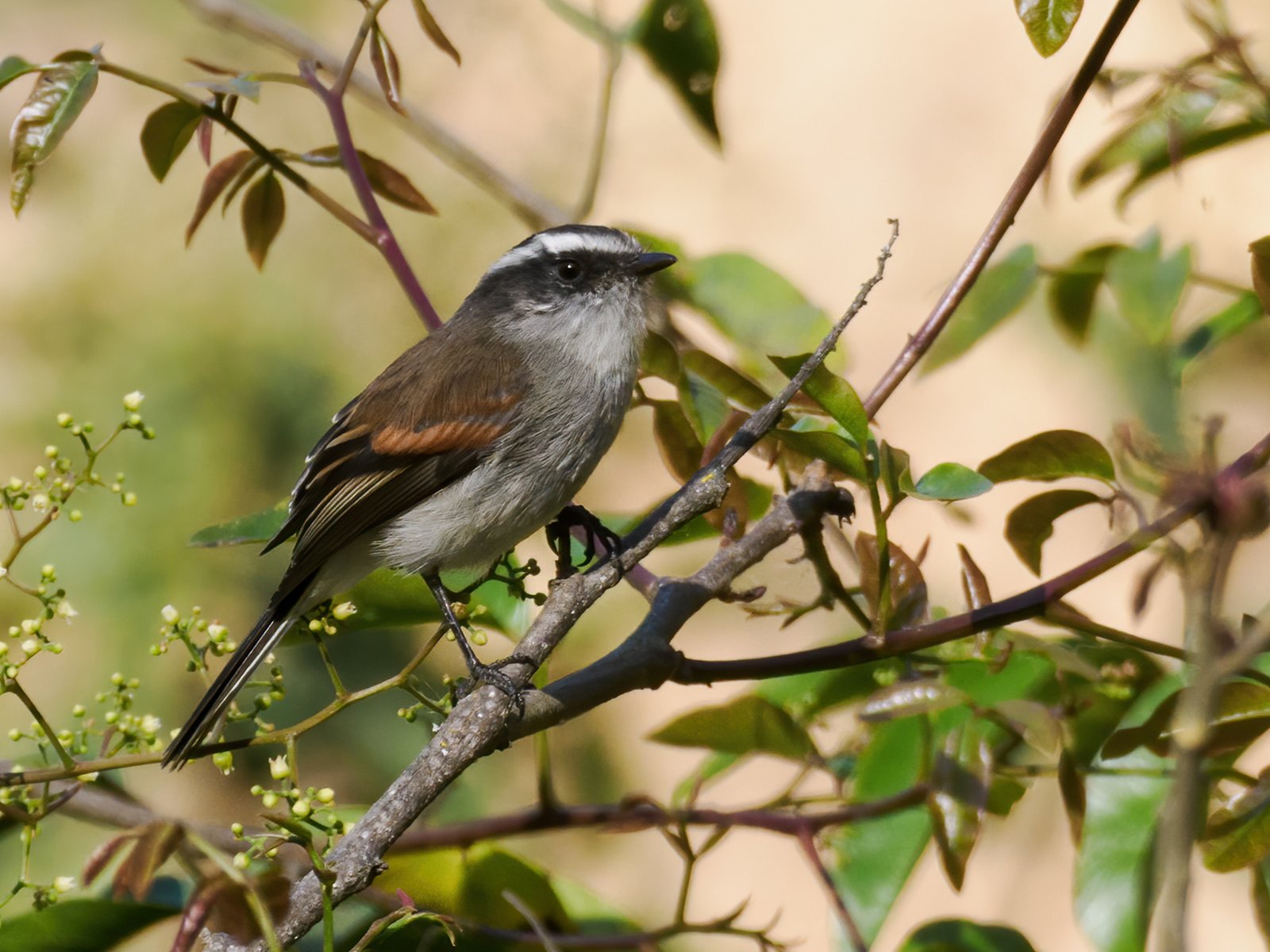
12 cm, small and compact, with a short black bill. The upperparts are dark brown, with a long white supercilium. The wings are blackish with two broad rufous wing bars. The underparts are greyish, with a paler throat and a whitish belly. The sexes are alike.
Confusion species
White-browed Chat-Tyrant Ochthoeca leucophrys is larger and paler greyish brown, and lives mainly in drier, more open valleys. Rufous-breasted Chat-Tyrant Ochthoeca rufipectoralis has an orange-rufous breast band and lives in humid montane forest. Tumbes Tyrant Ochthoeca salvini is larger and paler greyish brown and lives lower, in lowland dry forest.
Habitat
Dry to semi-humid montane scrub, shrubby ravines, riparian growth and the edges of small woods on the western slope of the Andes, roughly between 1500 and 3500 m. It perches low in shrubs, sallies briefly after insects and returns to a perch; it lives alone or in pairs. Little is known about the nest.
Where the bird is most at home, classified by the vegetation units of the Andes and the west coast.


Range and movements
Peru: only on the western slope of the Andes, from Piura south to Ancash. Absent from Colombia, Ecuador, Bolivia and the Galápagos. The species is endemic to Peru and so occurs only within the guide area.
- Resident
- dark = core range, pale = thinly spread
How and when to look
Search dry, shrubby ravines on the western slope between Piura and Ancash for a small, dark bird with a white supercilium perching low in the shrubs and making short sallies.
Conservation status
Least Concern according to the current assessment, but its range is small and the scrub is locally cut, burned and grazed.
Scientific name
Ochthoeca piurae | Chapman, 1924
Chapman described the species in 1924 and placed it straight away in the genus where it still stands. The genus Ochthoeca was introduced in 1847 by Cabanis. The genus name combines Greek okhthos, 'bank' or 'mound', with oikos, 'dwelling'. Refers to Piura in north-western Peru. The specimen the first description was based on came from Palambla, Piura, Peru.