All species › Passerines › Antpittas › Masked Antpitta
Masked Antpitta | Hylopezus auricularis
Maskermierpitta | Tororoí enmascarado | Torom-mascarado
The Masked Antpitta occurs only in northern Bolivia and has one of the smallest ranges of any antpitta. It was described in 1941, soon afterwards placed as a subspecies of Spotted Antpitta, and recognised again as a separate species after studies of its song and habitat in the late 1990s. It lives not in tall forest but in dense secondary scrub.
Voice
The song is a slow, trilling series of about forty hollow, high notes, lasting three to four seconds and descending slightly. It also gives a short series of clear notes followed by lower ones, and single calls.
Recording: Eduardo Quintanilla — CC BY-NC-SA 4.0 · xeno-canto
Identification
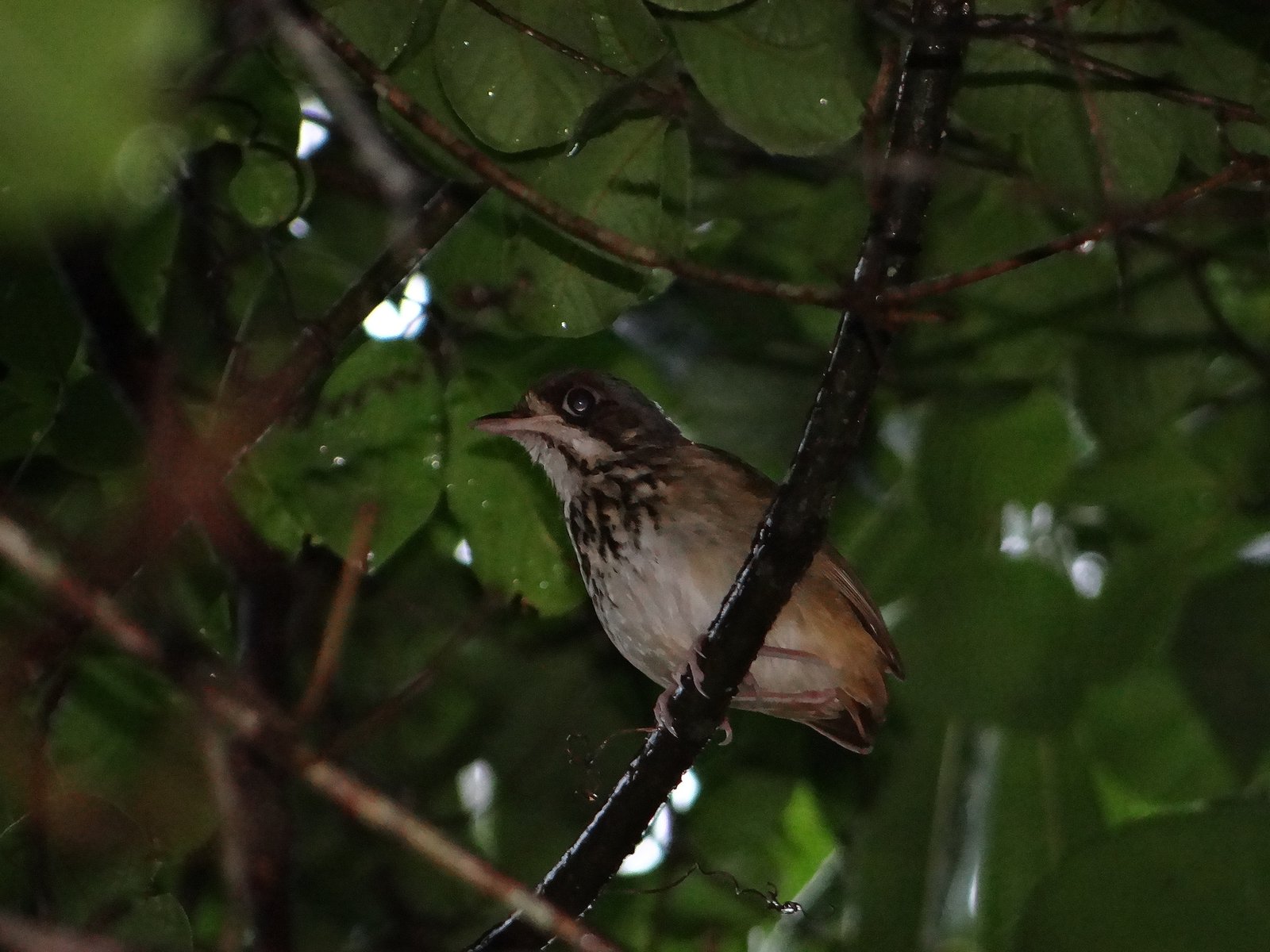
14 cm, round and almost tailless on long legs. The crown and nape are grey, the upperparts pale olive-brown. The head bears a mask: a brown cheek with white lores, a white moustachial stripe and below it a broad black malar stripe. The chin and throat are white; breast and flanks creamy with heavy black streaks; the centre of the belly is unmarked white. The sexes are alike.
Confusion species
No other Hylopezus occurs in its habitat. Thrush-like Antpitta Myrmothera campanisona and Amazonian Antpitta Myrmothera berlepschi lack the grey crown and the black-and-white head mask, and have a less sharply marked breast.
Habitat
Dense, tangled secondary scrub along the edges of clearings, fields and rivers in the lowlands, at around 100 to 200 m, preferably on muddy ground. It searches the ground for insects and other invertebrates. Almost nothing is known about the nest.
Where the bird is most at home, classified by the vegetation units of the Andes and the west coast.


Range and movements
Only in Bolivia, in south-eastern Pando and northern Beni, mainly around Riberalta. Absent from Colombia, Ecuador, Peru and the Galápagos, and not found outside the guide area.
- Resident
- dark = core range, pale = thinly spread
How and when to look
Listen in the early morning for the trilling song in dense scrub along forest edges and clearings around Riberalta in northern Beni. The bird sings from the ground or a low branch and stays in cover.
Conservation status
Vulnerable. The world range is very small and the population is estimated at about 500 mature birds, which appears stable. Because the species inhabits secondary growth, succession to tall forest can reduce its habitat; light disturbance seems rather to favour the species.
Scientific name
Hylopezus auricularis | (Gyldenstolpe, 1941)
Gyldenstolpe described the species in 1941 as Grallaria auricularis; because it was later moved to another genus, the author and year stand in brackets. The genus Hylopezus was introduced in 1909 by Ridgway. The genus name comes from Ancient Greek hulē, 'forest', and pezos, 'walking'. The species name is Medieval Latin auricularis, 'of the ear, eared', from Latin auricula, 'ear'; probably referring to the dark ear-coverts of the mask. The specimen the first description was based on came from Victoria, Bolivia.