All species › Passerines › Tanagers and allies › Masked Flowerpiercer
Masked Flowerpiercer | Diglossa cyanea
Maskerberghoningkruiper | Pinchaflor enmascarado | Fura-flor-mascarado
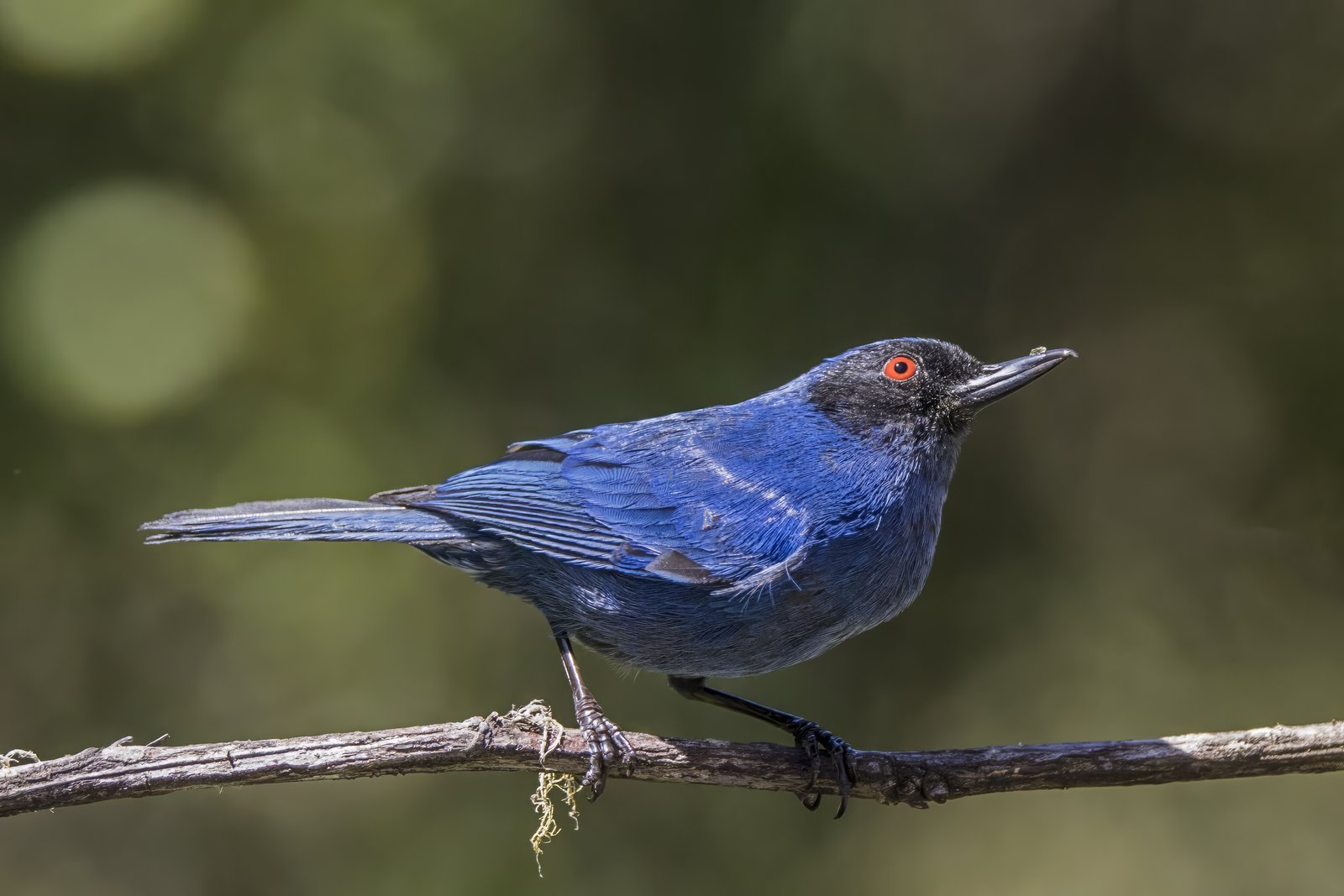
The Masked Flowerpiercer is a bright blue flowerpiercer with a black mask and a red eye, of upper montane forest and the treeline in the Andes. It is one of the most numerous flowerpiercers of the guide area and is often seen in small groups at forest edges. Besides nectar, which it takes from the side of flowers with its hooked bill, it eats many berries.
Voice
The song is a fast, rattling twitter of high, rather shrill notes, often sustained for a long time. The call is a short, high tsip.
Recording: GABRIEL LEITE — CC BY-NC-SA 4.0 · xeno-canto
Identification
14–15 cm, with a sturdy bill with a distinct hook at the tip. The plumage is bright ultramarine to cobalt blue, often paler and glossier on the crown and brow. The forehead, lores, area around the eye and cheeks form a black mask. The eye is bright red. The wings and tail are blackish with blue edges. The sexes are alike. Juveniles are dull grey with an olive tinge, without a distinct mask and with a darker eye.
Confusion species
Bluish Flowerpiercer Diglossa caerulescens is duller greyish blue, with only a small dark mask, and usually lives lower, in the forest canopy. Indigo Flowerpiercer Diglossa indigotica and Golden-eyed Flowerpiercer Diglossa glauca are darker blue with a yellow eye and live lower. Glossy Flowerpiercer Diglossa lafresnayii and Black Flowerpiercer Diglossa humeralis are largely black. Blue-backed Conebill Conirostrum sitticolor has a black head and rufous underparts.
Habitat
Humid montane forest, cloud forest, elfin forest at the treeline, scrub at forest edges, Polylepis groves and páramo edges, roughly between 2000 and 3600 m. It lives in pairs or small groups, often with mixed tanager flocks. It eats berries, nectar and insects. The nest is a cup of moss and fibres in a shrub or tree.
Where the bird is most at home, classified by the vegetation units of the Andes and the west coast.


Range and movements
In Colombia in all three Andean ranges and in the Sierra de Perijá. In Ecuador on both slopes of the Andes. In Peru along the eastern slope throughout the country and locally on the western slope in the north. In Bolivia on the eastern slope of the Andes in La Paz and Cochabamba and locally further south. Absent from the Galápagos. Outside the guide area in the mountains of Venezuela.
- Resident
- dark = core range, pale = thinly spread
How and when to look
Search along mountain roads through cloud forest and elfin forest near the treeline. The birds often show themselves in berry-bearing shrubs at the forest edge and call constantly.
Conservation status
Least Concern. Common over most of its range; the species tolerates disturbed forest edges and secondary scrub well.
Scientific name
Diglossa cyanea | (de Lafresnaye, 1840)
De Lafresnaye described the species in 1840 as Uncirostrum cyaneum; because it was later moved to another genus, the author and year stand in brackets. The genus Diglossa was introduced in 1832 by Wagler. The genus name comes from Greek diglōssos, 'double-tongued' or 'speaking two languages'. The specific name comes from Greek kuaneos, 'dark blue'. The specimen the first description was based on came from Bogotá, Colombia.