All species › Passerines › Gnatwrens and gnatcatchers › Masked Gnatcatcher
Masked Gnatcatcher | Polioptila dumicola
Maskermuggenvanger | Perlita azul | Balança-rabo-de-máscara
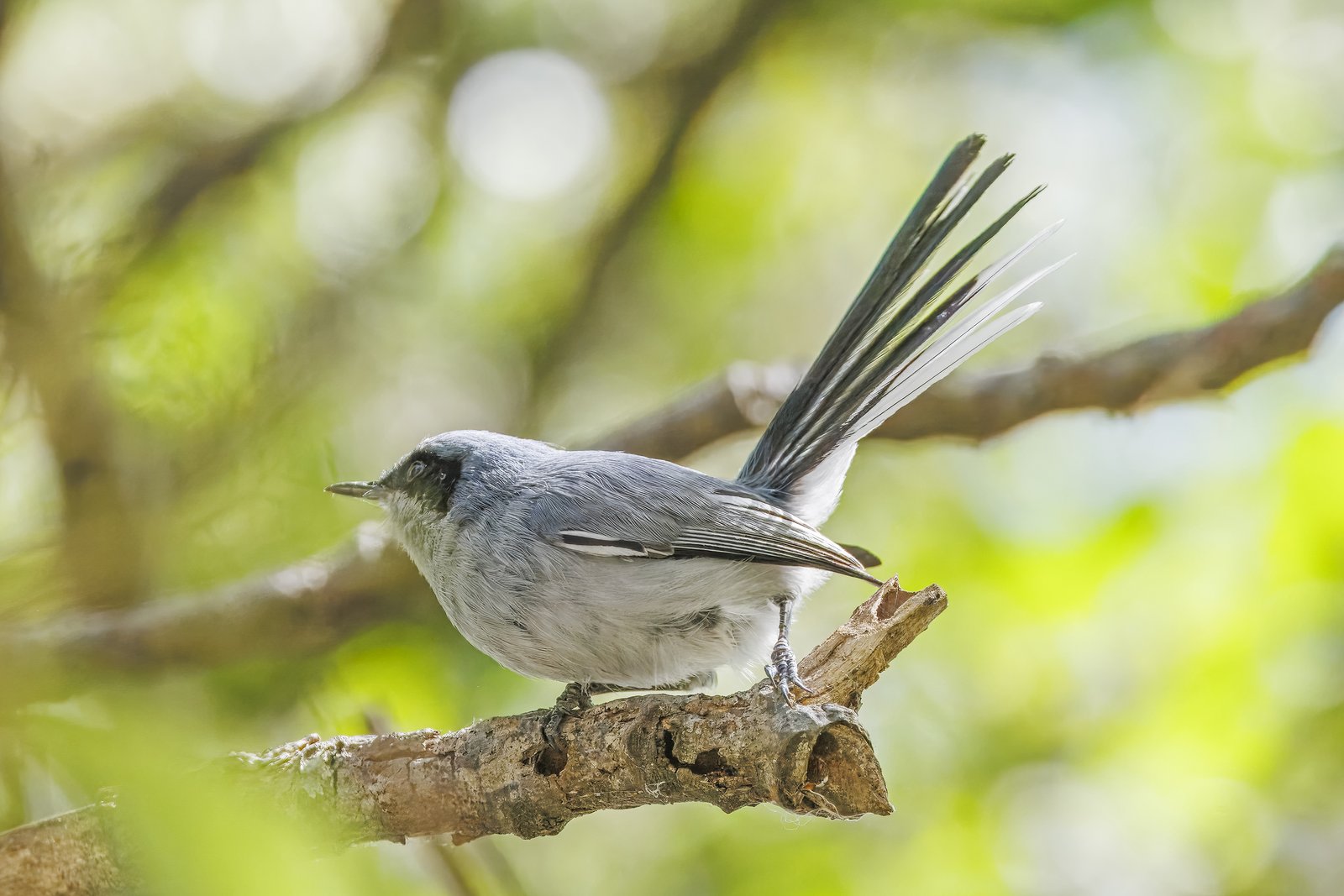
Masked Gnatcatcher is the largest gnatcatcher of the guide area and the only one in which the male has a black mask. It is a bird of dry woodland, savanna and scrub in southern South America and reaches the guide area only in Bolivia. There it lives both in the lowlands and in dry Andean valleys up to about 2000 m.
Voice
The song is short, sweet and musical, but differs between regions. It also has various calls, including soft, nasal, mewing notes.
Recording: Marcos E. Sosa — CC BY-NC-SA 4.0 · xeno-canto
Identification
12–13 cm, with a thin bill and a long tail. The male is blue-grey on the head and upperparts, with a broad black mask from the bill through the eye, narrowly edged white below. The throat and breast are pale grey and the belly is whitish. The tail is mostly black, with white outer tail feathers. The female lacks the mask and has only a narrow black crescent below the eye; her upperparts are duller grey. Birds from the Andean valleys of Bolivia are darker slate grey, those from the eastern lowlands paler, with a narrower mask.
Confusion species
Tropical Gnatcatcher Polioptila plumbea is smaller and the male has a black crown instead of a mask, with a white face; it lives in Amazonia, north of the range of Masked Gnatcatcher. Other small grey birds of dry woodland, such as tyrannulets of the genus Serpophaga, lack the long, black-and-white tail.
Habitat
Dry woodland and scrub of the Chaco and Chiquitano region, cerrado, savanna with scattered trees, riparian woodland and gardens in the lowlands; in the dry Andean valleys in dry montane woodland and scrub, around 1500–2000 m. It searches the foliage of trees and shrubs in pairs for small insects and spiders. The nest is a small, deep cup of plant fibres and spider silk, covered with lichens, on a branch.
Where the bird is most at home, classified by the vegetation units of the Andes and the west coast.


Range and movements
In Bolivia in the eastern and south-eastern lowlands (Beni, Santa Cruz, Chaco) and in the dry Andean valleys from Cochabamba southwards. Not recorded with certainty in Peru. Absent from Colombia, Ecuador and the Galápagos. Outside the guide area in Paraguay, Argentina, Uruguay and central and southern Brazil.
- Resident
- dark = core range, pale = thinly spread
How and when to look
In dry woodland and scrub around Santa Cruz or in the dry valleys of Cochabamba and Chuquisaca, look for pairs moving through the crowns of low trees. The soft, nasal call often gives the birds away; the male's black mask is visible at close range.
Conservation status
Least Concern. The species has a large range and tolerates semi-open and disturbed landscapes with trees; locally habitat is lost to clearance for agriculture.
Scientific name
Polioptila dumicola | (Vieillot, 1817)
Vieillot described the species in 1817 as Sylvia dumicola; because it was later moved to another genus, the author and year stand in brackets. The genus Polioptila was introduced in 1855 by Sclater. The genus name comes from Greek polios, 'grey', and ptilon, 'feather'. The species name comes from Latin dumus, 'thicket', and -cola, 'dweller': 'thicket-dweller'. The specimen the first description was based on came from Paraguay.