All species › Passerines › Gnatwrens and gnatcatchers › Tropical Gnatcatcher
Tropical Gnatcatcher | Polioptila plumbea
Amazonemuggenvanger | Perlita tropical | Balança-rabo-de-chapéu-preto
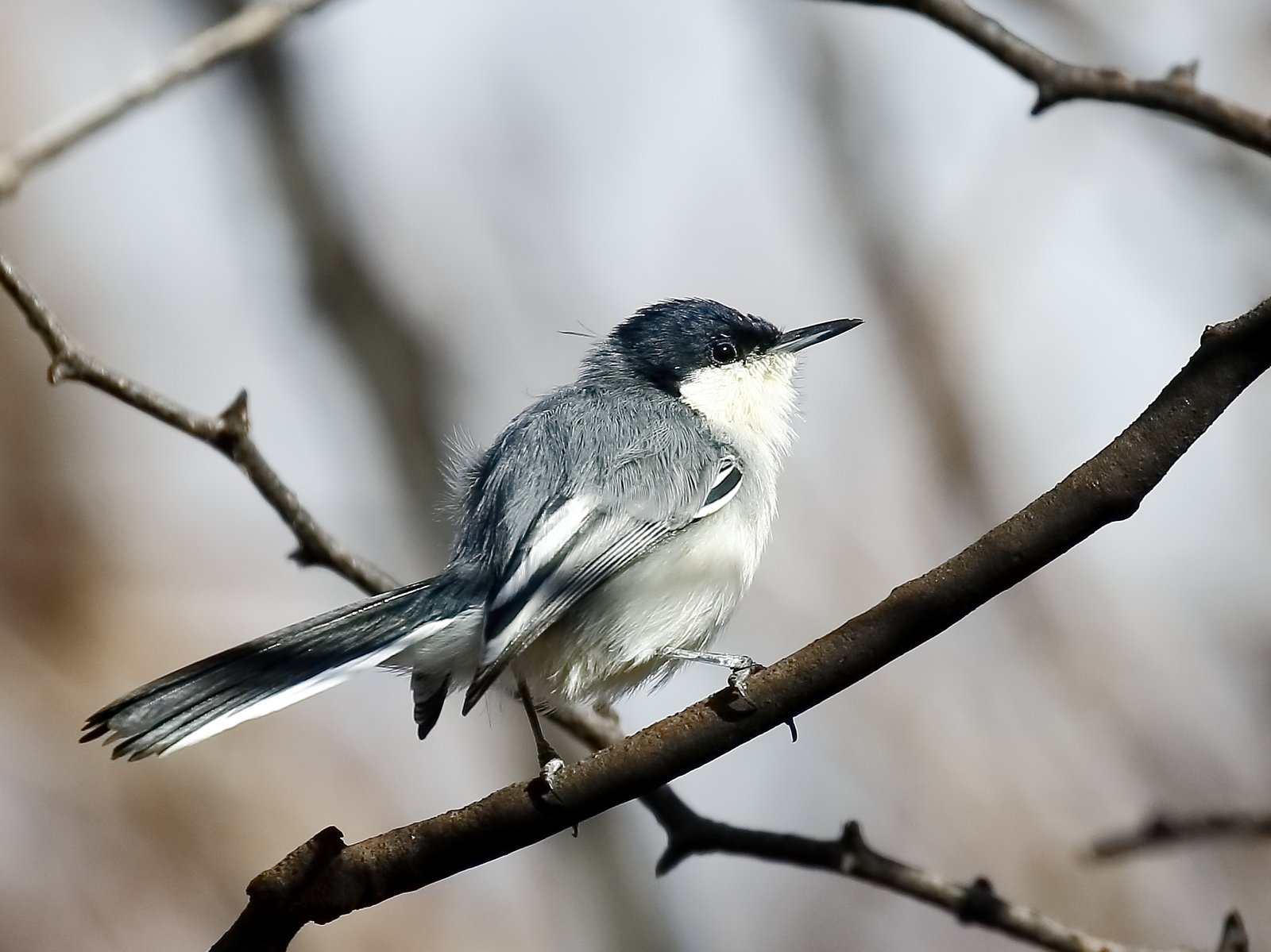
Tropical Gnatcatcher is a small, blue-grey and white gnatcatcher with a long, black-and-white tail that it constantly moves and spreads. The male has a black crown. In its current circumscription the species comprises the birds of Amazonia and northern Colombia; the birds of the Pacific lowlands and of the Marañón valley are treated as separate species.
Voice
The song is a fast series of high, thin notes, tsee-tsee-tsee-tsee, often slightly descending. The call is a nasal, mewing nyeh, often repeated.
Recording: JAYRSON ARAUJO DE OLIVEIRA — CC BY-NC-SA 4.0 · xeno-canto
Identification
10–11 cm, with a thin, straight bill and a long tail. The male is blue-grey on the back and nape, with a glossy black crown reaching to the eye or just below it; the face, throat and underparts are white. The central tail feathers are black, the outer ones white, so that from below the tail looks mostly white. The female has a grey crown without black and also a white face. Juveniles resemble the female, with a browner-tinged back.
Confusion species
Guianan Gnatcatcher Polioptila guianensis lacks the black crown, has a grey breast and lives high in the canopy of terra firme forest in eastern Colombia. Iquitos Gnatcatcher Polioptila clementsi is similar to it and lives only in white-sand forest near Iquitos. Slate-throated Gnatcatcher Polioptila schistaceigula has a dark grey throat and breast. White-browed Gnatcatcher Polioptila bilineata of the Pacific lowlands and Marañon Gnatcatcher Polioptila maior of the Marañón valley closely resemble Tropical Gnatcatcher but live west of the Andes or in the dry valleys.
Habitat
Forest edges, open and secondary forest, riverine forest and várzea, river islands, gallery forest in savanna and semi-open country with trees in the lowlands; in northern Colombia also dry forest. Mostly below 1000 m, locally higher in Colombia. It searches the foliage of medium to tall trees for small insects, in pairs and often with mixed flocks. The nest is a small, lichen-covered cup on a branch.
Where the bird is most at home, classified by the vegetation units of the Andes and the west coast.


Range and movements
In Colombia in the Caribbean lowlands, the Magdalena valley, the llanos and Amazonia in the east. In Ecuador in the eastern lowlands. In Peru in Amazonia, mainly in the north and centre. In Bolivia not or scarcely recorded. Absent from the Galápagos. Outside the guide area in Venezuela, the Guianas and Amazonian and north-eastern Brazil.
- Resident
- dark = core range, pale = thinly spread
How and when to look
Search forest edges, riverbanks and gardens with trees in the eastern lowlands and watch for pairs in mixed flocks. The nasal call and the high song often give the birds away, and the black-and-white tail shows when the bird spreads it.
Conservation status
Not evaluated in this circumscription. The species has a large range and tolerates disturbed and semi-open forest well.
Scientific name
Polioptila plumbea | (Gmelin, 1788)
Gmelin described the species in 1788 as Todus plumbeus; because it was later moved to another genus, the author and year stand in brackets. The genus Polioptila was introduced in 1855 by Sclater. The genus name comes from Greek polios, 'grey', and ptilon, 'feather'. The species name is Latin plumbeus, 'lead-coloured', after the grey upperparts. The specimen the first description was based on came from Suriname.