All species › Passerines › Wrens › Southern Nightingale-Wren
Southern Nightingale-Wren | Microcerculus marginatus
Zuidelijke nachtegaalwinterkoning | Soterrey pechiescamado | Uirapuru-veado
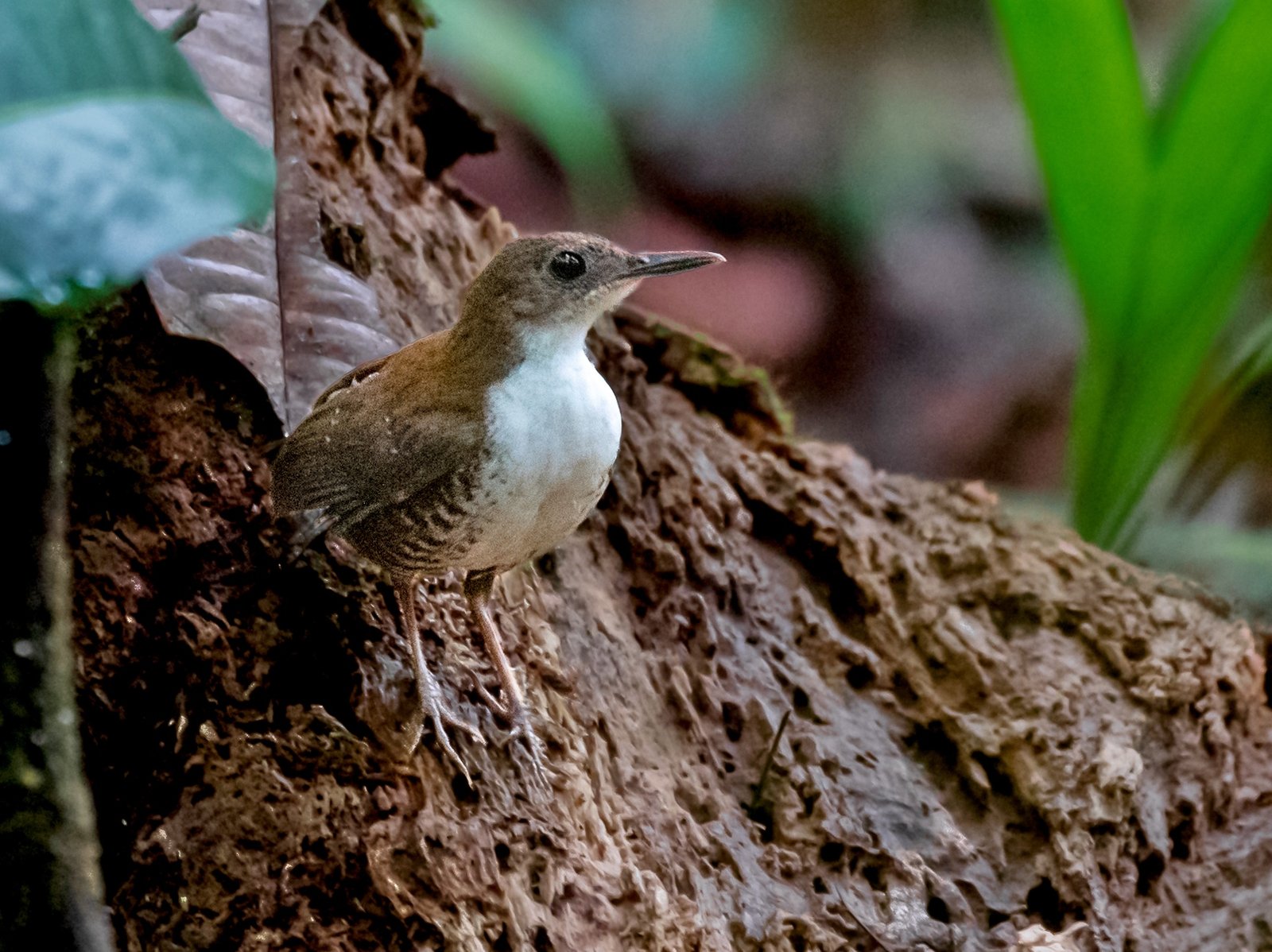
The Southern Nightingale-Wren is a small, almost tailless wren of the forest floor in humid lowland and foothill forest. It walks on the ground and along fallen logs, constantly bobbing its rear body. Its song, a long series of pure whistles that drop lower and lower with ever longer pauses, is a regular sound of the early morning in many forests.
Voice
The song starts with a short series of fast notes and passes into a long series of high, pure whistles, each slightly lower than the last, with pauses that grow longer and longer; the whole may last more than a minute. Call: a sharp chik.
Recording: Carlos Andrés Pinto Quinche — CC BY-NC-SA 4.0 · xeno-canto
Identification
10–11 cm, with a long, straight, thin bill, long legs and a very short tail. The upperparts are plain dark brown. The throat and breast are white; the flanks and belly are brown, with dark scaling. The amount of white and the strength of the scaling vary between regions. The sexes are alike; young birds are more heavily scaled dark below, including on the breast.
Confusion species
Wing-banded Wren Microcerculus bambla has a broad white band across the closed wing and a grey breast, and lives in the foothills of the eastern slope. White-breasted Wood Wren Henicorhina leucosticta has black-and-white striped sides to the head, a white supercilium and a cocked tail. Musician Wren Cyphorhinus arada is larger and rufous-brown, with bare blue skin around the eye. Leaftossers (Sclerurus) are larger, with a longer, blackish tail, and toss through the leaf litter.
Habitat
The floor and lowest layer of humid evergreen forest, especially old forest with many fallen logs, in the lowlands and foothills, up to about 1700 m. It walks over the forest floor and along logs, searching for insects and spiders among leaf litter and moss. Little is known about the nest.
Where the bird is most at home, classified by the vegetation units of the Andes and the west coast.


Range and movements
In Colombia in the Pacific lowlands, the Magdalena valley, the northern foothills and the lowlands and foothills east of the Andes. In Ecuador in humid forest west of the Andes and in the Amazonian lowlands and foothills of the eastern slope. In Peru in the Amazonian lowlands and on the lower eastern slope. In Bolivia in the northern lowlands and the Yungas foothills. Absent from the Galápagos. Outside the guide area from Costa Rica and Panama to Venezuela and Amazonian Brazil.
- Resident
- dark = core range, pale = thinly spread
How and when to look
Listen in the early morning in quiet, old forest for the falling series of whistles, then patiently scan the forest floor; the bird often perches on a fallen log, bobbing its rear body.
Conservation status
Least Concern. Depends on closed forest; disappears where forest is fragmented or cleared.
Scientific name
Microcerculus marginatus | (Sclater, 1855)
Sclater described the species in 1855 as Heterocnemis marginata; because it was later moved to another genus, the author and year stand in brackets. The genus Microcerculus was introduced in 1862 by Sclater. The genus name is a diminutive formed from Greek mikros, 'small', and kerkos, 'tail'. The species name comes from Latin marginatus, 'edged, bordered', from margo, 'edge'; probably for the dark-edged feathers. The specimen the first description was based on came from Bogotá, Colombia.