All species › Passerines › Wrens › Wing-banded Wren
Wing-banded Wren | Microcerculus bambla
Witbandwinterkoning | Cucarachero alifranjeado | Uirapuru-de-asa-branca
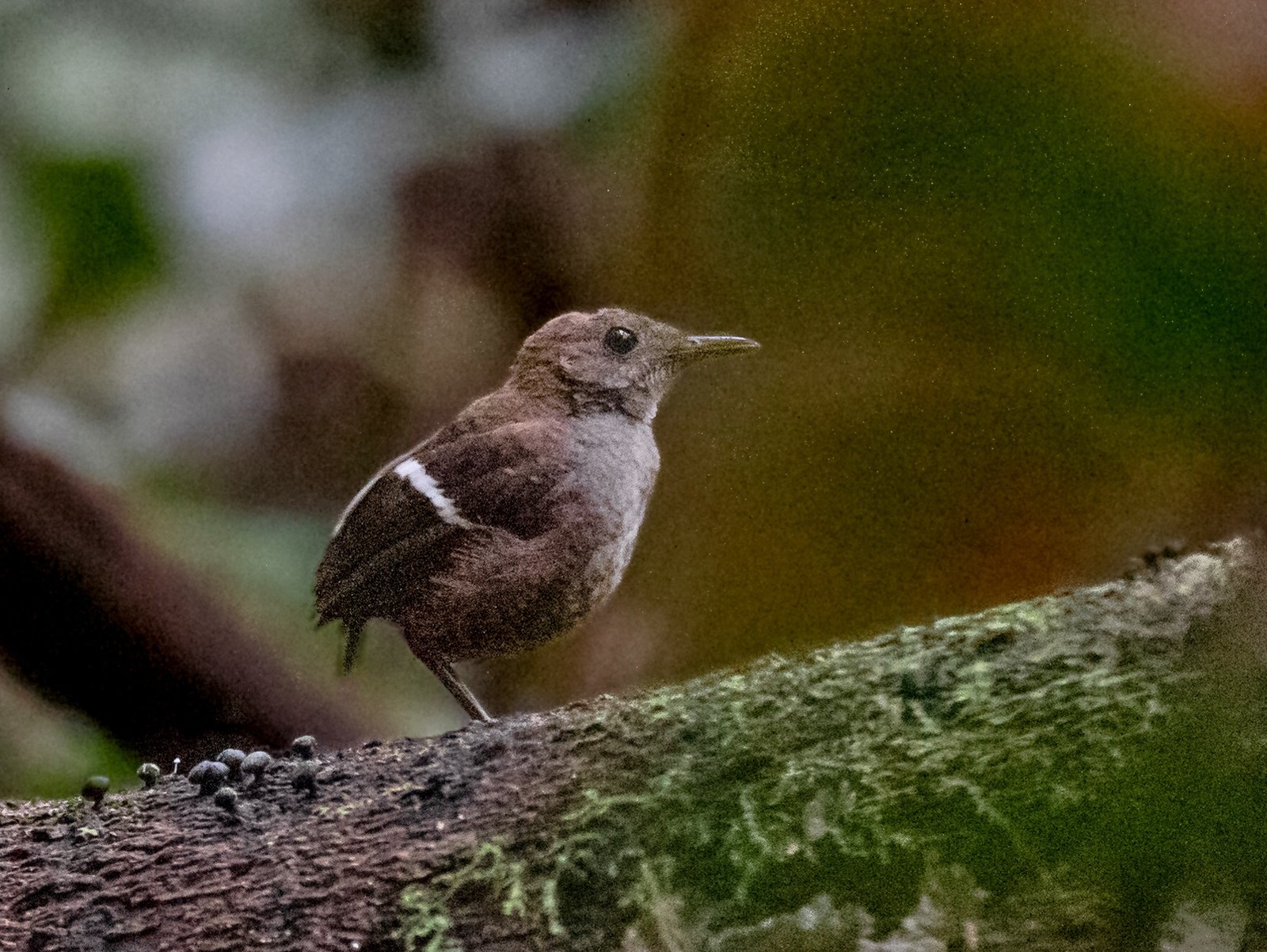
The Wing-banded Wren is a small, dark, short-tailed wren of the forest floor, recognised by a broad white band across the wing. In the guide area it lives mainly in the foothills of the eastern slope of the Andes. It stays low in the shade of the undergrowth, but its high, pure whistles carry far through the forest.
Voice
The song is a series of three to six clear, high whistles with short pauses between them, sometimes ending in a long, sustained glissando. Call: a sharp, metallic click.
Recording: Paul Lenrumé — CC BY-NC-SA 4.0 · xeno-canto
Identification
11 cm, with a long, thin bill, long legs and a short tail. The upperparts are blackish brown, with a broad white band across the greater coverts that shows even on the closed wing. The throat and breast are grey, in birds in Ecuador and Peru with a paler, whitish throat; the belly and flanks are brown with faint barring. The sexes are alike; young birds are scaled below and lack the white wing band.
Confusion species
Southern Nightingale-Wren Microcerculus marginatus lacks the white wing band and has a white throat and breast. The wood wrens (Henicorhina) have black-and-white striped sides to the head, a white supercilium and a cocked tail; Bar-winged Wood Wren Henicorhina leucoptera also has white wing bars, but lives higher, in stunted forest on isolated ridges.
Habitat
The understorey and floor of humid evergreen forest, especially in the foothills, with a wet, shady forest floor and many rotting logs; in the guide area roughly between 400 and 1500 m. It searches for insects and other invertebrates on trunks, branches and the ground, less in the leaf litter than related species. Little is known about the nest.
Where the bird is most at home, classified by the vegetation units of the Andes and the west coast.


Range and movements
In Colombia only in the far east, near the borders with Venezuela and Brazil. In Ecuador in the foothills of the eastern slope. In Peru on the lower eastern slope, from the north into the centre and south of the country. Not known from Bolivia or the Galápagos. Outside the guide area in southern and eastern Venezuela, the Guianas and northern and north-western Brazil.
- Resident
- dark = core range, pale = thinly spread
How and when to look
Listen in the morning in humid foothill forest on the eastern slope, along trails with many fallen logs; the song leads you to the bird, which usually stays low in the shade.
Conservation status
Least Concern. Local and scarce in the guide area; depends on closed forest in the foothills.
Scientific name
Microcerculus bambla | (Boddaert, 1783)
Boddaert described the species in 1783 as Formicarius bambla; because it was later moved to another genus, the author and year stand in brackets. The genus Microcerculus was introduced in 1862 by Sclater. The genus name is a diminutive formed from Greek mikros, 'small', and kerkos, 'tail'. The species name goes back to Buffon's 'Le bambla', which sounds like French bande blanche, 'white band', for the white wing bar. The specimen the first description was based on came from Cayenne, French Guiana.