All species › Passerines › Tanagers and allies › Medium Tree Finch
Medium Tree Finch | Camarhynchus pauper
Charles' boomvink | Pinzón arbóreo mediano | Tentilhão-arborícola-médio
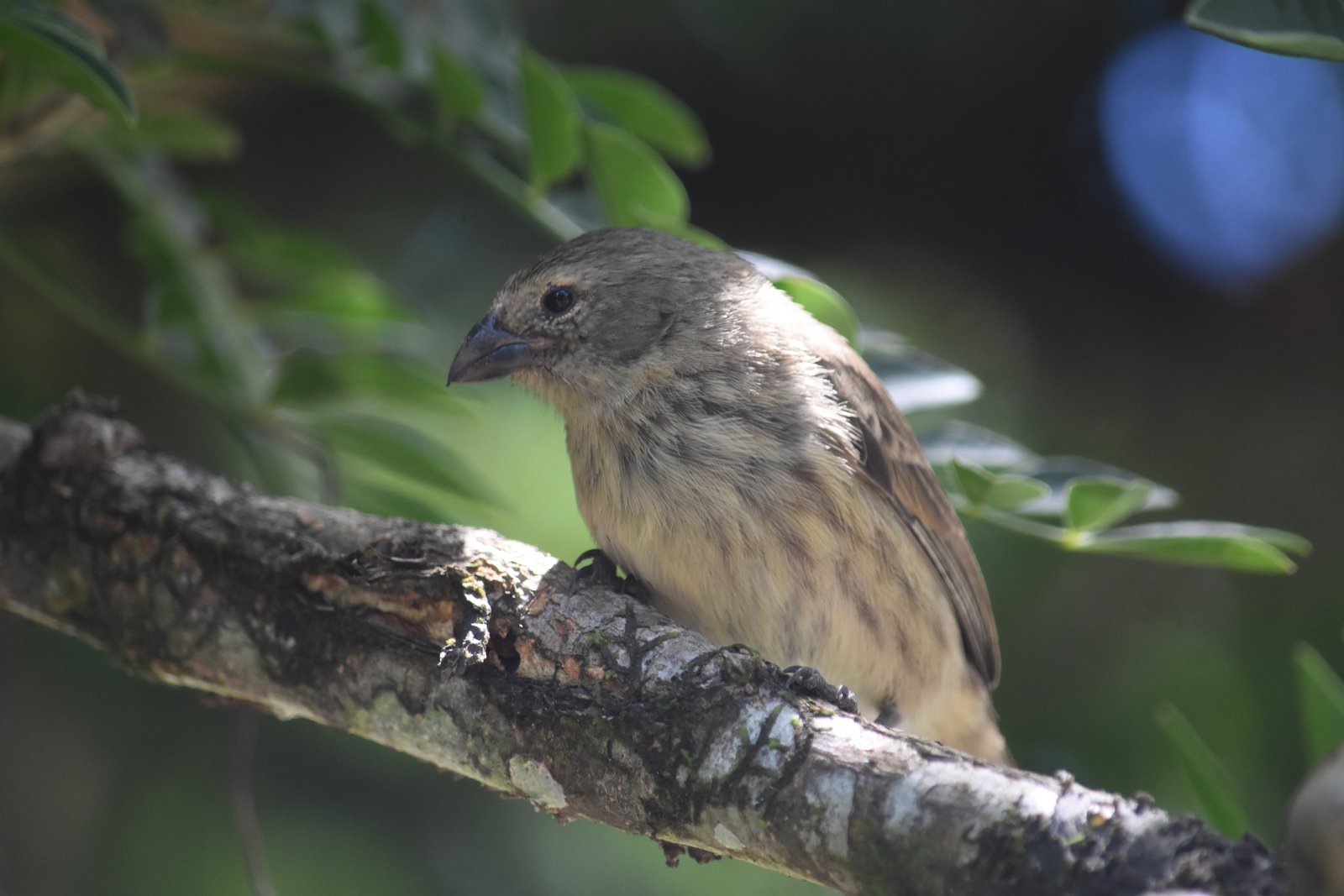
The Medium Tree Finch lives only in the highlands of Floreana, formerly known as Charles Island. It is one of the rarest of Darwin's finches. On Floreana it lives alongside Large and Small Tree Finches, and hybrids with Small Tree Finch occur.
Voice
The song is a series of a few repeated whistled notes, similar to that of the other tree finches. The call is a short, high chirp.
Recording: Barry Edmonston — CC BY-NC-SA 4.0 · xeno-canto
Identification
12–13 cm, with a thick, curved bill intermediate in size between those of Large and Small Tree Finches. Adult males have a black head and throat and a blackish upper breast; in younger males the black is more restricted. The upperparts are olive-grey, the underparts dingy white to greyish buff, with faint streaking on the flanks. Females and young birds lack the black and have a paler bill.
Confusion species
Small Tree Finch Camarhynchus parvulus is smaller, with a clearly smaller, shorter bill. Large Tree Finch Camarhynchus psittacula is slightly larger, with a heavier bill; it is scarce on Floreana. Hybrids with Small Tree Finch cannot be reliably identified in the field. Ground finches (Geospiza) have a conical bill with a straight upper edge.
Habitat
The humid highlands of Floreana, in remnants of Scalesia forest, woodland with Zanthoxylum and other native trees, and scrub; above about 300 m. It searches trees for insects and larvae in bark and twigs, and also eats fruit and buds. The nest is a domed structure in a tree.
Where the bird is most at home, classified by the vegetation units of the Andes and the west coast.


Range and movements
Endemic to Floreana (Galápagos); it occurs on no other island. Absent from mainland Colombia, Ecuador, Peru and Bolivia.
- Resident
How and when to look
In the highlands of Floreana, around Cerro Pajas and Asilo de la Paz, where it forages in the canopy with the other tree finches.
Conservation status
Critically Endangered. Its habitat is very small and largely degraded by farming and introduced plants. The larvae of the introduced parasitic fly Philornis downsi kill a large share of the nestlings; introduced rats and cats are also a threat. A large restoration programme on Floreana includes the removal of introduced mammals.
Scientific name
Camarhynchus pauper | Ridgway, 1890
Ridgway described the species in 1890 and placed it straight away in the genus where it still stands. The genus Camarhynchus was introduced in 1837 by Gould. The genus name combines Ancient Greek kamara, 'arch' or 'vault', and rhunkhos, 'bill'. The species name is Latin pauper, 'poor' or 'meagre'. The specimen the first description was based on came from Floreana Island, Galápagos.