All species › Passerines › Tanagers and allies › Small Tree Finch
Small Tree Finch | Camarhynchus parvulus
Kleine boomvink | Pinzón arbóreo pequeño | Tentilhão-arborícola-pequeno
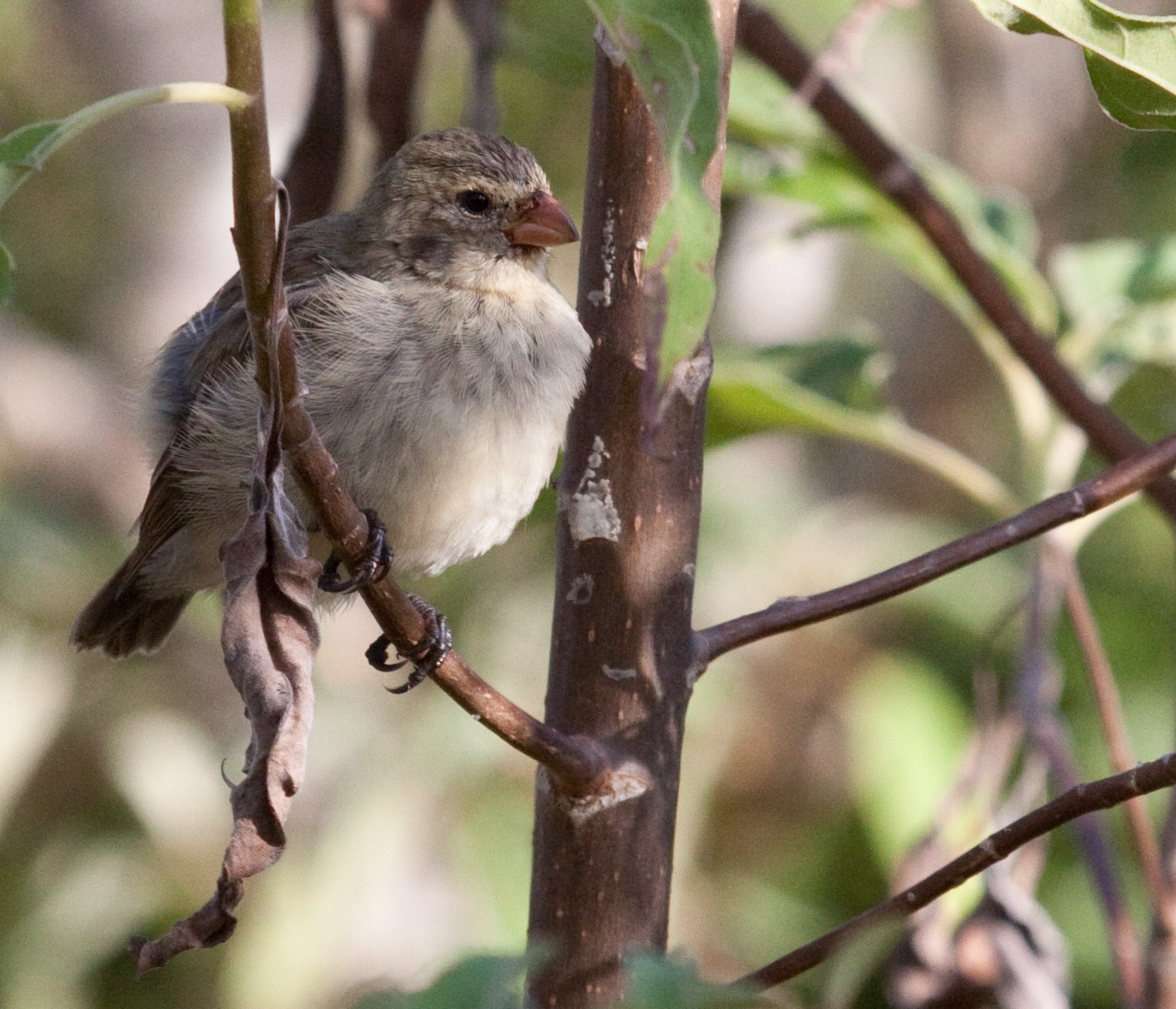
The Small Tree Finch is the most widespread and numerous tree finch of the Galápagos. It lives from the humid highlands to the arid lowlands and also occurs in gardens and villages. With its short, curved bill it picks insects from leaves and twigs.
Voice
The song is a series of a few repeated, two-syllable whistles with a high, clear tone. The call is a short, high chirp.
Recording: Eric DeFonso — CC BY-NC-SA 3.0 · xeno-canto
Identification
11–12 cm, with a short, stubby bill with a curved upper edge. Adult males have a black head and throat and often a blackish upper breast; the amount of black increases with age. The upperparts are olive-grey, the underparts dingy white to yellowish buff, faintly streaked on the flanks. Females and young birds are olive-grey without black, with a paler bill.
Confusion species
Large Tree Finch Camarhynchus psittacula is larger, with a clearly thicker bill. On Floreana, Medium Tree Finch Camarhynchus pauper has a larger bill. The warbler-finches Certhidea have a thin, pointed bill. Small Ground Finch Geospiza fuliginosa has a conical bill with a straight upper edge; males are entirely black, females darkly streaked.
Habitat
Woodland and scrub in all zones, but mainly the humid highlands with Scalesia and the transition zone; also farmland, gardens and villages. It picks insects and larvae from leaves, twigs and bark, and also eats nectar, fruit and seeds. The nest is a domed structure in a tree or shrub.
Where the bird is most at home, classified by the vegetation units of the Andes and the west coast.


Range and movements
Endemic to the Galápagos, on most of the central and southern islands, including Santa Cruz, Santiago, Isabela, Fernandina, San Cristóbal, Floreana, Pinzón and Rábida. Absent from Pinta, Marchena, Genovesa and Española. Absent from mainland Colombia, Ecuador, Peru and Bolivia.
- Resident
How and when to look
In the Santa Cruz highlands, for example at Los Gemelos, and in the vegetation around Puerto Ayora and the research station, often in mixed groups with other Darwin's finches.
Conservation status
Least Concern. The species is widespread and locally numerous. The introduced parasitic fly Philornis downsi causes high mortality among nestlings, and on Floreana hybrids with Medium Tree Finch occur.
Scientific name
Camarhynchus parvulus | (Gould, 1837)
Gould described the species in 1837 as Geospiza parvula; because it was later moved to another genus, the author and year stand in brackets. The genus Camarhynchus was introduced in 1837 by Gould. The genus name combines Ancient Greek kamara, 'arch' or 'vault', and rhunkhos, 'bill'. The species name is Latin parvulus, 'very small'. The specimen the first description was based on came from Santiago Island, Galápagos.