All species › Passerines › Tanagers and allies › Mangrove Finch
Mangrove Finch | Camarhynchus heliobates
Mangrovevink | Pinzón de manglar | Tentilhão-do-mangue
The Mangrove Finch is one of the rarest birds in the world: the wild population numbers about one hundred birds, in a few small mangrove forests on the west coast of Isabela. It is closely related to Woodpecker Finch and sometimes also uses a twig or spine to extract insects from crevices.
Voice
The song is a short series of clear, repeated whistles, similar to that of Woodpecker Finch. The call is a short, high chirp.
No recording with a suitable Creative Commons licence is available for this species yet.
Identification
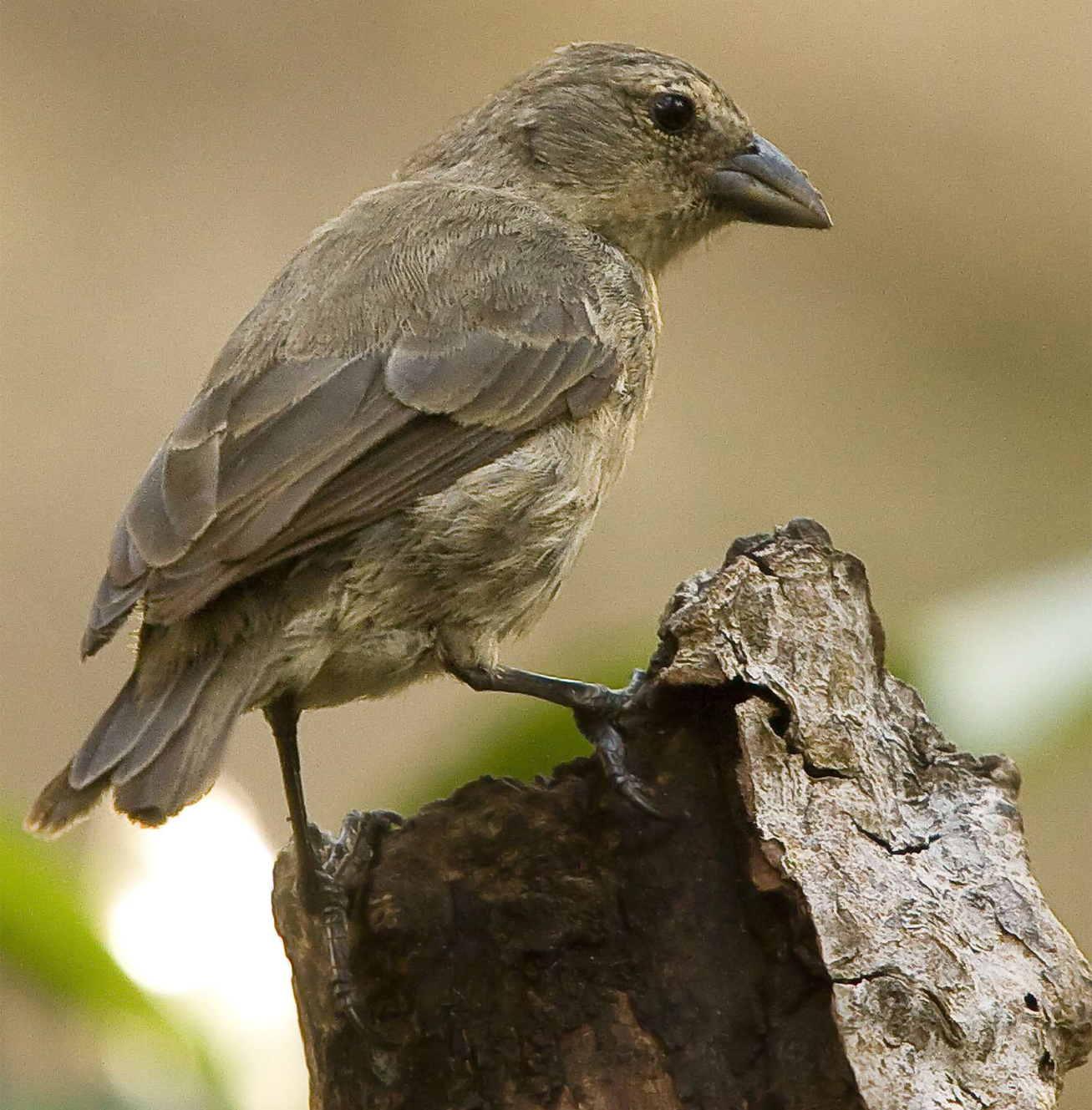
14 cm, a rather plainly coloured finch with a long, pointed, slightly decurved bill. The upperparts are olive-brown, the underparts dingy white to buff with faint dark streaking on the breast. Adult males have a black bill in the breeding season and often a darker head; females and young birds have a paler, horn-coloured bill.
Confusion species
Woodpecker Finch Camarhynchus pallidus is very similar but slightly larger, with a heavier bill and a paler, less streaked breast; it lives mainly in the highlands and not in mangroves. Small Tree Finch Camarhynchus parvulus has a short, stubby bill. The warbler-finches Certhidea are smaller, with a thin bill.
Habitat
Dense, tall mangrove forest with black and white mangroves along the coast, with pools and adjacent dry woodland. It searches for insects, larvae and spiders in bark, dead wood and leaf litter, sometimes with the help of a twig. The nest is built high in the mangroves.
Where the bird is most at home, classified by the vegetation units of the Andes and the west coast.

Range and movements
Endemic to the Galápagos. It now survives only on the north-west coast of Isabela, mainly at Playa Tortuga Negra and Caleta Black; formerly also on Fernandina and at other sites on Isabela, but extinct there. Absent from mainland Colombia, Ecuador, Peru and Bolivia.
- Resident
How and when to look
The mangrove forests where the species lives are not open to the public; access requires permission from the national park. In practice visitors almost never see the species.
Conservation status
Critically Endangered. The wild population numbers about one hundred birds at two small sites. The main threats are introduced black rats, which raid nests, and the parasitic fly Philornis downsi. A conservation programme controls rats and since the 2010s has reared young in captivity for release.
Scientific name
Camarhynchus heliobates | (Snodgrass & Heller, 1901)
Snodgrass & Heller described the species in 1901 as Geospiza heliobates; because it was later moved to another genus, the author and year stand in brackets. The genus Camarhynchus was introduced in 1837 by Gould. The genus name combines Ancient Greek kamara, 'arch' or 'vault', and rhunkhos, 'bill'. The species name comes from Greek hēlios, 'sun', and -batēs, 'treader, walker' (from bainō, 'to go, to step'). The specimen the first description was based on came from Tagus Cove, Isabela Island, Galápagos.