All species › Parrots › African and New World parrots › Military Macaw
Military Macaw | Ara militaris
Soldatenara | Guacamaya verde | Arara-militar
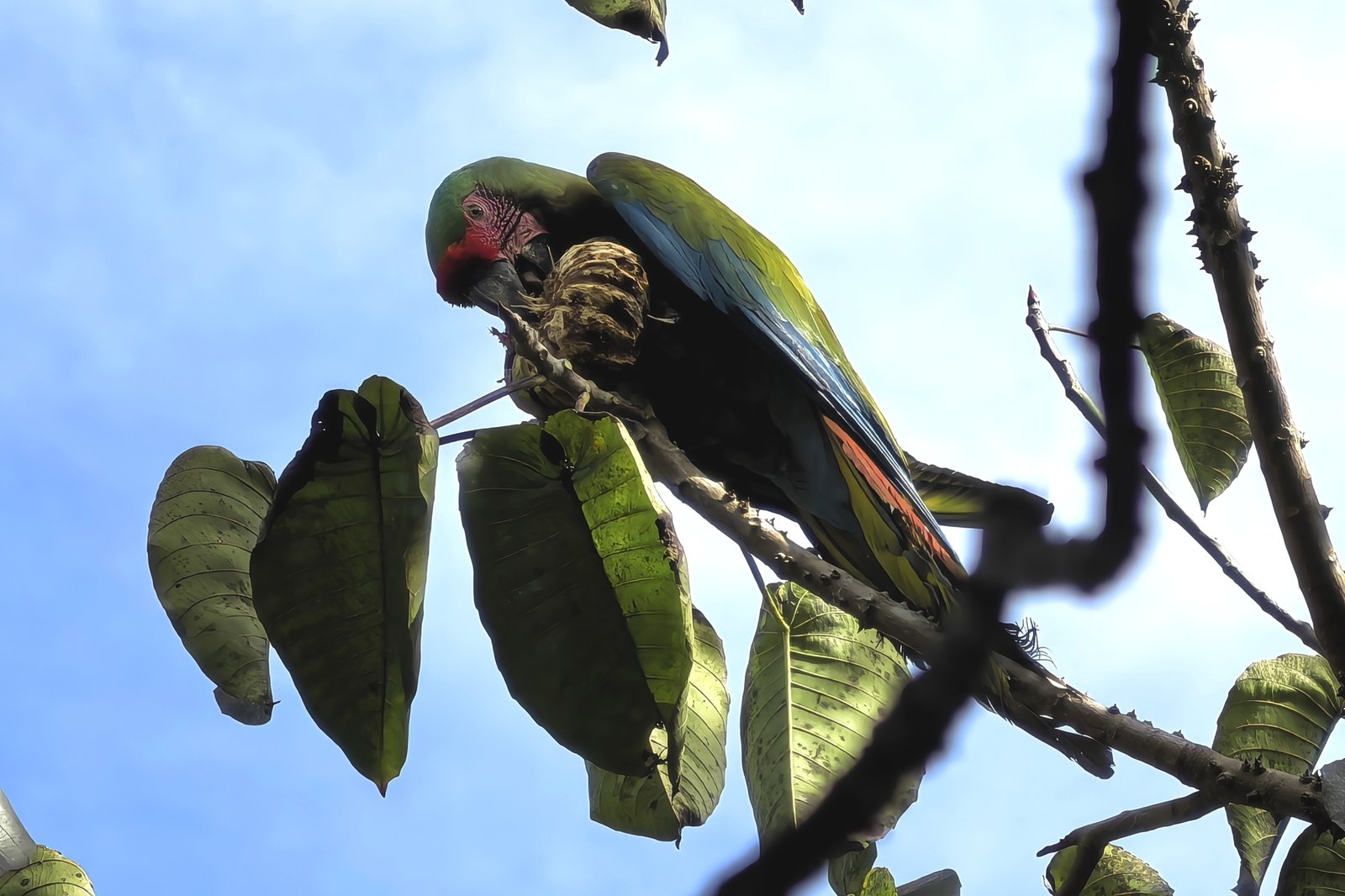
The Military Macaw is a large green macaw of the slopes and foothills of the Andes. It is very local, often near cliffs and canyons, where pairs and flocks roost and nest. Each morning the birds fly, calling loudly and sometimes tens of kilometres, to fruiting trees.
Voice
Deep, raucous, harsh screeches, mainly in flight; also a rolling krraa-ak.
Recording: Rosa Elena Albornoz @rosaelena_naturaleza — CC0 1.0 · xeno-canto
Identification
70–75 cm, with a long, pointed tail and a heavy, black bill. The plumage is grass green, with a red forehead. The bare, pinkish-white face has lines of tiny black feathers. The lower back and rump are pale blue, and the flight feathers are blue. The tail is reddish brown above with a blue tip; the underside of the wings and tail is olive-yellow. The sexes are alike.
Confusion species
Great Green Macaw Ara ambiguus is larger and paler, more yellowish green, with a more orange-red tail, and lives in the lowlands west of the Andes. Chestnut-fronted Macaw Ara severus is much smaller, with a chestnut forehead and reddish-brown underwings. Red-fronted Macaw Ara rubrogenys in Bolivia is smaller, with red on the ear coverts and an orange-red bend of the wing.
Habitat
Humid and semi-humid montane forest, dry valley forest and the Andean foothills, mostly between 500 and 2000 m, locally higher or lower. It eats fruit, nuts and seeds in the treetops. It roosts and nests in holes in cliffs or in large, hollow trees.
Where the bird is most at home, classified by the vegetation units of the Andes and the west coast.


Range and movements
In Colombia very locally in the Sierra Nevada de Santa Marta, the Serranía de Perijá and on the slopes of the three Andean ranges. In Ecuador and Peru very locally on the eastern slope of the Andes. In Bolivia along the eastern slope and in the dry valleys from La Paz to Chuquisaca and Tarija. Absent from the Galápagos. Outside the guide area in Mexico, Venezuela and north-western Argentina.
- Resident
- dark = core range, pale = thinly spread
How and when to look
At cliffs and canyons on the eastern slope, where flocks leave at dawn and return at dusk. Flying birds can be recognised by the green with blue and the long tail.
Conservation status
Vulnerable. The population is small and fragmented and is declining through capture for the cage-bird trade and the loss of forest on the slopes.
Scientific name
Ara militaris | (Linnaeus, 1766)
Linnaeus described the species in 1766 as Psittacus militaris; because it was later moved to another genus, the author and year stand in brackets. The genus Ara was introduced in 1799 by De Lacépède. The genus name comes from Tupi ará, 'macaw', an onomatopoeia of these birds' call. The species name comes from Latin militaris, 'military, martial, of soldiers'; possibly for the green plumage resembling a uniform. The specimen the first description was based on came from Colombia.