All species › Parrots › African and New World parrots › Great Green Macaw
Great Green Macaw | Ara ambiguus
Buffons ara | Guacamayo verde mayor | Arara-verde-grande
The Great Green Macaw is the largest green macaw. In the guide area it lives in north-western Colombia and, as a small, isolated population, in the hills near Guayaquil in western Ecuador. Pairs and small groups travel long distances to fruiting trees.
Voice
Deep, raucous, harsh screeches, mainly in flight; lower than those of Military Macaw.
No recording with a suitable Creative Commons licence is available for this species yet.
Identification
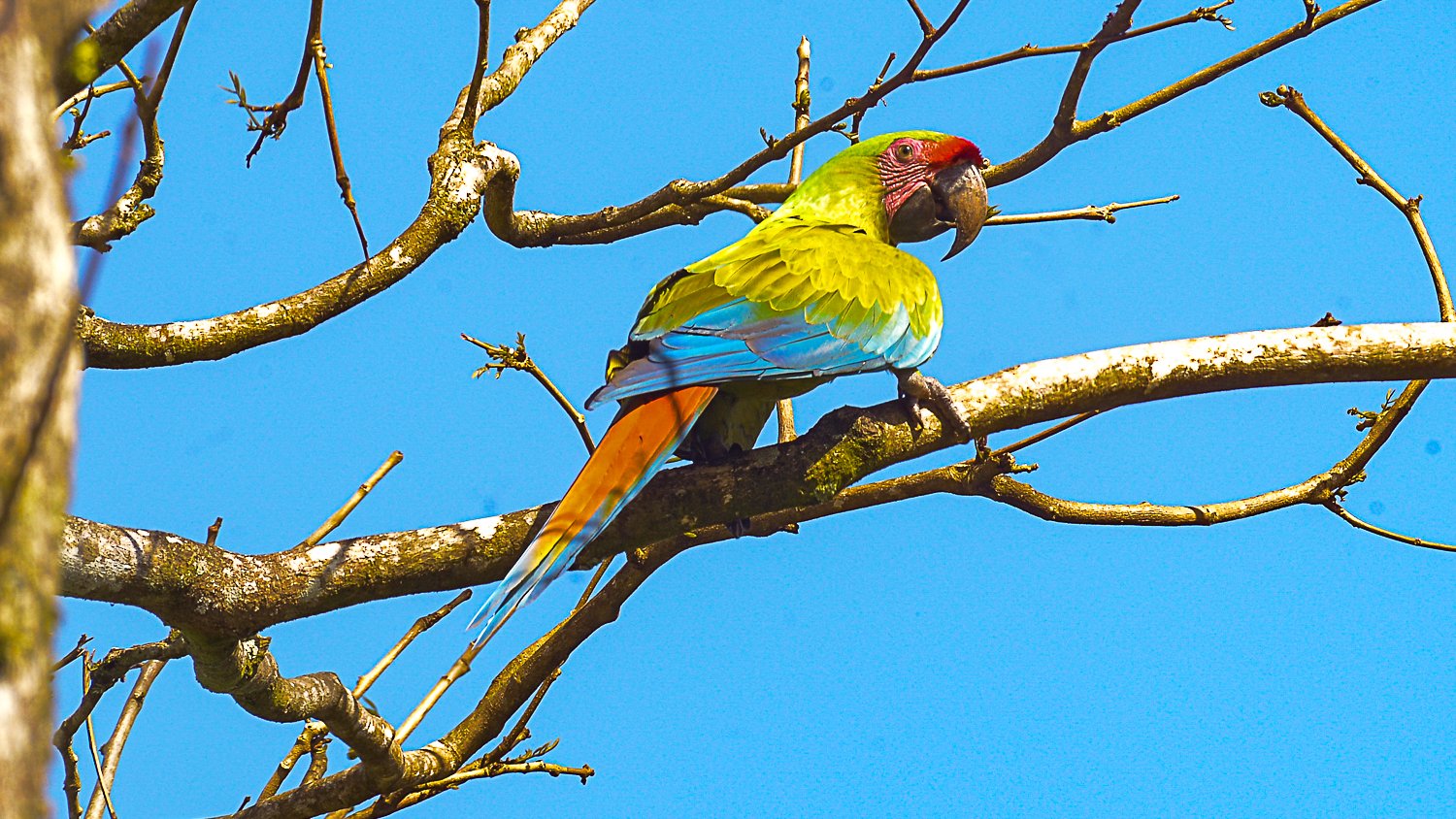
80–90 cm, with a long, pointed tail and a heavy, black bill. The plumage is pale yellowish green, with a red forehead. The bare, pink face has lines of tiny dark feathers. The lower back and rump are pale blue, and the flight feathers are blue. The tail is orange-red above with a blue tip; the underside of the wings and tail is olive-yellow. The sexes are alike.
Confusion species
Military Macaw Ara militaris is smaller and darker grass green, with a more reddish-brown tail; it lives mainly on the slopes of the Andes, and the two species hardly overlap in the guide area. Chestnut-fronted Macaw Ara severus is much smaller, with a chestnut forehead and reddish-brown underwings.
Habitat
In Colombia humid lowland and hill forest, also forest edges and clearings with large trees, up to roughly 600 m. In Ecuador semi-deciduous and dry deciduous forest in the hills. It eats fruit, seeds and nuts in the treetops; in Central America it depends heavily on the almendro, Dipteryx oleifera. It nests in cavities in large, old trees.
Where the bird is most at home, classified by the vegetation units of the Andes and the west coast.


Range and movements
In Colombia in the north-west, in the Chocó, Urabá and northern Antioquia and Córdoba, locally. In Ecuador only in the west, in the hills of the Cordillera Chongón-Colonche near Guayaquil, with a population of at most a few dozen birds. Absent from Peru, Bolivia and the Galápagos. Outside the guide area from Honduras to Panama.
- Resident
- dark = core range, pale = thinly spread
How and when to look
In Ecuador in the Bosque Protector Cerro Blanco near Guayaquil, best early in the morning. In Colombia in the large forests of Urabá and the northern Chocó.
Conservation status
Critically Endangered. Forest is being lost at a high rate, and birds are captured for the cage-bird trade. The Ecuadorian population is extremely small.
Scientific name
Ara ambiguus | (Bechstein, 1811)
Bechstein described the species in 1811 as Psittacus ambiguus; because it was later moved to another genus, the author and year stand in brackets. The genus Ara was introduced in 1799 by De Lacépède. The genus name comes from Tupi ará, 'macaw', an onomatopoeia of these birds' call. The species name comes from Latin ambiguus, 'doubtful, uncertain'; possibly because the species was hard to tell apart from the Military Macaw. The specimen the first description was based on came from Northwestern Colombia.