All species › Parrots › African and New World parrots › Scarlet Macaw
Scarlet Macaw | Ara macao
Geelvleugelara | Guacamaya roja | Arara-canga
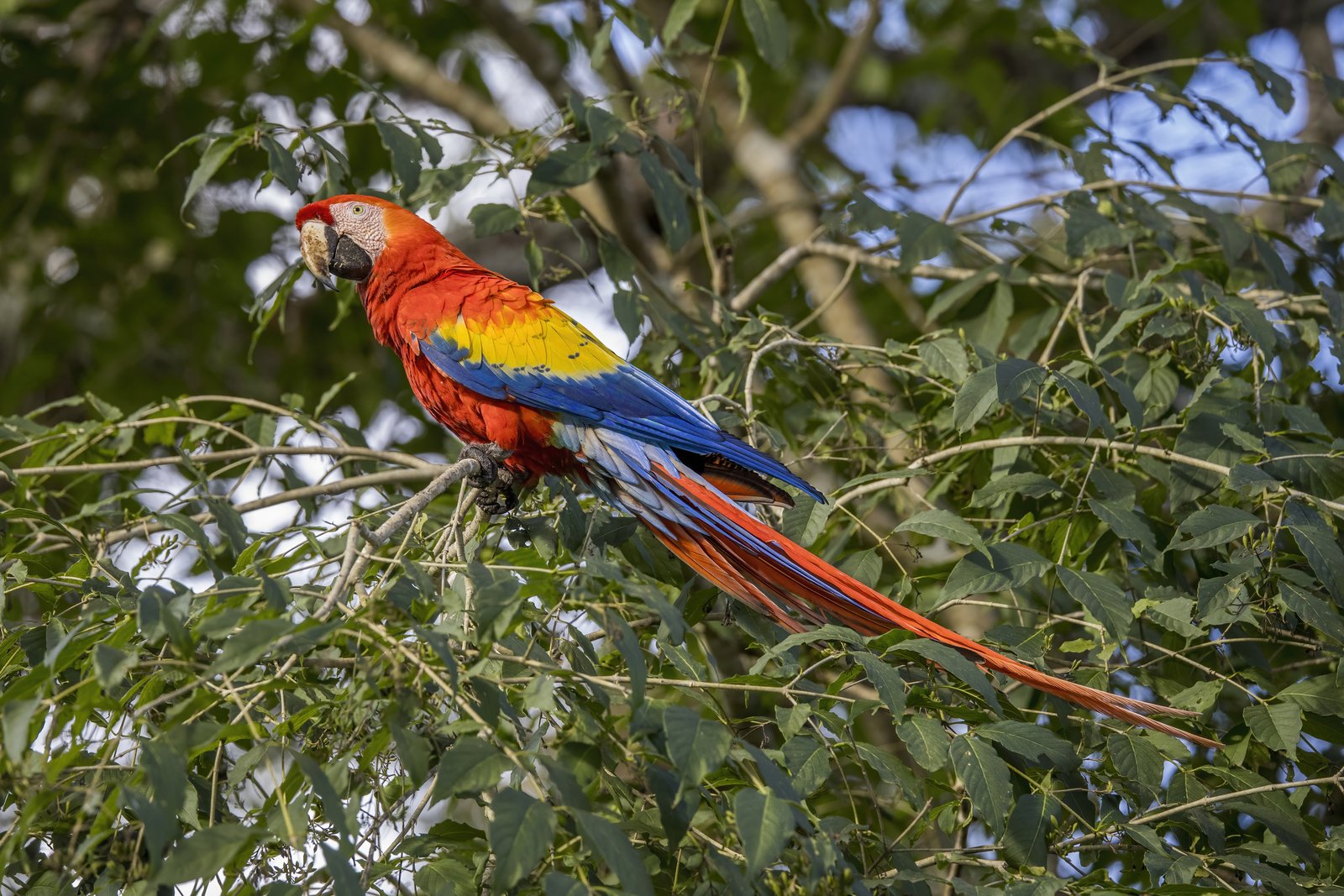
The Scarlet Macaw is one of the largest and most colourful parrots in the world, scarlet with yellow and blue in the wings. In the guide area it lives in the Amazonian lowlands east of the Andes, where pairs and small groups fly screeching loudly over the forest. At clay banks along the rivers dozens of macaws sometimes gather to eat clay.
Voice
Loud, harsh, raucous screeches, mainly in flight, audible over long distances. Groups at a clay lick keep up a continuous squabbling.
Recording: Paul Driver — CC BY-NC-SA 4.0 · xeno-canto
Identification
81–96 cm, of which more than half is tail, with a heavy, hooked bill: the upper mandible pale, the lower mandible black. The plumage is mostly scarlet. The upper wing coverts are yellow with green tips and form a broad yellow band on the wing; the flight feathers, the rump and the sides of the tail are blue. The cheeks are bare and white, with at most a few tiny feathers. In flight the long, pointed red tail and the yellow-and-blue wings stand out. The sexes are alike.
Confusion species
Red-and-green Macaw Ara chloropterus is slightly larger and darker red, with green instead of yellow wing coverts and distinct lines of small red feathers on the white cheeks; side by side on a clay lick the difference in the wing is obvious at once. Red-fronted Macaw Ara rubrogenys is much smaller and largely green, and lives only in the dry valleys of Bolivia.
Habitat
Tall, humid lowland forest on terra firme and along rivers, flooded forest and the edges of savanna and foothill forest, mostly below 1000 m. It eats fruit, nuts and seeds, including unripe ones, which it cracks open with its heavy bill. It visits clay banks along rivers to eat clay. It nests in a cavity high in a large, often dead tree.
Where the bird is most at home, classified by the vegetation units of the Andes and the west coast.


Range and movements
Mainly in the Amazonian lowlands east of the Andes. In Colombia in the east of the country. In Ecuador and Peru in the Amazonian lowlands and the foothills of the eastern slope. In Bolivia in the northern and central lowlands, into the savannas of the Beni. Absent from the Galápagos. Outside the guide area from southern Mexico through Central America, and in Venezuela, the Guianas and Brazilian Amazonia.
- Resident
- dark = core range, pale = thinly spread
How and when to look
At the clay licks along the rivers of south-eastern Peru, such as in Tambopata, in the morning, together with other macaws and parrots. Elsewhere mostly seen in flight at dawn and dusk, as pairs commute between roost and feeding area.
Conservation status
Least Concern, but strongly declining locally through deforestation and capture for the cage-bird trade; the species is listed on CITES Appendix I. In large, undisturbed Amazonian forests it is still fairly common.
Scientific name
Ara macao | (Linnaeus, 1758)
Linnaeus described the species in 1758 as Psittacus Macao; because it was later moved to another genus, the author and year stand in brackets. The genus Ara was introduced in 1799 by De Lacépède. The genus name comes from Tupi ará, 'macaw', an onomatopoeia of these birds' call. The species name comes from macao, a Brazilian Portuguese name for the Scarlet and Red-and-green Macaws. The specimen the first description was based on came from South America.