All species › Parrots › African and New World parrots › Red-fronted Macaw
Red-fronted Macaw | Ara rubrogenys
Roodwangara | Guacamayo frentirrojo | Arara-de-testa-vermelha
The Red-fronted Macaw is a medium-sized macaw found only in the dry inter-Andean valleys of central Bolivia. It nests in sheer cliffs along rivers and feeds in cactus scrub, dry forest and fields. With an estimated population of a few hundred adult birds it is one of the rarest macaws.
Voice
Loud, harsh screeches, mainly in flight and at the nesting cliffs; also raucous, shorter calls while feeding.
No recording with a suitable Creative Commons licence is available for this species yet.
Identification
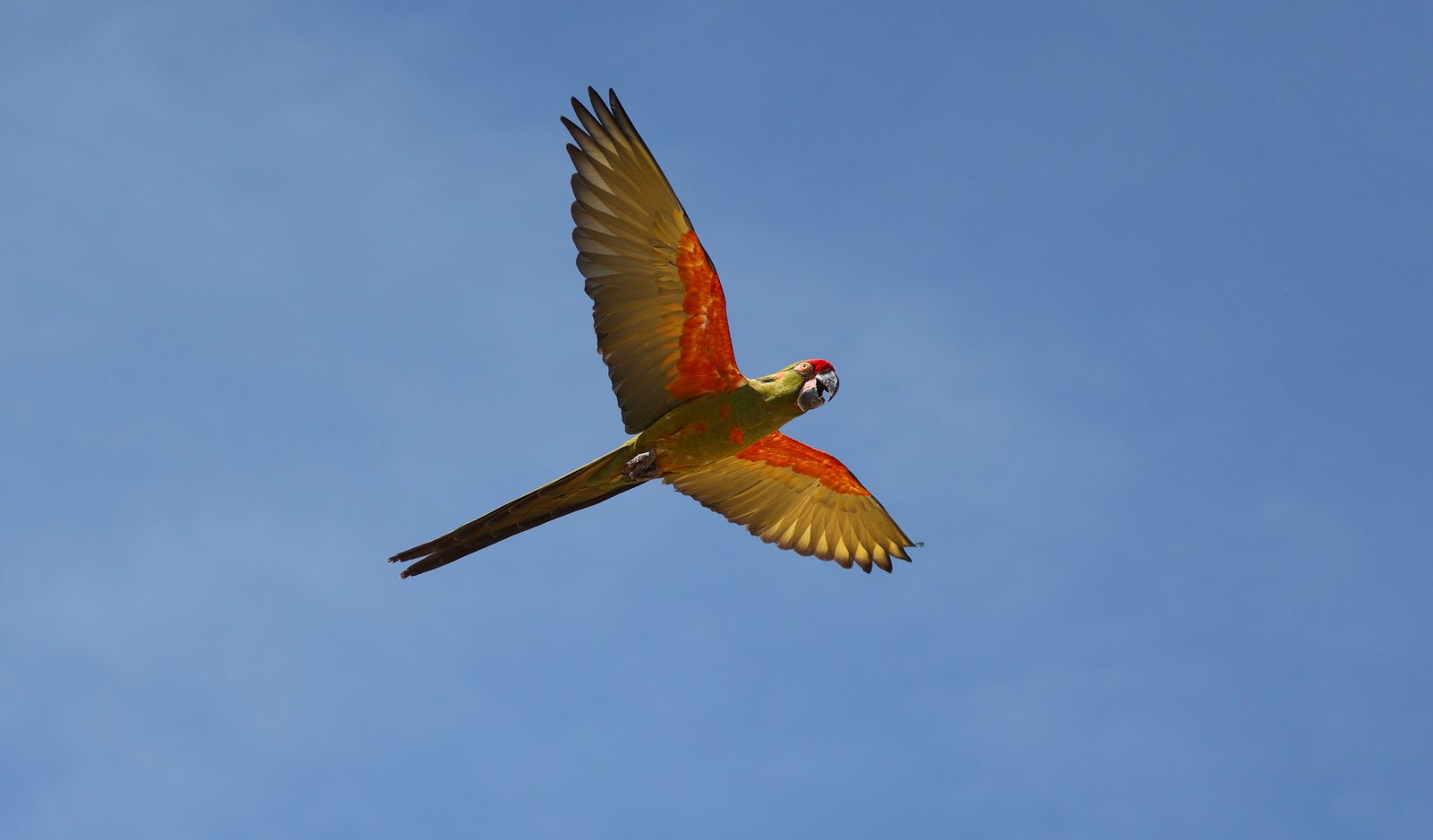
55–60 cm, with a long, pointed tail and a black bill. The plumage is olive green. The forehead and forecrown are red, and there is a red patch on the ear coverts. The bend of the wing and the lesser coverts are orange-red; in flight the orange-red underwing coverts also show. The primaries are blue, and the tail is green with a blue tip. There is a small, bare, pale patch of skin around the eye. The sexes are alike. Young birds largely lack the red on the head and wing.
Confusion species
Military Macaw Ara militaris is much larger, without red on the ear coverts and bend of the wing, and lives mainly in forest on the slopes. Blue-crowned Parakeet Thectocercus acuticaudatus occurs in the same valleys but is smaller, with a bluish head, a pale bill and no red on the wing. Mitred Parakeet Psittacara mitratus is smaller and all green with red patches on the face, without orange-red on the wing.
Habitat
Dry, semi-desert valleys with cacti, thorn scrub and low dry forest, with cliffs along rivers, roughly between 1100 and 2500 m, locally higher. It eats seeds, fruit, cactus fruit and flowers, and also maize and peanuts from fields. It nests in holes and crevices in sheer cliffs, often in loose colonies.
Where the bird is most at home, classified by the vegetation units of the Andes and the west coast.


Range and movements
Endemic to Bolivia: in the dry inter-Andean valleys of Cochabamba, Santa Cruz, Chuquisaca and Potosí, mainly in the drainages of the Río Grande, the Río Mizque and the Río Pilcomayo. Absent from Colombia, Ecuador, Peru and the Galápagos.
- Resident
- dark = core range, pale = thinly spread
How and when to look
In the dry valleys around Saipina and Comarapa in Santa Cruz and along the Río Mizque, where birds fly in the morning from the nesting and roosting cliffs to the fields and scrub. Look for the orange-red in the wing of flying birds.
Conservation status
Critically Endangered. The population is small and fragmented; birds are persecuted as crop pests, captured for the cage-bird trade, and their habitat is degraded by woodcutting and grazing.
Scientific name
Ara rubrogenys | de Lafresnaye, 1847
De Lafresnaye described the species in 1847 and placed it straight away in the genus where it still stands. The genus Ara was introduced in 1799 by De Lacépède. The genus name comes from Tupi ará, 'macaw', an onomatopoeia of these birds' call. The species name comes from Latin ruber, 'red', and gena, 'cheek', for the red patch on the head and cheeks. The specimen the first description was based on came from Bolivia.