All species › Parrots › African and New World parrots › Chestnut-fronted Macaw
Chestnut-fronted Macaw | Ara severus
Dwergara | Guacamayo frenticastaño | Maracanã-guaçu
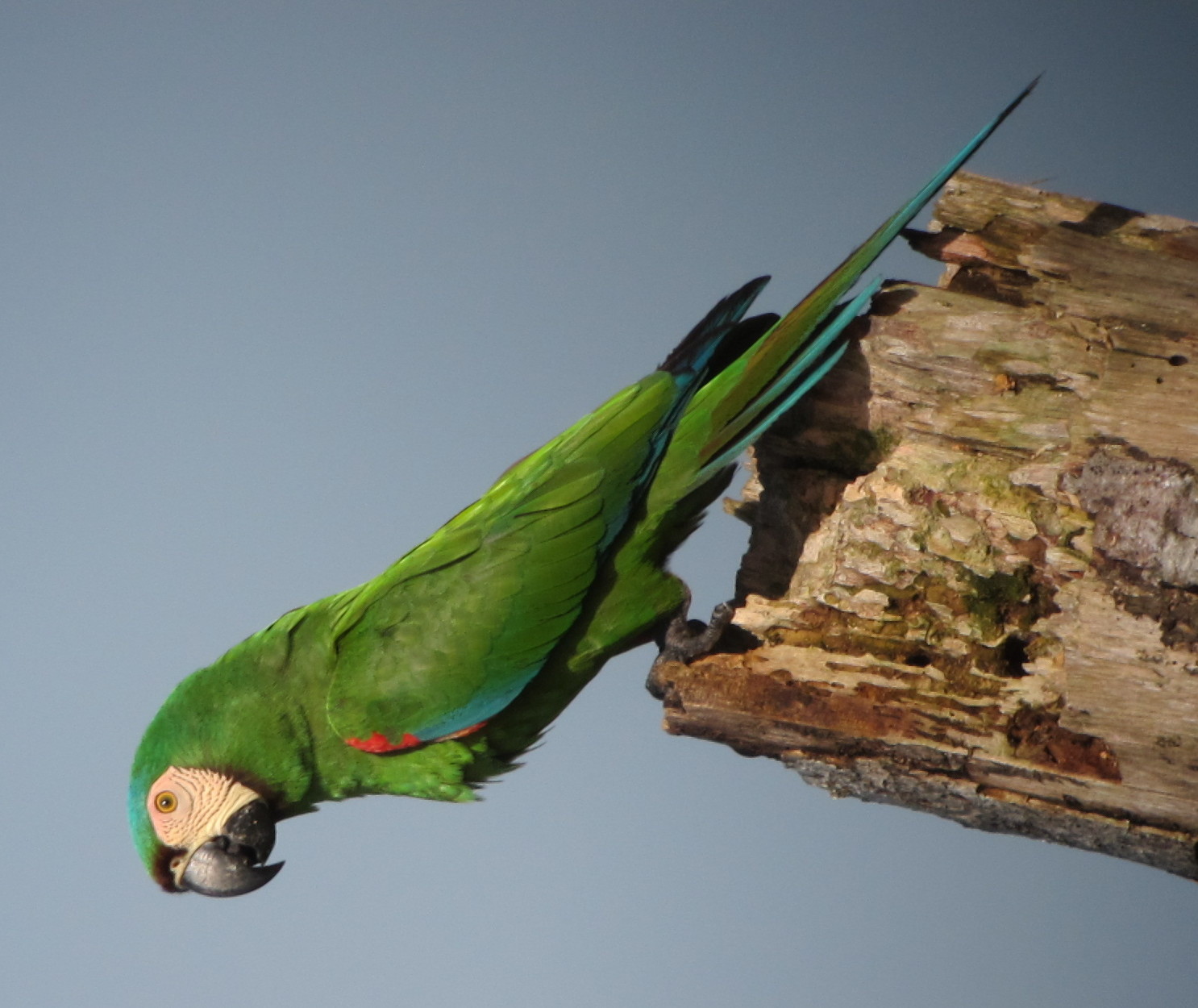
The Chestnut-fronted Macaw is the most widespread small macaw in the guide area, mainly green with a chestnut forehead. It lives in pairs and flocks in humid lowland forest, along rivers and in semi-open country, and regularly visits clay licks. In flight the long tail and the red underwing stand out.
Voice
Loud, harsh, hoarse screeches, higher and less deep than those of the large macaws, mainly in flight.
Recording: Juan Freile — CC BY-NC-SA 4.0 · xeno-canto
Identification
46 cm, with a long, pointed tail and a black bill. The face is bare and white, with lines of small black feathers. A narrow chestnut band lies on the forehead and chin; the crown is bluish. The body is green. The bend of the wing and the underwing coverts are red, the flight feathers blue above. The tail is reddish brown above with a blue tip, and olive-yellow below. The sexes are alike.
Confusion species
Red-bellied Macaw Orthopsittaca manilatus has a bare yellowish face, a red belly patch and no red in the underwing. Blue-headed Macaw Primolius couloni is smaller, with a blue head and a grey face. Red-shouldered Macaw Diopsittaca nobilis is much smaller, with a blue forehead. Military Macaw Ara militaris and Great Green Macaw Ara ambiguus are much larger, with a red forehead.
Habitat
Humid lowland forest, várzea, riverine forest, forest edges, secondary forest and open country with scattered trees, mostly below 1000 m. It eats fruit, seeds and flowers and regularly visits clay licks. It nests in cavities in dead trees or palms.
Where the bird is most at home, classified by the vegetation units of the Andes and the west coast.


Range and movements
In Colombia in the Chocó and the north of the country, and east of the Andes in the llanos and Amazonia. In Ecuador and Peru in the Amazonian lowlands and the foothills of the eastern slope. In Bolivia in the northern and central lowlands. Absent from the Galápagos. Outside the guide area in eastern Panama, Venezuela, the Guianas and Brazilian Amazonia.
- Resident
- dark = core range, pale = thinly spread
How and when to look
At clay licks along the rivers of Madre de Dios and in eastern Ecuador, in the morning. Pairs like to perch on dead treetops along rivers and fly over calling at dawn and dusk.
Conservation status
Least Concern and fairly common over most of its range. The species tolerates forest edges and secondary forest, but is trapped locally for the cage-bird trade.
Scientific name
Ara severus | (Linnaeus, 1758)
Linnaeus described the species in 1758 as Psittacus severus; because it was later moved to another genus, the author and year stand in brackets. The genus Ara was introduced in 1799 by De Lacépède. The genus name comes from Tupi ará, 'macaw', an onomatopoeia of these birds' call. The species name comes from Latin severus, 'stern, serious'; the reason for this name is unclear, possibly the sober colours. The specimen the first description was based on came from Amazon River, Brazil.