All species › Parrots › African and New World parrots › Monk Parakeet
Monk Parakeet | Myiopsitta monachus
Monniksparkiet | Cotorra argentina | Caturrita
The Monk Parakeet is the only parrot that builds a large nest of sticks instead of breeding in a cavity. In the guide area it lives only in Bolivia: in the dry Chaco lowlands of the south-east and, as a separate form, in the dry Andean valleys, where it breeds in colonies on cliffs. Outside South America it has become established in many places as an escaped cage bird.
Voice
Loud, shrill, grating screeches, such as kwee-kwee-kwee, and continuous chattering at the colony.
Recording: Christian Bøggild — CC BY-NC-SA 4.0 · xeno-canto
Identification
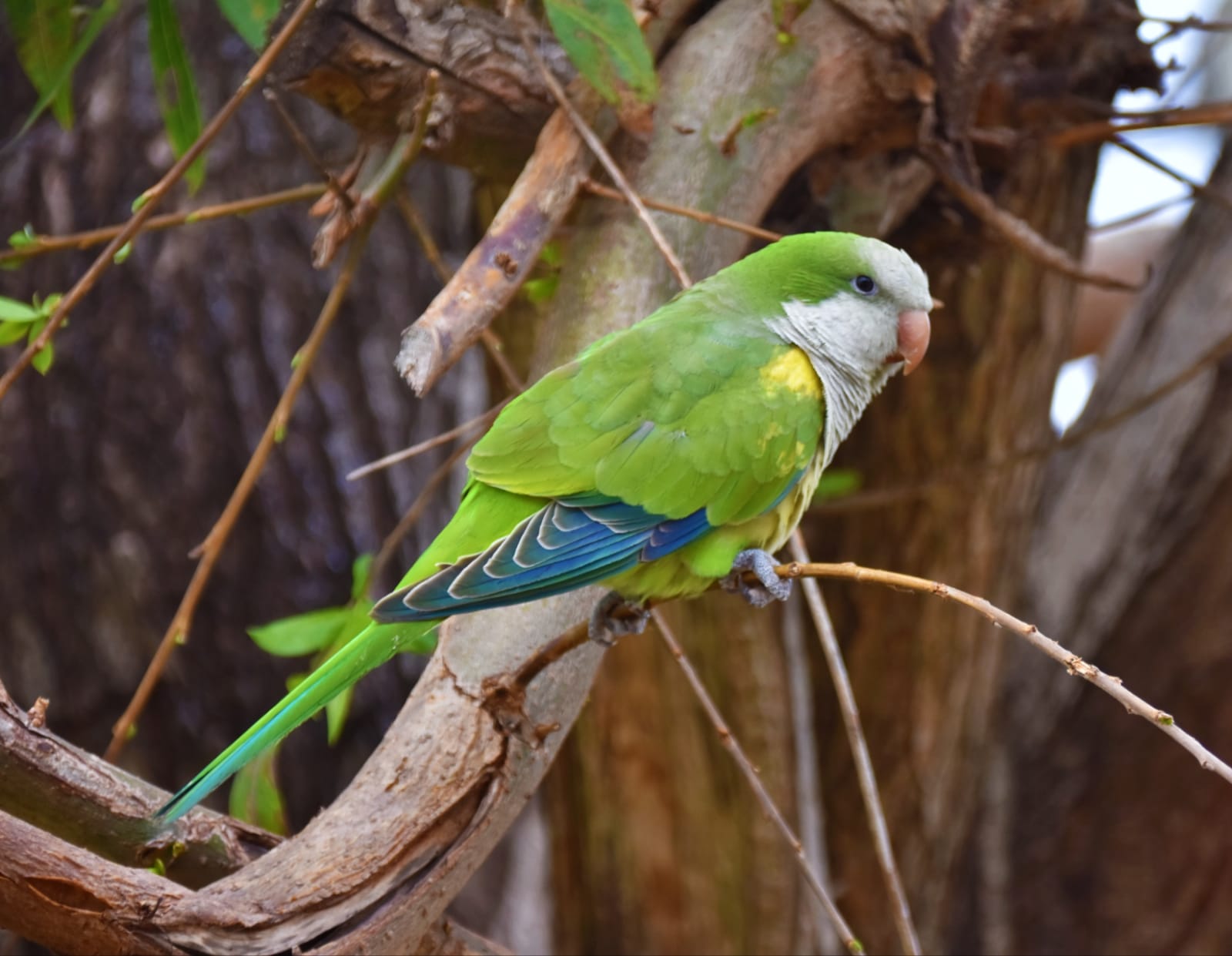
28–30 cm, with a long, pointed tail and a fairly heavy, orange-tinged horn-coloured bill. The forehead, face, throat and breast are grey; the breast feathers have pale edges, giving a scaled look. A yellowish-green band crosses the belly; the rest of the plumage is green. The flight feathers are blue. The sexes are alike. The form of the Andean valleys (luchsi) has a plain pale grey, unscaled breast, brighter green upperparts and a yellower belly.
Confusion species
Grey-hooded Parakeet Psilopsiagon aymara is much smaller and slimmer, with a grey hood and a whitish breast, and lives higher in the Andes. Blue-crowned Parakeet Thectocercus acuticaudatus is larger, with a blue head, a pale bill and a green breast. Green-cheeked Parakeet Pyrrhura molinae is smaller and darker, with a dark cap, a scaled breast and a maroon tail.
Habitat
In the lowlands dry Chaco forest, savanna with palms, fields, ranchland and villages. In the Andean valleys dry scrub with cacti and thorny shrubs along rivers, roughly between 1000 and 3000 m. It eats seeds, fruit, buds and flowers, and also crops such as maize and sunflowers. In the lowlands it builds large stick nests in trees and on poles and pylons, often with several nest chambers; the form of the Andean valleys breeds in colonies on ledges and in crevices of cliffs.
Where the bird is most at home, classified by the vegetation units of the Andes and the west coast.


Range and movements
Only in Bolivia: in the dry lowlands of the south-east, in Santa Cruz, Chuquisaca and Tarija, and in the dry Andean valleys of Cochabamba, Chuquisaca and Santa Cruz, including along the Río Grande and the Río Mizque. Absent from Colombia, Ecuador, Peru and the Galápagos. Outside the guide area in Paraguay, Uruguay, Argentina and southern Brazil; established in North America and Europe, among other regions.
- Resident
- dark = core range, pale = thinly spread
How and when to look
Look for the cliff colonies in the dry valleys of the Río Grande and the Río Mizque, where the birds come and go with loud screeching in the morning. In the Chaco lowlands the large stick nests in trees and on pylons reveal the presence of the species.
Conservation status
Least Concern. The species is locally controlled as a crop pest and trapped for the trade. The form of the Andean valleys has a small range.
Scientific name
Myiopsitta monachus | (Boddaert, 1783)
Boddaert described the species in 1783 as Psittacus monachus; because it was later moved to another genus, the author and year stand in brackets. The genus Myiopsitta was introduced in 1854 by Bonaparte. The genus name comes from Greek mus, muos, 'mouse', and Modern Latin psitta, 'parrot', for the mouse-grey face and underparts of the Monk Parakeet. The species name comes from Latin monachus, 'monk', for the grey hood. The specimen the first description was based on came from Montevideo, Uruguay.