All species › Parrots › African and New World parrots › Mountain Parakeet
Mountain Parakeet | Psilopsiagon aurifrons
Citroenparkiet | Perico cordillerano | Periquito-das-montanhas
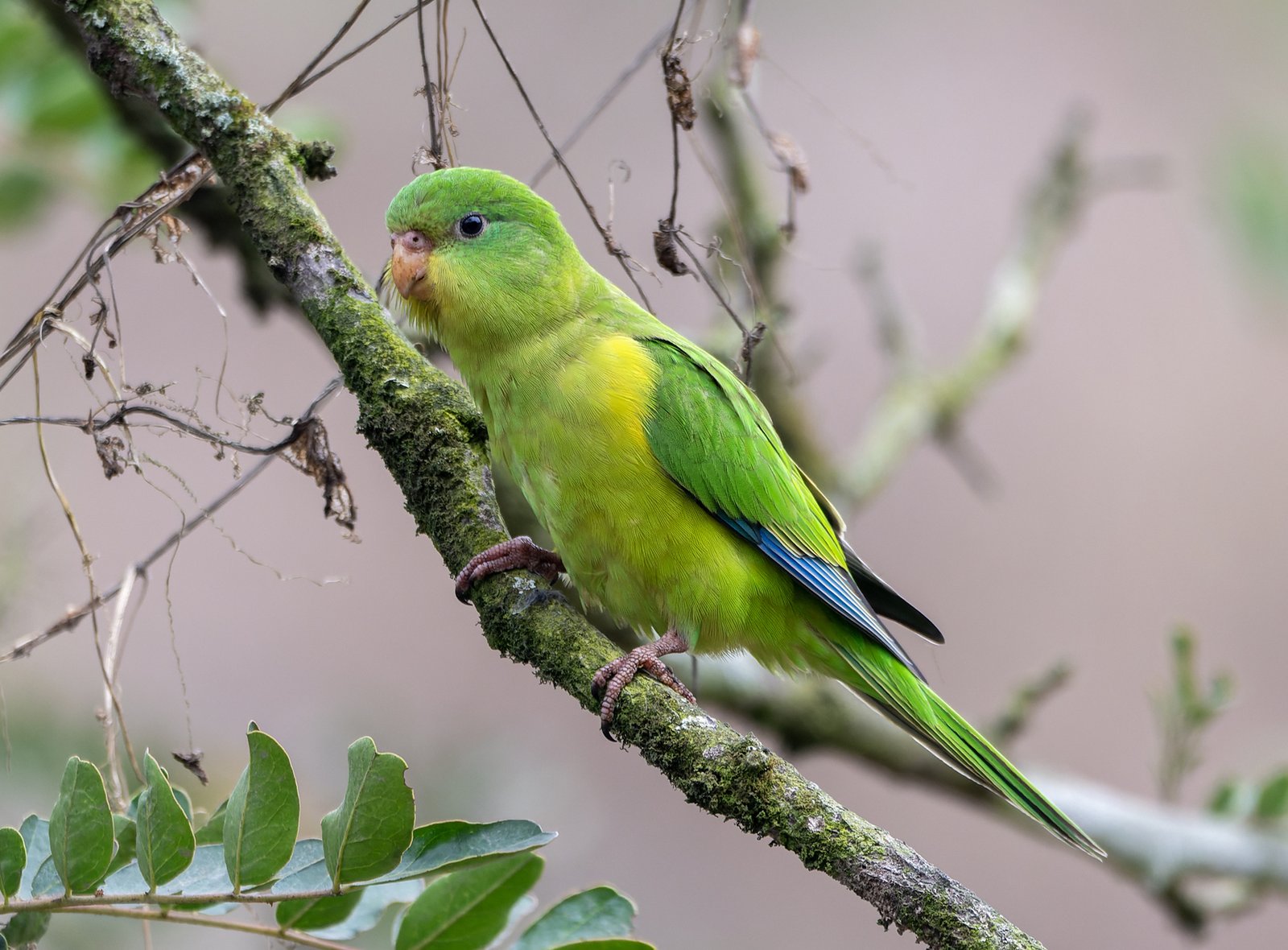
The Mountain Parakeet is a small, green parakeet with a pointed tail, found on the dry western slope, in the inter-Andean valleys and on the high plateau of Peru and Bolivia. The male of most forms has a yellow face. It occurs from the coastal valleys of Peru to well above 4000 m, and is one of the few parakeets of the puna.
Voice
A high, grating chatter and short, buzzy calls, rapidly repeated in flight; flocks keep in constant contact.
Recording: Barry Edmonston — CC BY-NC-SA 4.0 · xeno-canto
Identification
18–20 cm, with a pointed, medium-length tail and a small, pale, horn to pinkish bill. The plumage is bright green, slightly yellower below, with bluish flight feathers. In males of the northern forms the forehead, face and throat are yellow; in the southern form (in southern Peru and Bolivia) the yellow is more restricted. The female is plain green, at most with a yellow tinge on the face. Juveniles resemble the female.
Confusion species
Grey-hooded Parakeet Psilopsiagon aymara has a grey-brown hood, a greyish-white breast and a longer tail. Andean Parakeet Bolborhynchus orbygnesius is stockier and darker green, with a shorter, less pointed tail, and lives more in humid montane scrub and forest edges. Barred Parakeet Bolborhynchus lineola is barred with black and lives in cloud forest.
Habitat
Dry scrub with cacti, shrubby puna, Polylepis groves, fields, orchards, gardens and parks, from the irrigated coastal valleys to well above 4000 m. It feeds on seeds, buds, flowers and fruit, including those of cacti, and often forages on the ground. It nests in cavities, including in steep earth banks and rocks.
Where the bird is most at home, classified by the vegetation units of the Andes and the west coast.


Range and movements
In Peru along the western slope and in the coastal valleys from north to south, in the Marañón valley and on the high plateau of the south. In Bolivia on the altiplano and in the Andes and dry valleys of the west. Absent from Colombia, Ecuador and the Galápagos. Outside the guide area in northern Chile and north-western Argentina.
- Resident
- dark = core range, pale = thinly spread
How and when to look
In the western Andean valleys of Peru and around Arequipa, and on the altiplano around Lake Titicaca, where flocks forage among shrubs, fields and village gardens. Flying flocks give themselves away by their constant chatter.
Conservation status
Least Concern. The species benefits locally from fields and gardens and has a large range.
Scientific name
Psilopsiagon aurifrons | (Lesson, 1831)
Lesson described the species in 1831 as Psittacus (Lathamus) aurifrons; because it was later moved to another genus, the author and year stand in brackets. The genus Psilopsiagon was introduced in 1912 by Ridgway. The genus name comes from Greek psilos, 'bare', and siagōn, 'jaw'. The species name comes from Latin aurum, 'gold', and frons, 'forehead'. The specimen the first description was based on came from Peru.