All species › Parrots › African and New World parrots › Grey-hooded Parakeet
Grey-hooded Parakeet | Psilopsiagon aymara
Aymaraparkiet | Catita aimará | Periquito-de-capuz-cinza
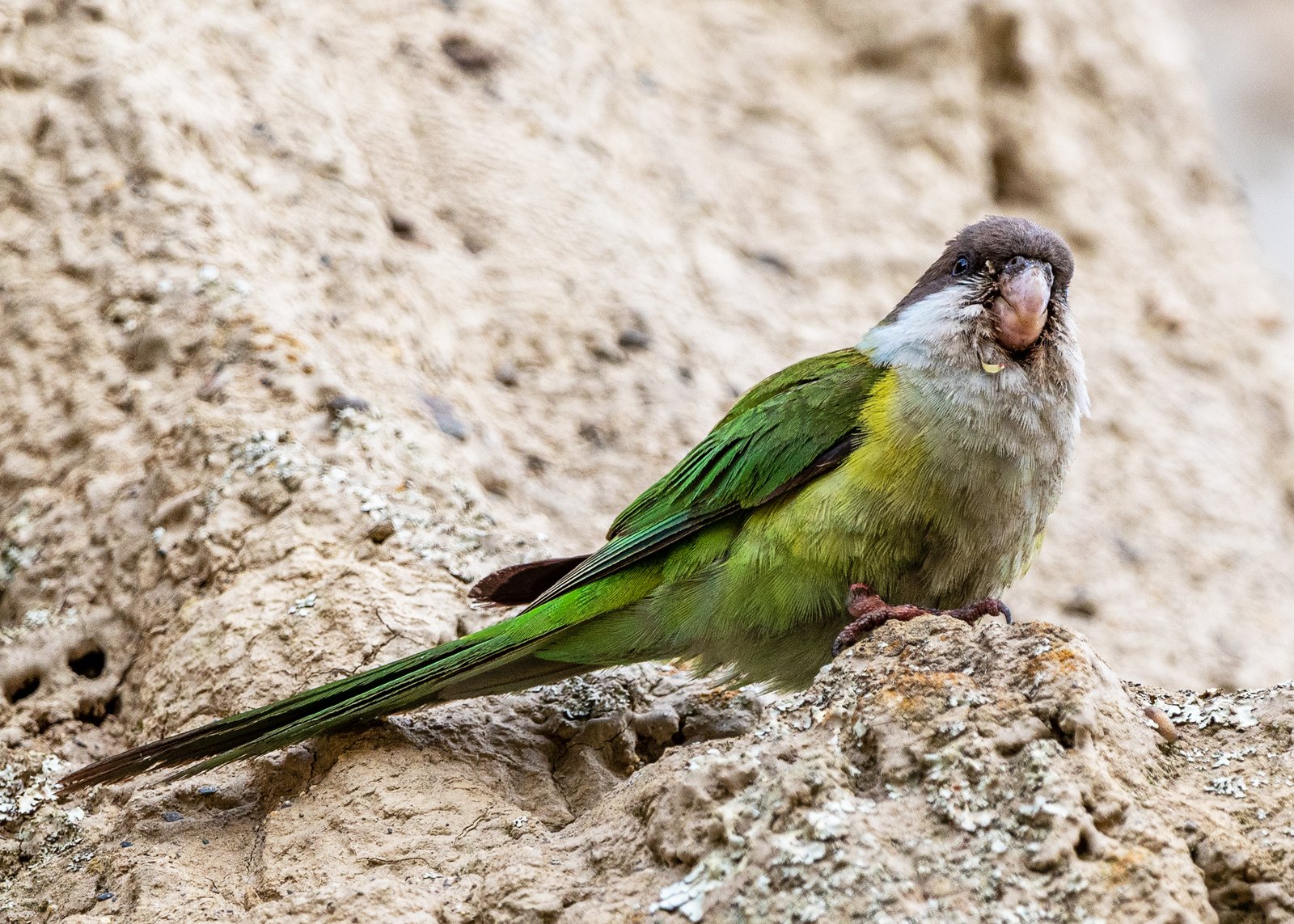
The Grey-hooded Parakeet is a small, slender parakeet with a long, pointed tail and a grey-brown hood, found in the dry valleys and slopes of the Andes of Bolivia and Argentina. It lives in fast, chattering flocks that fly low over scrub, fields and villages. Together with the Mountain Parakeet it forms the genus Psilopsiagon, parakeets of the high Andes.
Voice
A lively, high chatter and short, grating calls such as dzeet, mainly in flight; flocks call constantly.
Recording: Jacob Wijpkema — CC BY-NC-SA 4.0 · xeno-canto
Identification
19–20 cm, with a long, graduated, pointed tail and a small, pale, pinkish-horn bill. The crown, cheeks and nape form a grey-brown hood. The throat and breast are pale grey to greyish white, and the belly and flanks are yellowish green. The upperparts are bright green and the flight feathers bluish. The sexes are alike. Juveniles are duller, with a less sharply defined hood.
Confusion species
Mountain Parakeet Psilopsiagon aurifrons lacks the grey hood, is plain green (the male with a yellow face) and has a shorter tail. Andean Parakeet Bolborhynchus orbygnesius is stockier and plain green, with a short tail. Monk Parakeet Myiopsitta monachus is larger, with a grey forehead and a grey, scalloped breast; in the dry Andean valleys of Bolivia it breeds in colonies on cliffs.
Habitat
Dry inter-Andean valleys, slopes with scrub and cacti, Polylepis and alder groves, fields, orchards, eucalyptus plantations and villages, roughly between 1800 and 4000 m. It feeds on seeds, buds, flowers and fruit, both in shrubs and on the ground. It nests in cavities, including in steep banks and trees.
Where the bird is most at home, classified by the vegetation units of the Andes and the west coast.


Range and movements
In Bolivia in the Andes and dry valleys of the west, centre and south of the country, mainly from La Paz and Cochabamba south to Tarija. Absent from Colombia, Ecuador, Peru and the Galápagos. Outside the guide area in north-western Argentina and rarely in the far north of Chile.
- Resident
- dark = core range, pale = thinly spread
How and when to look
In the dry valleys around Cochabamba and further south, where flocks fly noisily over fields, scrub and village edges in the early morning. Perched birds are green and inconspicuous in the bushes; look for the grey hood and the long tail.
Conservation status
Least Concern. The species adapts to farmland and villages and is regularly seen over much of its range.
Scientific name
Psilopsiagon aymara | (d'Orbigny, ACVMD, 1839)
D'Orbigny, ACVMD described the species in 1839 as Arara aymara; because it was later moved to another genus, the author and year stand in brackets. The genus Psilopsiagon was introduced in 1912 by Ridgway. The genus name comes from Greek psilos, 'bare', and siagōn, 'jaw'. The species name refers to the Aymara, the Indigenous people of the Altiplano of Bolivia and Peru, not necessarily the type locality. The specimen the first description was based on came from Sica Sica, La Paz, Bolivia.