All species › Parrots › African and New World parrots › Cobalt-winged Parakeet
Cobalt-winged Parakeet | Brotogeris cyanoptera
Kobaltvleugelparkiet | Perico alicobáltico | Periquito-de-asa-azul
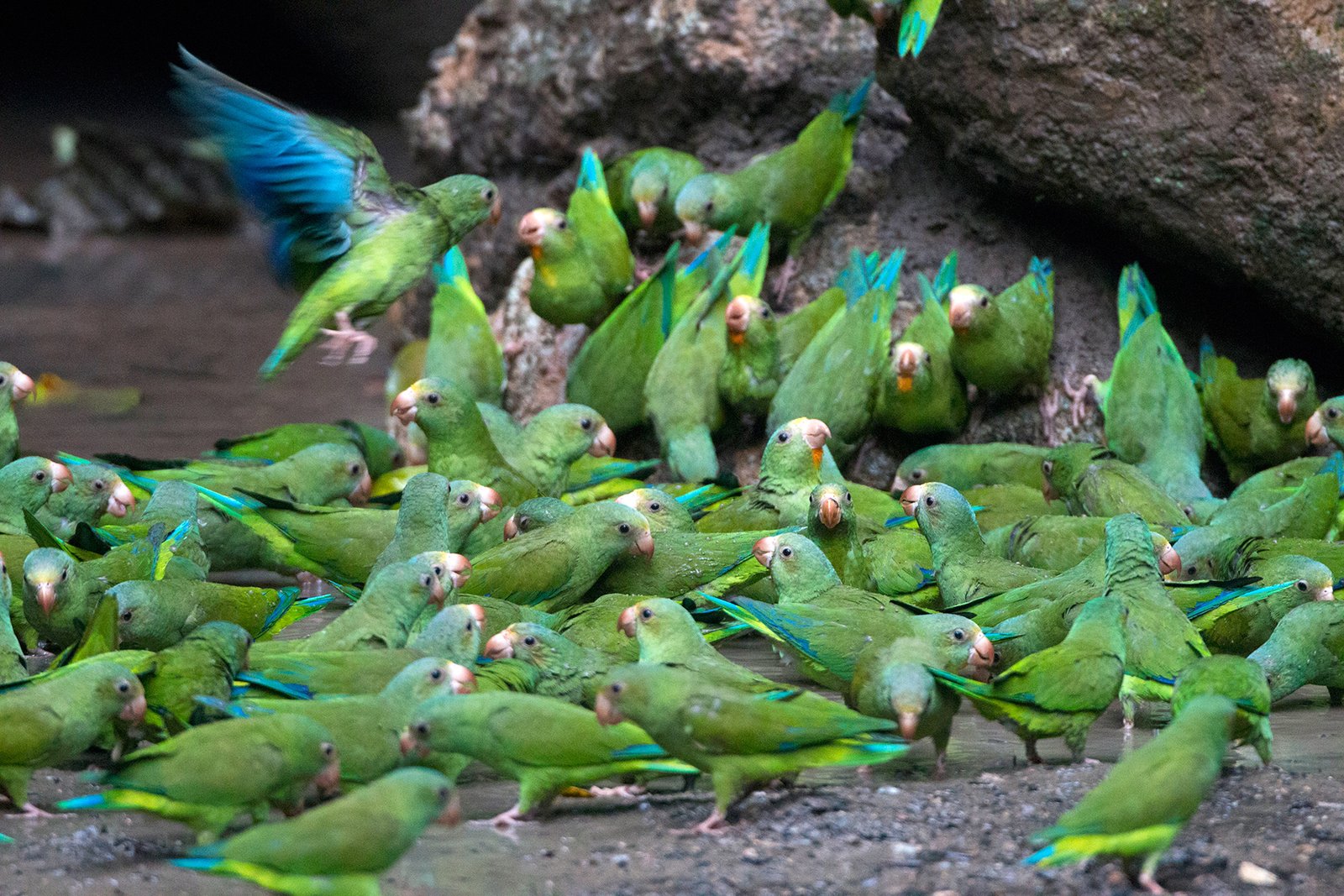
The Cobalt-winged Parakeet is the commonest small parakeet over much of western Amazonia. Flocks fly with loud chattering above the canopy and gather in fruiting and flowering trees. The cobalt-blue flight feathers show mainly in flight.
Voice
A shrill, high cheet and rapid, continuous chattering; one of the most frequently heard parrot sounds in Amazonian lowland forest.
Recording: JAYRSON ARAUJO DE OLIVEIRA — CC BY-NC-SA 4.0 · xeno-canto
Identification
18–19 cm, with a short, pointed tail and a pale, horn-coloured bill. The plumage is green, with a yellowish-green forehead and a slightly bluish crown. There is a small orange spot on the chin. The primaries and their coverts are cobalt blue. Birds of the Huallaga in Peru (gustavi) also have a yellow bend of the wing and yellow coverts. The sexes are alike.
Confusion species
Tui Parakeet Brotogeris sanctithomae has a yellow forehead and lacks the orange chin spot and the blue in the wing, and lives mainly along rivers. Manu Parrotlet Nannopsittaca dachilleae is smaller, with a pale blue forehead and no blue in the wing. Dusky-billed Parrotlet Forpus modestus is smaller, with a short, wedge-shaped tail and a dark upper mandible.
Habitat
The canopy and edges of terra firme and flooded forest, clearings with tall trees and the Andean foothills, from the lowlands to roughly 1200 m. It eats fruit, seeds, flowers and nectar, and visits clay licks. It nests in a termite nest in a tree or in a tree cavity.
Where the bird is most at home, classified by the vegetation units of the Andes and the west coast.


Range and movements
In Colombia in the lowlands east of the Andes, from the south to the llanos. In Ecuador throughout the eastern lowlands and foothills. In Peru in the eastern lowlands and foothills from north to south. In Bolivia in the north and north-west, in Pando, Beni, La Paz and Cochabamba. Absent from the Galápagos. Outside the guide area in southern Venezuela and western Brazil.
- Resident
- dark = core range, pale = thinly spread
How and when to look
At any larger forest lodge in the Amazonian lowlands of Ecuador and Peru, from a canopy tower or at a clay lick in the morning. Watch for flocks flying fast above the canopy and for the blue in the wing.
Conservation status
Least Concern. The species is common in a large range with much undisturbed forest; locally forest is lost to clearing.
Scientific name
Brotogeris cyanoptera | (Pelzeln, 1870)
Pelzeln described the species in 1870 as Sittace cyanoptera; because it was later moved to another genus, the author and year stand in brackets. The genus Brotogeris was introduced in 1825 by Vigors. The genus name comes from Greek brotos, 'man, mortal', and gērus, 'voice, speech', for the ability to mimic human speech. The species name comes from Greek kuanos, 'dark blue', and pteron, 'wing', for the blue flight feathers. The specimen the first description was based on came from Brazil.