All species › Parrots › African and New World parrots › Orange-chinned Parakeet
Orange-chinned Parakeet | Brotogeris jugularis
Toviparkiet | Perico barbinaranja | Periquito-de-queixo-laranja
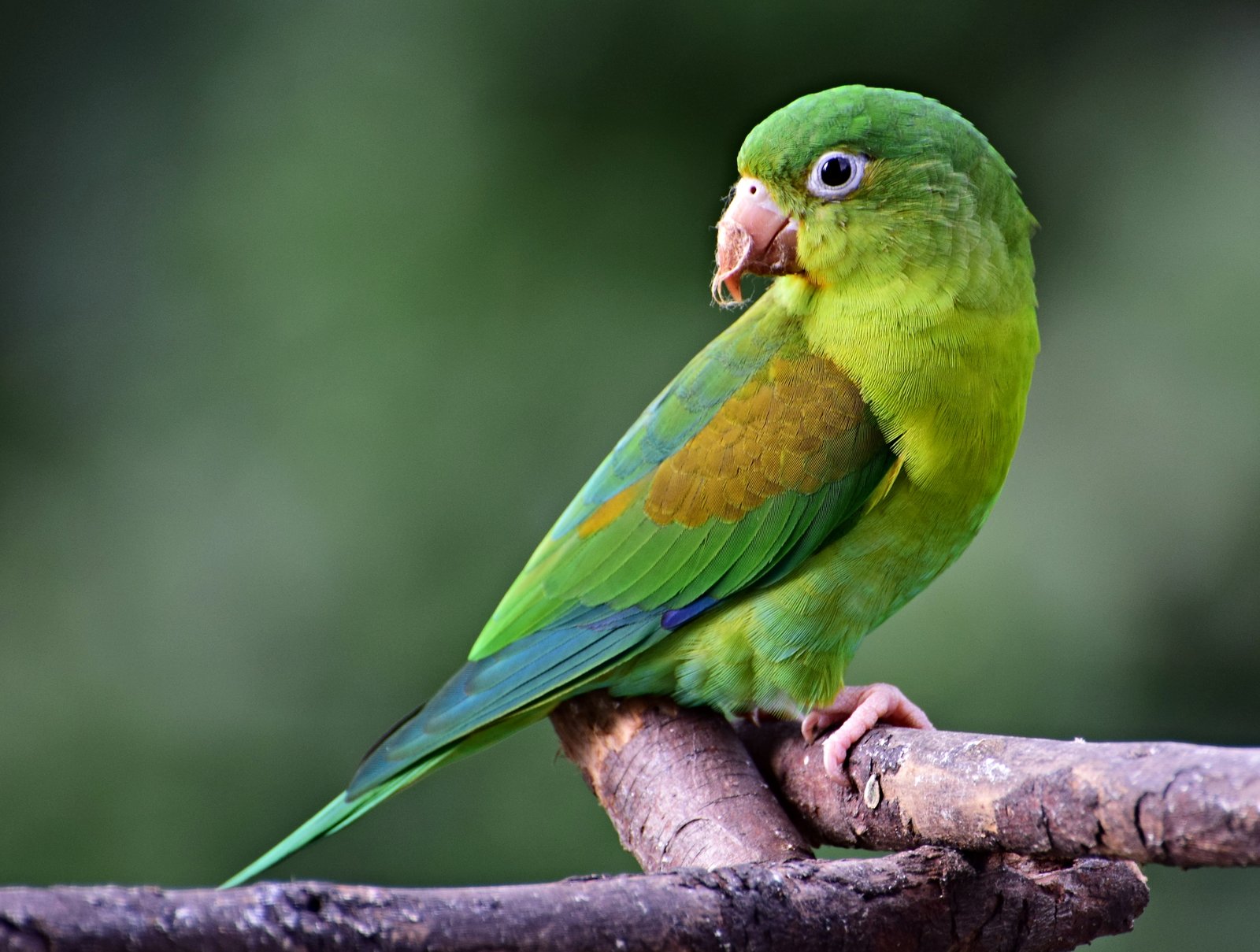
The Orange-chinned Parakeet is a small, green parakeet of the open and semi-open country of northern Colombia. It is recognisable by a small orange chin spot and brownish shoulders. Flocks are common in wooded pastures, plantations and villages.
Voice
A shrill, rapid chit-chit and continuous, harsh chattering; flocks are noisy even when perched.
Recording: Stephan Risch — CC BY-NC-SA 4.0 · xeno-canto
Identification
18 cm, with a fairly short, pointed tail and a pale, horn-coloured bill. The plumage is green, slightly more yellowish below. There is a small orange spot on the chin. The lesser wing coverts are olive-brown and form brown shoulders. The underwing coverts are yellow. The sexes are alike. Juveniles resemble the adults, with a smaller chin spot.
Confusion species
Green-rumped Parrotlet Forpus passerinus and Spectacled Parrotlet Forpus conspicillatus are smaller, with a short, wedge-shaped tail, and lack the orange chin spot and brown shoulders. Brown-throated Parakeet Eupsittula pertinax is larger, with a long tail and a brownish face and throat. Cobalt-winged Parakeet Brotogeris cyanoptera also has an orange chin spot, but has blue flight feathers and no brown shoulders, and lives east of the Andes.
Habitat
Open woodland, dry forest, forest edges, pastures and fields with scattered trees, plantations, gardens and villages, from the lowlands to roughly 1200 m. It eats fruit, seeds, flowers and nectar. It nests in a termite nest in a tree or in a tree cavity.
Where the bird is most at home, classified by the vegetation units of the Andes and the west coast.


Range and movements
In Colombia in the north: in the Caribbean lowlands, in the Magdalena and Cauca valleys, in Urabá and in the north-east. Absent from Ecuador, Peru, Bolivia and the Galápagos. Outside the guide area from southern Mexico through Central America to northern Venezuela.
- Resident
- dark = core range, pale = thinly spread
How and when to look
In the wooded pastures of the Caribbean lowlands and the Magdalena valley, and in parks and gardens of towns such as Santa Marta. Flocks feed in flowering trees and give themselves away by their chattering.
Conservation status
Least Concern. The species is common in open, human-made landscapes; it is locally trapped for the cage-bird trade.
Scientific name
Brotogeris jugularis | (Müller, 1776)
Müller described the species in 1776 as Psittacus jugularis; because it was later moved to another genus, the author and year stand in brackets. The genus Brotogeris was introduced in 1825 by Vigors. The genus name comes from Greek brotos, 'man, mortal', and gērus, 'voice, speech', for the ability to mimic human speech. The species name comes from Latin jugulum, 'throat', for the orange chin spot. The specimen the first description was based on came from Bonda, Santa Marta, Colombia.