All species › Passerines › Tanagers and allies › Moss-backed Tanager
Moss-backed Tanager | Bangsia edwardsi
Groenrugtangare | Tangara dorsimusgosa | Sanhaço-de-dorso-musgo
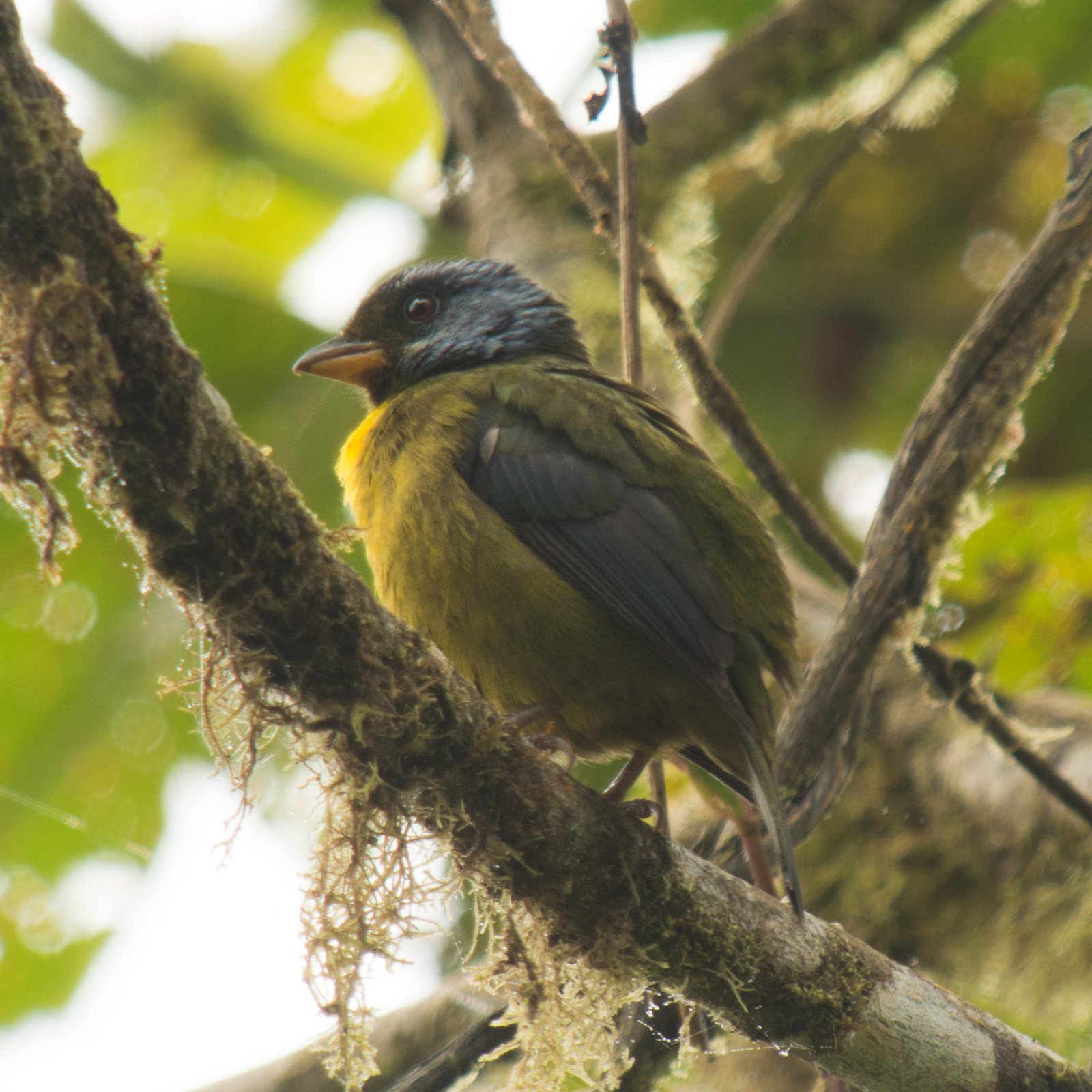
The Moss-backed Tanager is a stocky tanager of wet foothill and lower montane forest in the Chocó, with a blue head, a moss-green back and a yellow breast patch. It often perches high on mossy branches and bare twigs and joins mixed flocks. Of the Bangsia tanagers it is the most widespread in Ecuador.
Voice
A rapid, somewhat rattling series of high, dry notes, often from a high perch, and thin tsit calls.
Recording: Patricio Mena Valenzuela — CC BY-NC-SA 4.0 · xeno-canto
Identification
16 cm, with a short, stout black bill and a short tail. Crown and cheeks are blue, the face around the bill and the throat black. Back, wings and tail are moss green. A yellow patch lies in the centre of the breast; belly and flanks are green. The iris is dark. The sexes are alike. Juveniles are duller, with a greenish head.
Confusion species
Golden-chested Tanager Bangsia rothschildi is blue-black without a green back and has yellow undertail coverts; it usually lives lower. Gold-ringed Tanager Bangsia aureocincta of the Western Andes in Colombia has a black head with a golden-yellow ring and lives higher. Yellow-green Tanager Bangsia flavovirens is plain yellowish green without a blue head.
Habitat
Wet foothill forest, lower montane forest and cloud forest on the Pacific side, also forest edges and old secondary growth, roughly from 500 to 2100 m, mostly between 700 and 1500 m. It eats mainly fruit and berries and also searches mossy branches for insects. The nest is a cup of moss.
Where the bird is most at home, classified by the vegetation units of the Andes and the west coast.


Range and movements
In Colombia on the Pacific slope of the Western Andes, from Chocó south to Nariño. In Ecuador on the western slope in the north, in Esmeraldas, Carchi, Imbabura and north-western Pichincha. Absent from Peru, Bolivia and the Galápagos. Does not occur outside the guide area.
- Resident
- dark = core range, pale = thinly spread
How and when to look
In north-western Ecuador, search forest edges and roads in foothill forest, for example around Milpe and Mashpi, where the birds also visit fruit feeders; look for a green tanager with a blue head high on a bare branch.
Conservation status
Least Concern. The range is limited to the Chocó and forest on the lower slopes is cleared locally; the species tolerates forest edges and secondary forest.
Scientific name
Bangsia edwardsi | (Elliot, 1865)
Elliot described the species in 1865 as Buthraupis edwardsi; because it was later moved to another genus, the author and year stand in brackets. The genus Bangsia was introduced in 1919 by Penard. The genus name honours Outram Bangs (1863–1932), an American zoologist and from 1900 curator of mammals at Harvard's Museum of Comparative Zoology. The species name honours Henri Milne-Edwards (1800–1885), a French zoologist. The specimen the first description was based on came from Colombia.