All species › Passerines › Tyrant flycatchers and allies › Mouse-colored Tyrannulet
Mouse-colored Tyrannulet | Nesotriccus murinus
Muisgrijze vliegenpikker | Tiranolete murino | Bagageiro
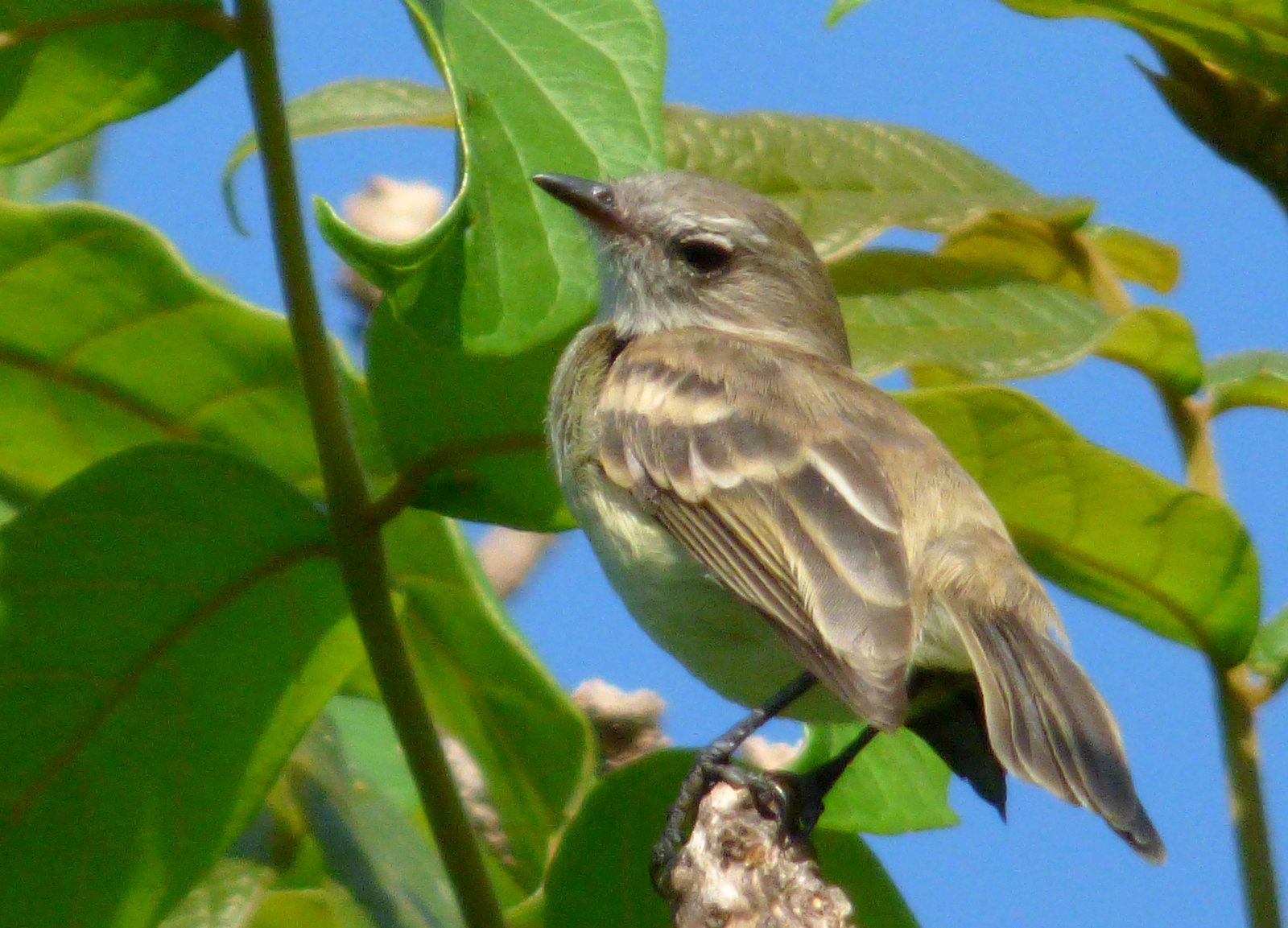
The Mouse-colored Tyrannulet is a small, plain grey-brown tyrant flycatcher of dry scrub, savanna and semi-open country. It is most noticeable by its scratchy, accelerating call. The species is widespread in South America; the birds of the dry west of Ecuador and Peru and of the Marañón valley are now often treated as separate species, Nesotriccus tumbezanus and Nesotriccus maranonicus.
Voice
A scratchy, accelerating series, chrr-chrr-chrr-chr-chr, often repeated at dawn, and short, hoarse calls.
No recording with a suitable Creative Commons licence is available for this species yet.
Identification
12 cm, with a rather short bill with a pale, pinkish to orange base to the lower mandible. The upperparts are dull greyish brown, the crown sometimes slightly raised. A pale, buffy-white eyebrow contrasts with a dark eyestripe. The wings are dark, with two buffy-brown to cinnamon wing bars. The throat is whitish, the breast pale grey and the belly pale buffy yellow. The sexes are alike.
Confusion species
Southern Beardless Tyrannulet Camptostoma obsoletum is smaller, with a more obvious crest and a darker bill, and often cocks its tail. Southern Scrub Flycatcher Sublegatus modestus has a short, all-black bill and a stronger contrast between grey breast and yellow belly. Small-billed Elaenia Elaenia parvirostris is larger, with a white eyering and a white crown patch. Plain Inezia Inezia inornata has a grey head with a white eyering and purer white wing bars.
Habitat
Dry scrub, savanna with scattered trees, open dry woodland, gallery forest, shrubby riverbanks, pasture with trees and gardens, from the lowlands up to about 1500 m, locally higher in dry Andean valleys. It takes insects and berries in shrubs and low trees. The nest is a cup of plant fibres in a fork of branches.
Where the bird is most at home, classified by the vegetation units of the Andes and the west coast.


Range and movements
Colombia: widespread in the Caribbean lowlands, the Magdalena and Cauca valleys and east of the Andes in the llanos and Amazonia. Ecuador: mainly in the eastern lowlands, locally in dry valleys in the north. Peru: in the east, mainly in San Martín, Loreto, Ucayali and Madre de Dios. Bolivia: widespread in the lowlands, the Beni savannas, the Chaco and the dry valleys of the eastern slope. Absent from the Galápagos. Outside the guide area from Panama and Venezuela to Brazil, Paraguay and northern Argentina.
- Resident
- dark = core range, pale = thinly spread
How and when to look
In dry scrub, savannas and gardens, listen for the scratchy call, especially in the early morning. In Bolivia the species is fairly common around Santa Cruz and in the Beni savannas.
Conservation status
Least Concern. The species is widespread and benefits from open, human-modified landscapes.
Scientific name
Nesotriccus murinus | (Spix, 1825) (GBIF: Phaeomyias murina)
Spix described the species in 1825 as Platyrhynchus murinus; because it was later moved to another genus, the author and year stand in brackets. The genus Nesotriccus was introduced in 1895 by Townsend. The genus name combines Greek nēsos, 'island', with Triccus, a tyrant-flycatcher genus name; the type species lives on Cocos Island. Latin murinus, 'mouse-like', for the mouse-grey plumage. The specimen the first description was based on came from Juazeiro, Bahia, Brazil.