All species › Passerines › Tyrant flycatchers and allies › Bearded Tachuri
Bearded Tachuri | Polystictus pectoralis
Baardtiran | Tachurí barbado | Papa-moscas-canela
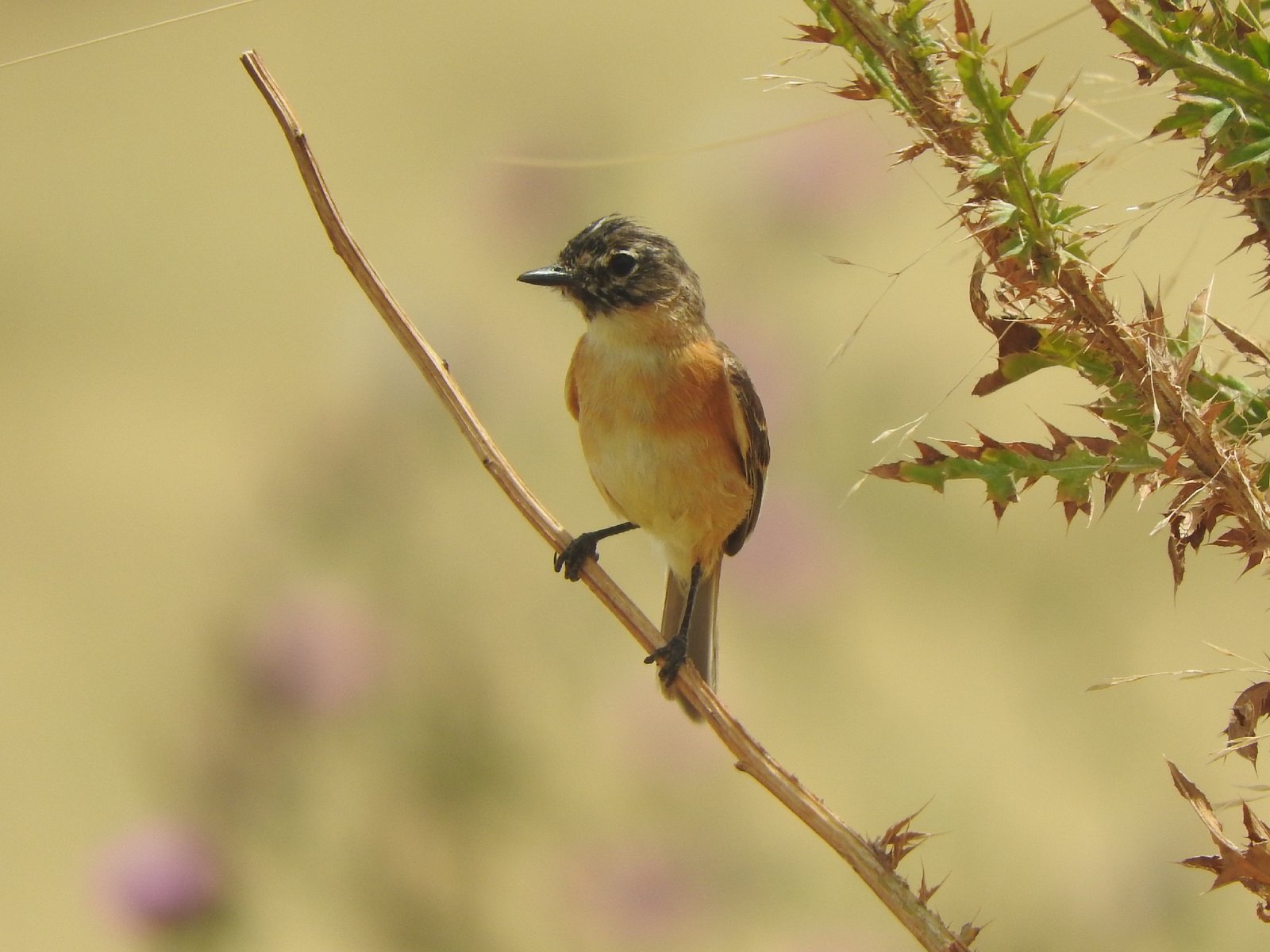
The Bearded Tachuri is a very small tyrant of open grassland and savanna. The male has a blackish, bushy crest and a streaked 'beard' on the chin. The species is spread over much of South America, but occurs only locally everywhere, as it is tied to natural grassland.
Voice
From a stem and in a display flight the male sings a high, thin series of short notes, ending in a brief, low, toneless note. The contact call is a weak, rising whistle.
Recording: Jeremy Minns — CC BY-NC-SA 3.0 · xeno-canto
Identification
10 cm, with a short black bill and a fairly short tail. The male has a dark grey to blackish crown with a bushy, usually flattened crest, a short white supercilium, a thin black eye-stripe and a black-and-white streaked chin. The upperparts are buffy brown, with a rufous rump; the wings are dusky, with cinnamon edges and two wing bars. The underparts are pale yellowish white, with a cinnamon wash on the breast and flanks. The female is duller, without a beard, with a brown crown and a whitish throat.
Confusion species
Sharp-tailed Grass Tyrant Culicivora caudacuta has a long, pointed tail and a striped head. Fulvous-crowned Scrub Tyrant Euscarthmus meloryphus has an orange-brown crown patch, no beard and lives in scrub. Rufous-sided Scrub Tyrant Euscarthmus rufomarginatus has yellower underparts and rufous flanks.
Habitat
Natural grassland, savanna with scattered shrubs and tall grass in open cerrado, often near wet spots, mostly below 1300 m. It searches for insects low in the grass and in small shrubs. The nest is a small cup low in a shrub or among grasses.
Where the bird is most at home, classified by the vegetation units of the Andes and the west coast.


Range and movements
In Colombia very locally in the savannas of the llanos in the east. The form bogotensis of the Andes of Cundinamarca and the Cauca Valley is probably extinct. In Bolivia in the savannas of the east, mainly in the austral winter. Absent from Ecuador, Peru and the Galápagos. Outside the guide area in Venezuela, the Guianas, Brazil, Paraguay, Uruguay and northern Argentina.
- Resident
- dark = core range, pale = thinly spread
How and when to look
Search the llanos of Colombia and the savannas of Beni and Santa Cruz in Bolivia for small birds in tall grass; singing males perch on top of a grass stem or make a short song flight.
Conservation status
Near Threatened. The population is declining through conversion of natural grassland to fields, pasture and plantations, overgrazing and fire.
Scientific name
Polystictus pectoralis | (Vieillot, 1817)
Vieillot described the species in 1817 as Sylvia pectoralis; because it was later moved to another genus, the author and year stand in brackets. The genus Polystictus was introduced in 1850 by Reichenbach. The genus name comes from Greek polustiktos, 'much-spotted', from polus, 'many', and stiktos, 'spotted'. The species name comes from Latin pectoralis, 'of the breast', for the breast markings. The specimen the first description was based on came from Paraguay.