All species › Passerines › Tyrant flycatchers and allies › White-crested Spadebill
White-crested Spadebill | Platyrinchus platyrhynchos
Witkuifbreedbektiran | Picochato crestiblanco | Patinho-de-coroa-branca
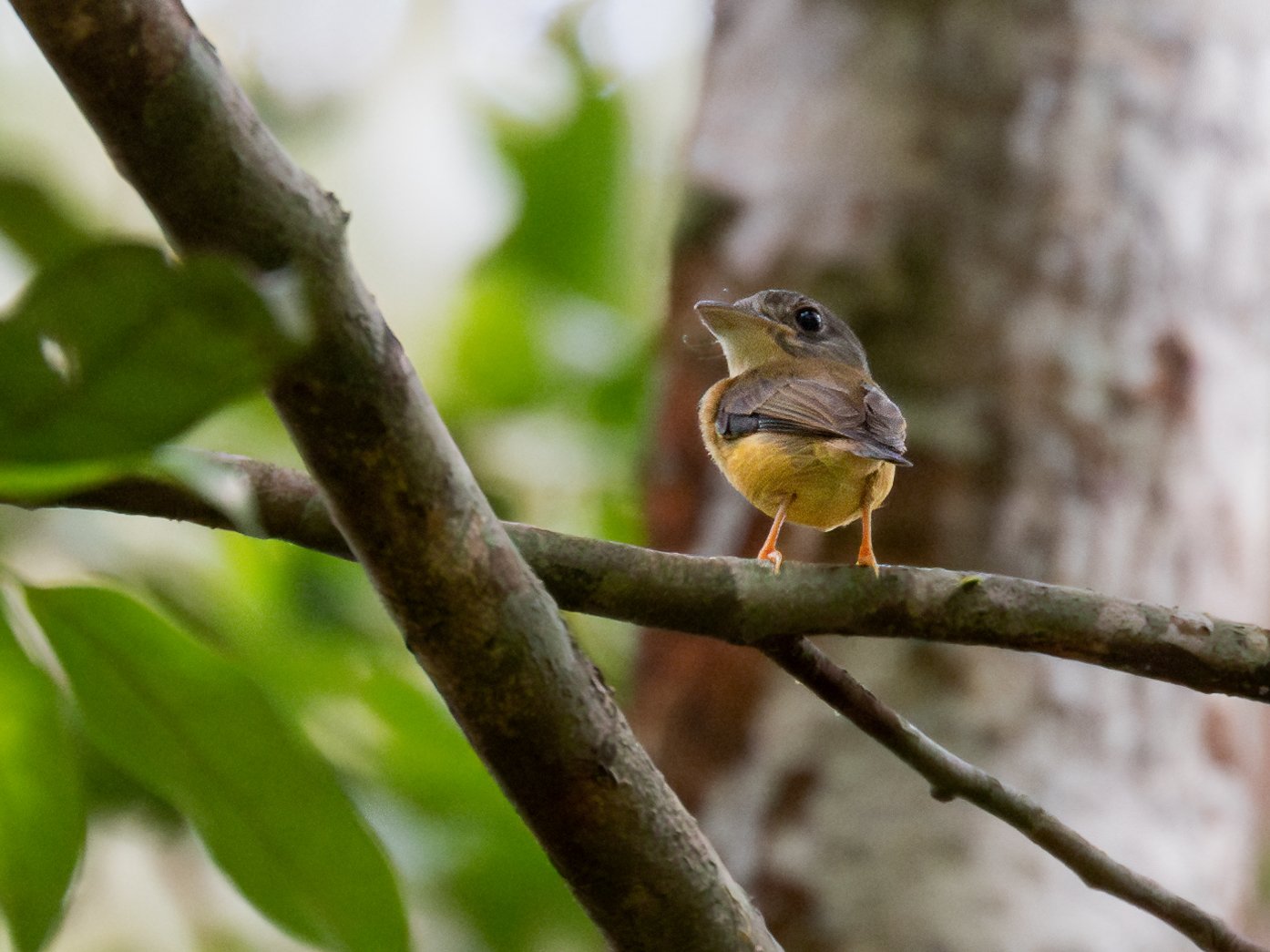
The White-crested Spadebill is the largest spadebill of the Amazonian lowlands, with a grey head and a white crown patch. It lives in the lower storey of tall terra firme forest. Its face is plainer than in most related species.
Voice
A buzzy, sharp trill, often preceded by a high skweep.
Recording: Felipe Arantes — CC BY-NC-SA 4.0 · xeno-canto
Identification
11 cm, with a large head, a very broad, flat bill and a short tail. The head is grey, with a concealed white crown patch that is larger in the male, a pale eye-ring and pale lores. The back is olive-brown. The throat is white, the breast and belly warm ochre to cinnamon.
Confusion species
Golden-crowned Spadebill Platyrinchus coronatus is smaller, with a rufous crown, a strongly patterned face and yellowish underparts. Cinnamon-crested Spadebill Platyrinchus saturatus is darker brown, with a cinnamon crown patch and a paler belly. Ruddy-tailed Flycatcher Terenotriccus erythrurus has similar underparts, but a small bill, a longer, rufous tail and no white throat.
Habitat
The lower storey of tall, humid terra firme forest in the lowlands and foothills, up to about 1000 m. It sits still on thin twigs and suddenly flies up to snatch insects from the undersides of leaves. The nest is a small cup in a fork, low above the ground.
Where the bird is most at home, classified by the vegetation units of the Andes and the west coast.


Range and movements
In Colombia in the east, in Amazonia. In Ecuador and Peru in the eastern lowlands. In Bolivia in the north, in Pando, Beni and La Paz. Absent west of the Andes and from the Galápagos. Outside the guide area in southern Venezuela, the Guianas and Amazonian Brazil.
- Resident
- dark = core range, pale = thinly spread
How and when to look
Listen along trails in tall terra firme forest for the buzzy trill, then search at two to five metres for a still bird with a grey head. Suitable places include Yasuní, the Iquitos area and Tambopata.
Conservation status
Least Concern. The species has a large range, but is generally scarce and avoids heavily fragmented forest.
Scientific name
Platyrinchus platyrhynchos | (Gmelin, 1788)
Gmelin described the species in 1788 as [Todus] platyrhynchos; because it was later moved to another genus, the author and year stand in brackets. The genus Platyrinchus was introduced in 1805 by Desmarest, A-G. The genus name comes from Greek platus, 'flat', and rhunkhos, 'bill'. The species name comes from Greek platus, 'flat', and rhunkhos, 'bill', like the genus name. The specimen the first description was based on came from Unknown (Suriname suggested).