All species › Passerines › Tyrant flycatchers and allies › Yellow-throated Spadebill
Yellow-throated Spadebill | Platyrinchus flavigularis
Geelkeelbreedbektiran | Picochato goliamarillo | Patinho-de-garganta-amarela
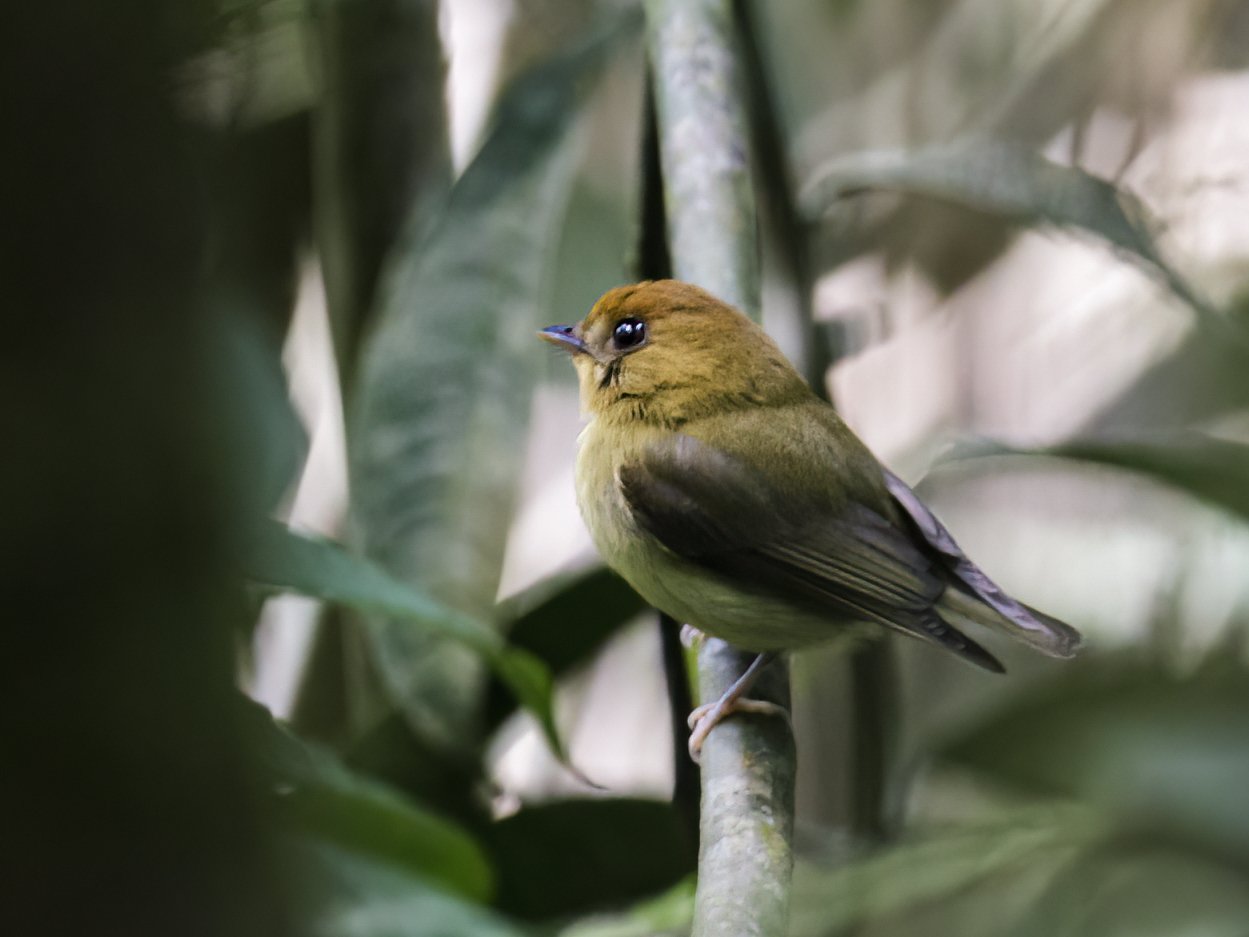
The Yellow-throated Spadebill is a scarce spadebill of montane forest in the northern and central Andes, with a bright yellow throat and underparts. It lives in the lower and middle storeys of humid forest. Relatively few records are known from its entire range.
Voice
A sharp, high peeyew, repeated at intervals, and a short, thin trill.
Recording: Paul Driver — CC BY-NC-SA 4.0 · xeno-canto
Identification
10 cm, with a large head, a very broad, flat bill and a short tail. The head is rufous-brown to cinnamon-brown, with a concealed white crown patch in the male; the face is fairly plain, without the black pattern of related species. The back is olive-green. The throat and underparts are bright yellow, the breast with an olive wash.
Confusion species
White-throated Spadebill Platyrinchus mystaceus has a white throat, an olive-brown head and a strongly patterned face. Golden-crowned Spadebill Platyrinchus coronatus is smaller, with a yellow crown stripe and black facial marks, and lives lower. Flatbills of the genus Tolmomyias have a longer tail and wing bars and perch higher in the trees.
Habitat
The lower and middle storeys of humid montane forest and cloud forest, mainly between about 1200 and 2300 m. It behaves like other spadebills: it sits still on a twig and suddenly flies up to snatch insects from the undersides of leaves. Little is known about the nest.
Where the bird is most at home, classified by the vegetation units of the Andes and the west coast.


Range and movements
In Colombia locally in the Andes. In Ecuador on the eastern slope of the Andes. In Peru locally along the eastern slope, south into the centre of the country. Absent from Bolivia and the Galápagos. Outside the guide area in the Andes of western Venezuela.
- Resident
- dark = core range, pale = thinly spread
How and when to look
Search the lower storey of undisturbed montane forest on the eastern slope and listen for the high call. The bird often sits still for a long time, usually a few metres above the ground.
Conservation status
Least Concern. The species is scarce and local everywhere; montane forest is being cleared in many places.
Scientific name
Platyrinchus flavigularis | Sclater, 1862
Sclater described the species in 1862 and placed it straight away in the genus where it still stands. The genus Platyrinchus was introduced in 1805 by Desmarest, A-G. The genus name comes from Greek platus, 'flat', and rhunkhos, 'bill'. The species name comes from Latin flavus, 'yellow', and gularis, 'of the throat', so 'yellow-throated'. The specimen the first description was based on came from Albán, Cundinamarca, Colombia.