All species › Passerines › Tyrant flycatchers and allies › Golden-crowned Spadebill
Golden-crowned Spadebill | Platyrinchus coronatus
Geelkapbreedbektiran | Picochato coronidorado | Patinho-de-coroa-dourada
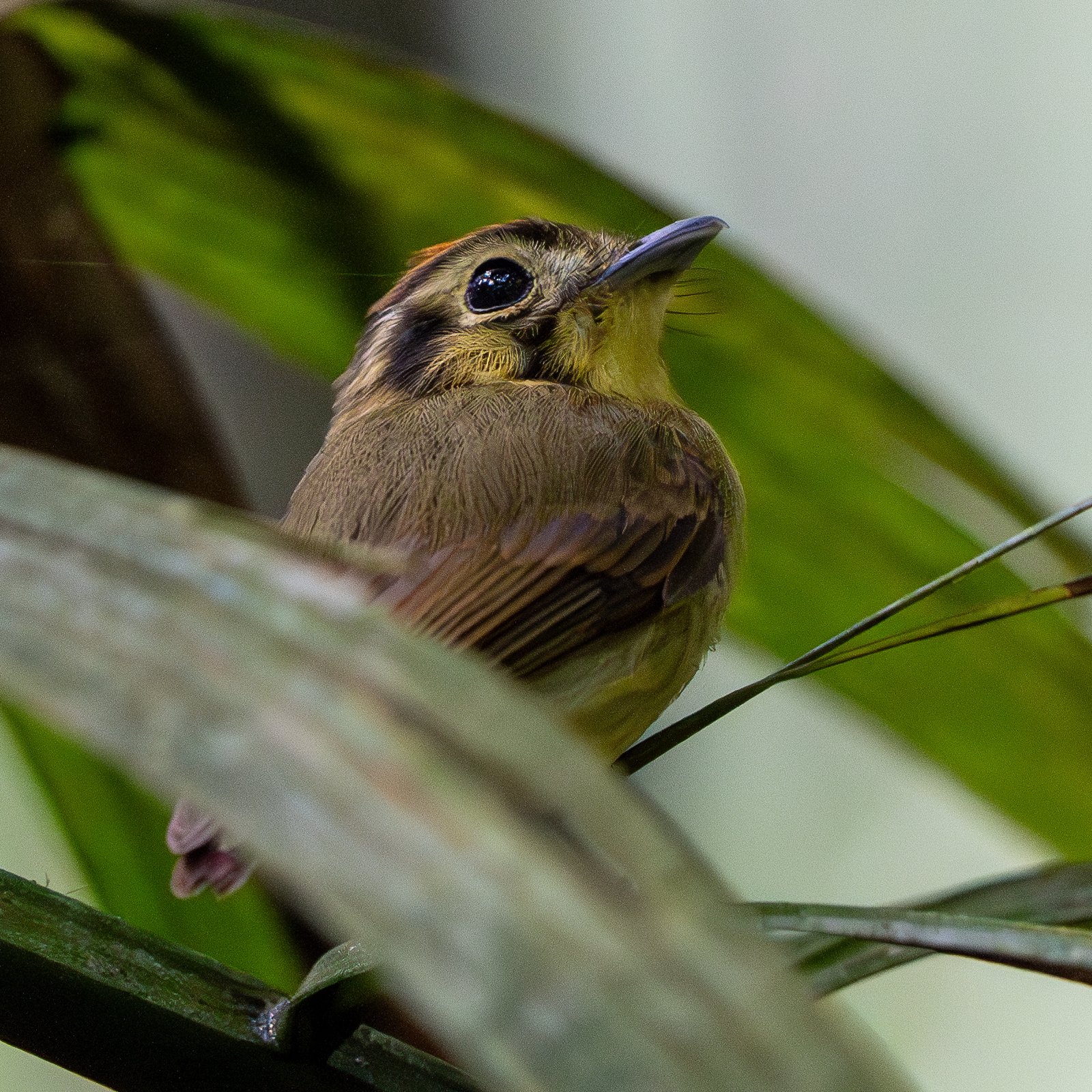
The Golden-crowned Spadebill is the smallest spadebill of the guide area, with a rufous crown with a yellow central stripe. It lives in the lower storey of humid lowland forest on both sides of the Andes. Its song is a high, insect-like trill.
Voice
A high, thin, buzzy trill that rises slightly and falls again, recalling an insect.
Recording: Johan Chaves — CC BY-NC-SA 4.0 · xeno-canto
Identification
9 cm, with a large head, a very broad, flat bill and a short tail. The upperparts are olive-green. The crown is rufous and bordered black, with a golden-yellow central stripe that is smaller in the female. The face is yellowish olive, with a yellow eye-ring and black marks behind the eye and on the ear-coverts. The underparts are pale yellow, with an olive wash on the breast.
Confusion species
White-crested Spadebill Platyrinchus platyrhynchos is larger, with a grey head, a white crown patch and ochre underparts. Cinnamon-crested Spadebill Platyrinchus saturatus is darker, with a plainer face and a white throat. White-throated Spadebill Platyrinchus mystaceus has a white throat and lives higher, in montane forest.
Habitat
The lower storey of humid terra firme forest in the lowlands and foothills, also older secondary forest, up to about 1000 m. It sits still on thin twigs and suddenly flies up to snatch insects from the undersides of leaves. The nest is a small cup in the fork of a shrub, low above the ground.
Where the bird is most at home, classified by the vegetation units of the Andes and the west coast.


Range and movements
In Colombia in the Pacific lowlands, in the north and in Amazonia. In Ecuador in the north-west and throughout the eastern lowlands. In Peru in the eastern lowlands. In Bolivia in the north and north-west of the lowlands. Absent from the Galápagos. Outside the guide area from Honduras to Panama, in Venezuela, the Guianas and Amazonian Brazil.
- Resident
- dark = core range, pale = thinly spread
How and when to look
Listen in the lower storey of tall forest for the high trill, then search at eye level for a small, still bird with a large head; it often stays on one twig for a long time. Forest trails at Yasuní, Tambopata and Manu are suitable places.
Conservation status
Least Concern. The species has a very large range, but usually disappears from heavily fragmented forest.
Scientific name
Platyrinchus coronatus | Sclater, 1858
Sclater described the species in 1858 and placed it straight away in the genus where it still stands. The genus Platyrinchus was introduced in 1805 by Desmarest, A-G. The genus name comes from Greek platus, 'flat', and rhunkhos, 'bill'. Latin coronatus means 'crowned', referring to the golden crown stripe. The specimen the first description was based on came from Río Napo, Ecuador.