All species › Passerines › Tyrant flycatchers and allies › White-throated Spadebill
White-throated Spadebill | Platyrinchus mystaceus
Witkeelbreedbektiran | Picochato goliblanco | Patinho
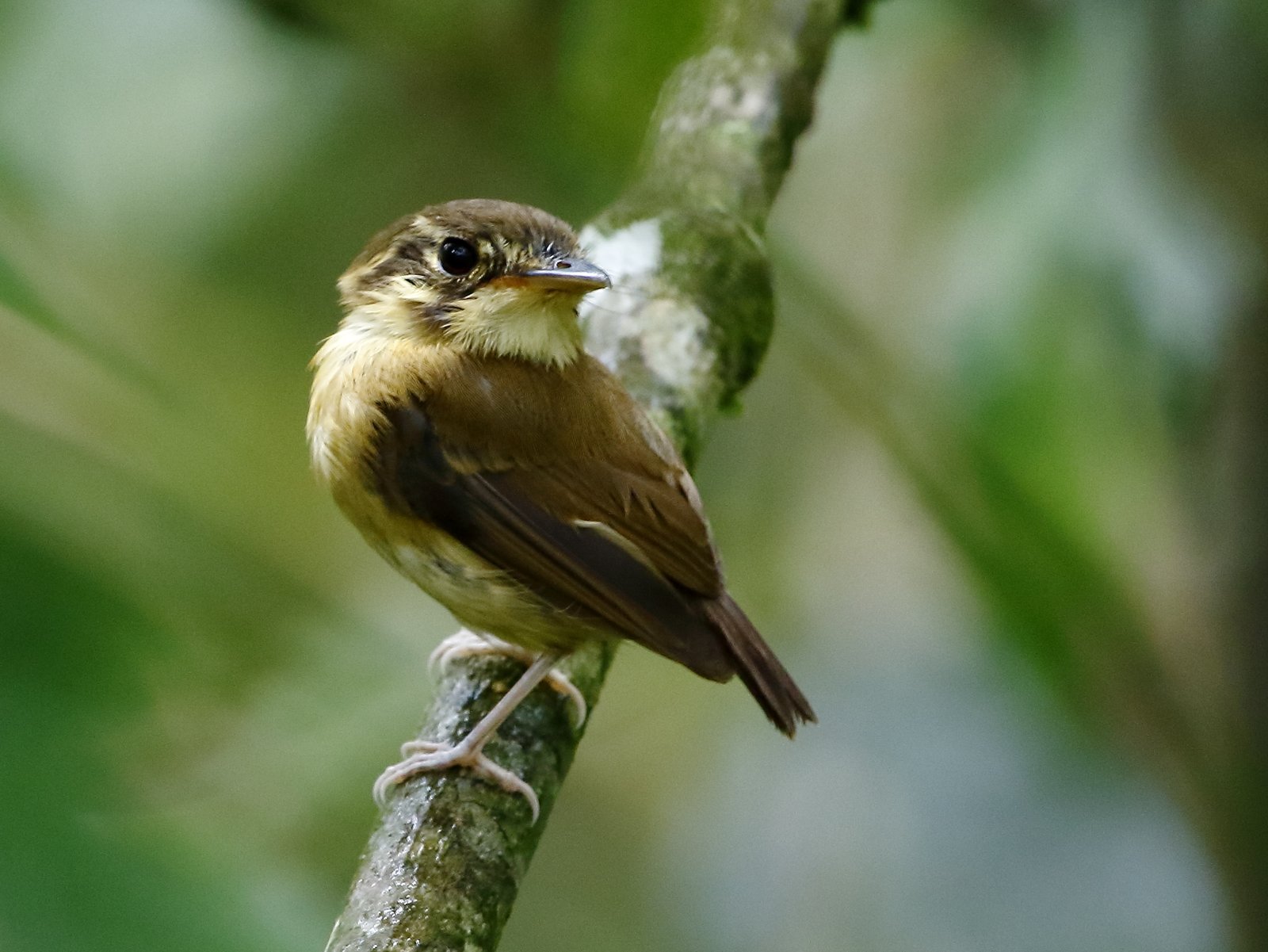
The White-throated Spadebill is a small, brownish spadebill of the lower storey of montane forest in the Andes. It has the strongly patterned face of many spadebills, with a pure white throat as the clearest feature. In the guide area it is the spadebill of middle elevations.
Voice
A high, thin, slightly rising trill, and as a call a sharp, high squeep.
Recording: Juan Freile — CC BY-NC-SA 4.0 · xeno-canto
Identification
10 cm, with a large head, a very broad, flat bill and a short tail. The upperparts are olive-brown. The face is yellowish brown, with a yellowish eye-ring, a dark stripe behind the eye and a dark patch on the ear-coverts. The throat is pure white, the breast brownish ochre, the belly pale yellow. The male has a concealed yellow crown patch, which is smaller or absent in the female.
Confusion species
Yellow-throated Spadebill Platyrinchus flavigularis has a yellow throat, a rufous-brown head and a much plainer face. Golden-crowned Spadebill Platyrinchus coronatus has a rufous crown and a yellower breast and lives lower, in lowland forest. White-crested Spadebill Platyrinchus platyrhynchos has a grey head and a plain face and lives in the Amazonian lowlands.
Habitat
The lower storey of humid montane forest, cloud forest and older secondary forest, roughly between 600 and 2500 m. It sits still on thin twigs and suddenly flies up to snatch insects from the undersides of leaves. The nest is a small, cone-shaped cup in a fork, low above the ground.
Where the bird is most at home, classified by the vegetation units of the Andes and the west coast.


Range and movements
In Colombia in all three Andean ranges and in the Sierra Nevada de Santa Marta. In Ecuador on both slopes of the Andes. In Peru along the eastern slope throughout the country. In Bolivia along the eastern slope in the Yungas, from La Paz to Santa Cruz. Absent from the Galápagos. Outside the guide area in Venezuela, Costa Rica and Panama and, as a different form, in eastern Brazil, Paraguay and north-eastern Argentina.
- Resident
- dark = core range, pale = thinly spread
How and when to look
Walk slowly along trails in cloud forest and listen for the high trill; the bird often sits motionless on a thin twig just above the trail. It also joins mixed flocks in the lower storey.
Conservation status
Not Evaluated in this taxonomic treatment. Some authors treat the Andean forms and those of eastern Brazil as separate species. In suitable forest the species is still widespread, but locally habitat is lost to deforestation.
Scientific name
Platyrinchus mystaceus | Vieillot, 1818
Vieillot described the species in 1818 and placed it straight away in the genus where it still stands. The genus Platyrinchus was introduced in 1805 by Desmarest, A-G. The genus name comes from Greek platus, 'flat', and rhunkhos, 'bill'. The species name comes from Greek mustax, 'moustache', referring to the head pattern; Azara had called the bird 'Bigotillos'. The specimen the first description was based on came from San Ignacio Guazú, Paraguay.