All species › Passerines › Tanagers and allies › Moustached Flowerpiercer
Moustached Flowerpiercer | Diglossa mystacalis
Witbaardberghoningkruiper | Pinchaflor bigotudo | Fura-flor-bigodudo
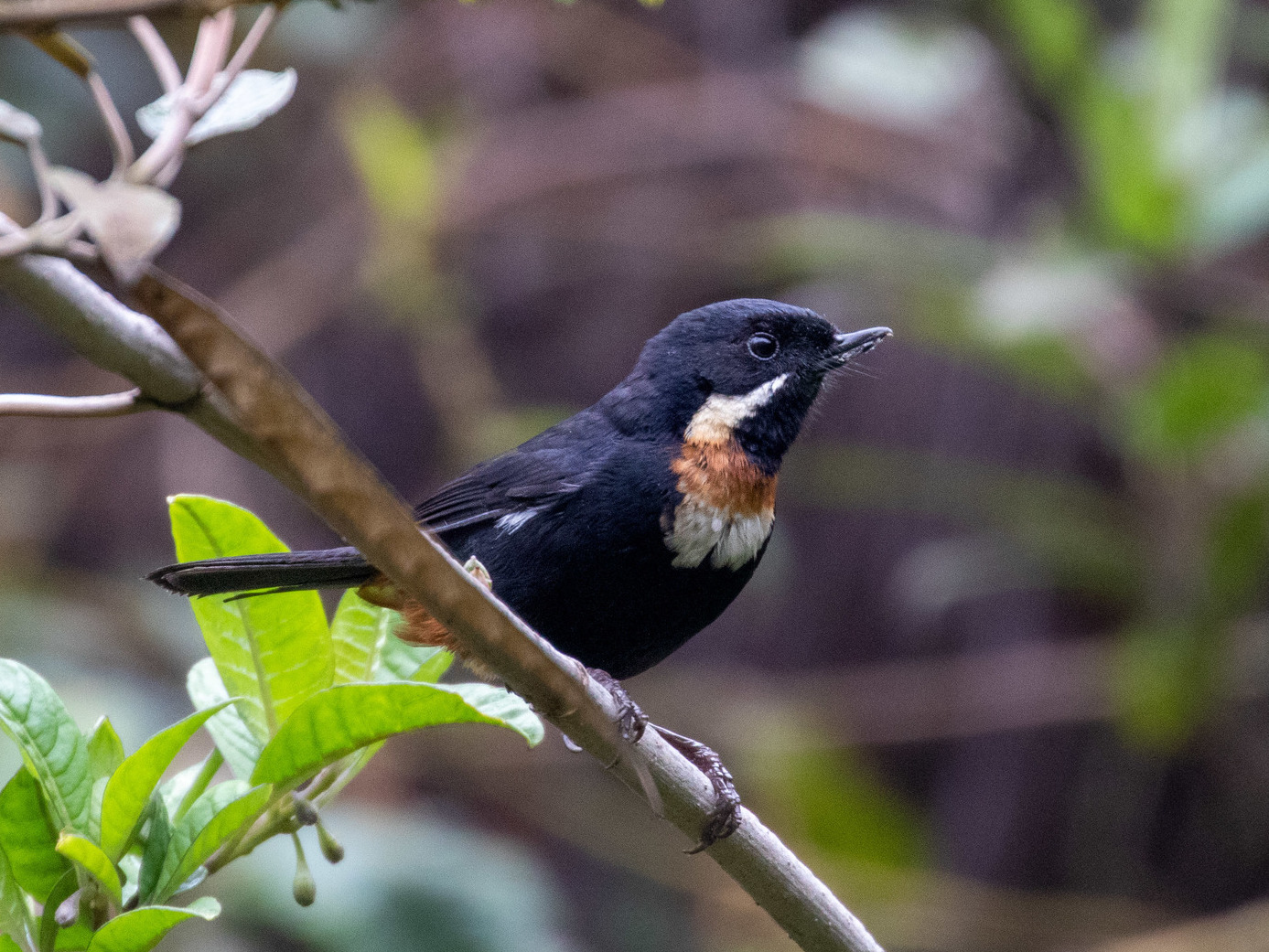
The Moustached Flowerpiercer is a black flowerpiercer with a white moustache stripe, of upper montane forest and the treeline in Peru and Bolivia. South of the Marañón it replaces the Glossy Flowerpiercer. With its white moustache and rufous undertail it is readily recognizable within its range.
Voice
The song is a fast, high, twittering series of thin notes. The call is a sharp tsit.
Recording: Jerome Fischer — CC BY-NC-SA 4.0 · xeno-canto
Identification
14 cm, with a black, upturned bill with a hooked tip. The plumage is mostly black, with a conspicuous white moustache stripe below the eye along the throat, a blue-grey shoulder patch and rufous undertail coverts. Depending on the subspecies, a narrow whitish or rufous band crosses the breast. The sexes are alike. Young birds are duller and browner, with a less distinct moustache stripe.
Confusion species
Black-throated Flowerpiercer Diglossa brunneiventris has a grey moustache stripe, but a grey back and a rufous belly. Black Flowerpiercer Diglossa humeralis is entirely black, without a white moustache stripe; it occurs only in northern Peru. Grey-bellied Flowerpiercer Diglossa carbonaria in Bolivia has a grey belly and no white moustache stripe. Masked Flowerpiercer Diglossa cyanea is blue, with a black mask.
Habitat
Upper montane forest, elfin forest at the treeline, Polylepis groves and shrubbery at the edge of the puna, roughly between 2800 and 4000 m. It lives alone or in pairs, often in mixed flocks, and searches flowering shrubs for nectar, which it steals by piercing flowers at the base; it also eats insects.
Where the bird is most at home, classified by the vegetation units of the Andes and the west coast.


Range and movements
In Peru along the Andes south of the Marañón, from the north to the south-east. In Bolivia on the east slope of the Andes, in the Yungas. Absent from Colombia, Ecuador and the Galápagos. It does not occur outside the guide area.
- Resident
- dark = core range, pale = thinly spread
How and when to look
At the treeline and in Polylepis groves in the Andes of Peru and Bolivia, look for black birds searching flowering shrubs; the white moustache stripe stands out even at a distance.
Conservation status
Least Concern. Common in suitable habitat; fires and clearing of treeline forest locally reduce its habitat.
Scientific name
Diglossa mystacalis | de Lafresnaye, 1846
De Lafresnaye described the species in 1846 and placed it straight away in the genus where it still stands. The genus Diglossa was introduced in 1832 by Wagler. The genus name comes from Greek diglōssos, 'double-tongued' or 'speaking two languages'. The specific name comes from Greek mustax, 'moustache': moustached. The specimen the first description was based on came from Yungas of La Paz, Bolivia.