All species › Swifts › Hummingbirds › Napo Sabrewing
Napo Sabrewing | Campylopterus villaviscensio
Naposabelvleugel | Alasable del Napo | Asa-de-sabre-do-napo
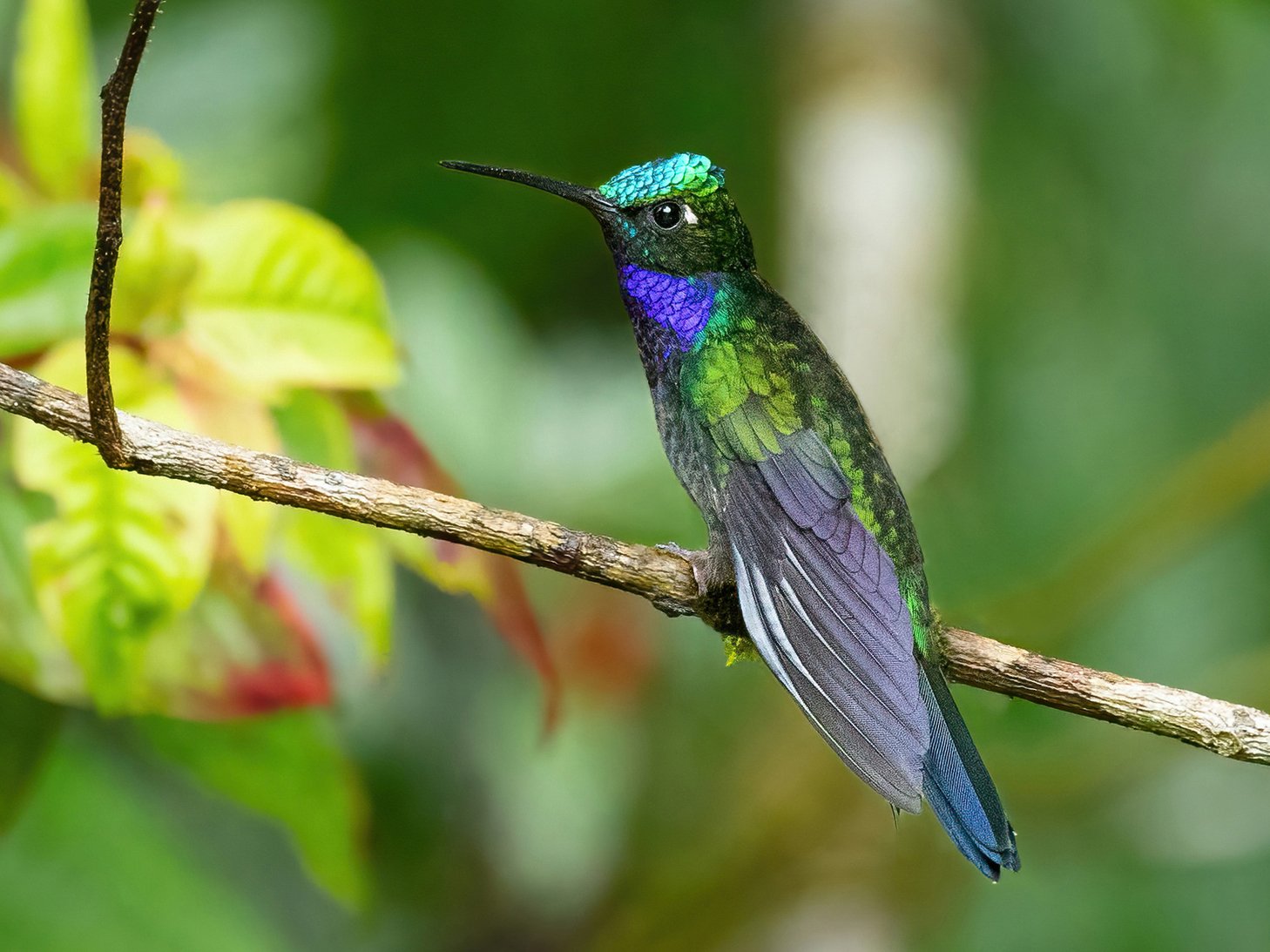
The Napo Sabrewing is a medium-sized hummingbird of foothill forest on the eastern slope of the Andes, mainly in Ecuador. The male is dark, with a glittering green crown and a deep violet-blue throat and breast. Males sing inside the forest, often near streams, with a long, varied song.
Voice
The song is a long, varied series of twittering, rattling and squeaky notes, often given at length from a low perch inside the forest. The call is a sharp chip.
Recording: Juan Freile — CC BY-NC-SA 4.0 · xeno-canto
Identification
12–13 cm, with a slightly decurved, black bill and a small white spot behind the eye. The male is dark green above, with a glittering green crown; the throat and breast are dark violet-blue and the belly dark greyish green. The tail is steel blue to blue-black, with small grey tips to the outer feathers. The female is green above and grey below, with grey tail tips. The male has broadened shafts to the outer primaries.
Confusion species
Grey-breasted Sabrewing Campylopterus largipennis is larger, with large white tail corners, and lives lower, in the lowlands. The male Fork-tailed Woodnymph Thalurania furcata is smaller, with a green throat, a violet belly and a forked tail. The male Violet-fronted Brilliant Heliodoxa leadbeateri has a violet forehead, a green throat and a straight bill.
Habitat
The interior and edges of humid foothill forest and lower montane forest, often in ravines and along streams, mostly between about 900 and 1700 m. It forages in the lower and middle levels at flowers of shrubs and epiphytes and catches small insects. Little is known about the nest.
Where the bird is most at home, classified by the vegetation units of the Andes and the west coast.


Range and movements
In Colombia only in the far south, on the eastern slope in Putumayo. In Ecuador on the eastern slope of the Andes from north to south. In Peru in the north, on the eastern slope and in the ridges along the border with Ecuador. Absent from Bolivia and the Galápagos. Not found outside the guide area.
- Resident
- dark = core range, pale = thinly spread
How and when to look
Search along streams in foothill forest on the eastern slope of Ecuador, for example around Wildsumaco and in the Cordillera de Guacamayos. Singing males sit hidden in the lower forest; listen for their long, varied song.
Conservation status
Least Concern. The range is fairly small and foothill forest is being cleared locally.
Scientific name
Campylopterus villaviscensio | (Bourcier, 1851)
Bourcier described the species in 1851 as Trochilus Villaviscensio; because it was later moved to another genus, the author and year stand in brackets. The genus Campylopterus was introduced in 1827 by Swainson. The genus name combines Greek kampulos, 'bent', with pteron, 'wing', referring to the thickened, curved shafts of the outer primaries. The species name honours Manuel Villavicencio (1822–1871), an Ecuadorian geographer, physician and politician. The specimen the first description was based on came from Napo, Ecuador.