All species › Swifts › Hummingbirds › Lazuline Sabrewing
Lazuline Sabrewing | Campylopterus falcatus
Blauwbuiksabelvleugel | Alasable lazulita | Asa-de-sabre-lazulita
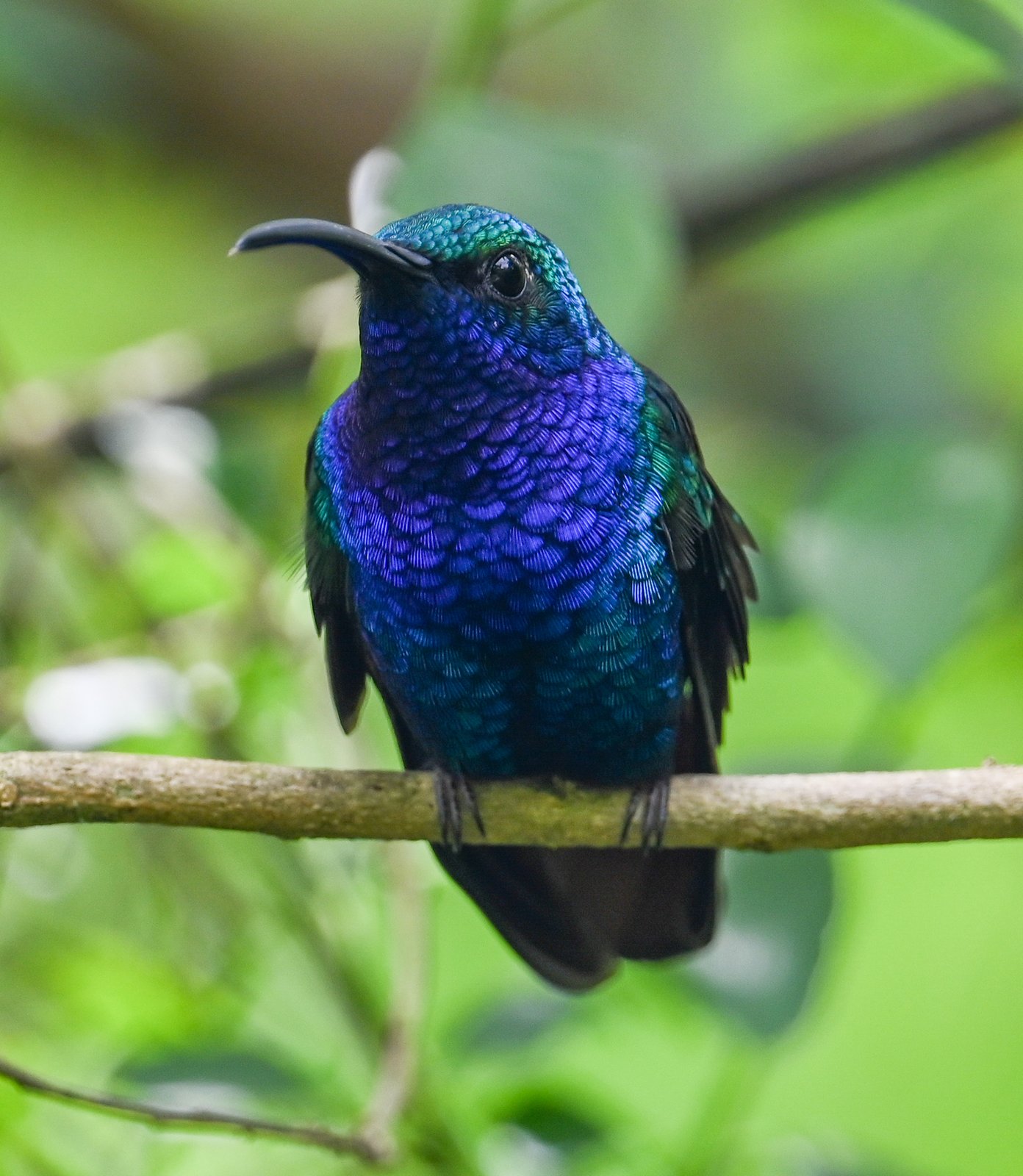
The Lazuline Sabrewing is a sabrewing of the montane forests of Colombia and Venezuela, with a glittering violet-blue throat and breast and a largely rufous tail. That tail separates it from the other sabrewings in the guide area. It also visits gardens and coffee plantations with flowering shrubs.
Voice
High, sharp chip notes. The song is a series of twittering and squeaky notes from a perch at the forest edge.
Recording: Mauricio Álvarez Rebolledo (Colección de Sonidos Ambientales - Instituto Humboldt) — CC BY-NC-SA 3.0 · xeno-canto
Identification
12–13 cm, with a decurved, black bill. The male is glossy green above, with a glittering violet-blue throat and breast and a green belly. The tail is chestnut with a narrow dark terminal edge; the central pair of feathers is bronzy green. The female is green above and grey below, with a violet-blue throat patch and the same rufous tail. The male has broadened shafts to the outer primaries.
Confusion species
Santa Marta Sabrewing Campylopterus phainopeplus, in the Sierra Nevada de Santa Marta, has a steel-blue tail without rufous. Rufous-tailed Hummingbird Amazilia tzacatl also has a rufous tail, but has a straight bill with a red base and a green throat. Violet Sabrewing Campylopterus hemileucurus, only a vagrant, is larger and entirely dark violet, with white tail corners.
Habitat
Edges of humid montane forest, clearings, older secondary forest, scrub, shade coffee and gardens, mostly between about 1000 and 2500 m, sometimes up to 3000 m. It forages at low to middle heights at flowering shrubs and catches insects. The nest is a moss cup on a twig or branch.
Where the bird is most at home, classified by the vegetation units of the Andes and the west coast.


Range and movements
In Colombia in the Andes, especially the Eastern Andes, and also in the Sierra Nevada de Santa Marta and the Serranía de Perijá. In Ecuador rare and local in the north, on the eastern slope. Absent from Peru, Bolivia and the Galápagos. Outside the guide area in the mountains of northern and western Venezuela.
- Resident
- dark = core range, pale = thinly spread
How and when to look
Search flowering shrubs along forest edges and in gardens at middle elevations, for example in the Sierra Nevada de Santa Marta or around Bogotá in the Eastern Andes. Look for the rufous tail as it hovers in front of a flower.
Conservation status
Least Concern. The species tolerates forest edges, scrub and gardens.
Scientific name
Campylopterus falcatus | (Swainson, 1821)
Swainson described the species in 1821 as Trochilus falcatus; because it was later moved to another genus, the author and year stand in brackets. The genus Campylopterus was introduced in 1827 by Swainson. The genus name combines Greek kampulos, 'bent', with pteron, 'wing', referring to the thickened, curved shafts of the outer primaries. The species name comes from Latin falcatus, 'sickle-shaped', referring to the curved primaries. The specimen the first description was based on came from northern Venezuela.